
The Desert Rock Architects Who Redefined Heavy Music
When Josh Homme dismantled Kyuss in 1996, he wasn't interested in repeating the stoner rock formula that had made his previous band a cult phenomenon. Instead, Queens of the Stone Age emerged from Palm Desert, California with a mission to strip heavy music down to its most seductive essentials—thick bass frequencies, hypnotic repetition, and grooves designed to move bodies rather than pummel them into submission. What started as Homme's solo project quickly evolved into rock's most important heavy band of the 2000s, proving that monolithic riffs could coexist with pop sensibility and that desert rock didn't have to remain an underground curiosity.
The band's impact extends far beyond their Californian origins. By fusing stoner rock's low-end obsession with glam's swagger, punk's economy, and art rock's willingness to experiment, Queens of the Stone Age created a template that countless bands have followed but few have matched. Their rotating lineup—featuring everyone from Screaming Trees' Mark Lanegan to Foo Fighters' Dave Grohl—has always served Homme's singular vision: heavy music that refuses to sacrifice melody, hooks that lodge themselves in your skull while rattling your ribcage.
Across seven studio albums and nearly three decades, Queens of the Stone Age have maintained an impressive consistency while never making the same record twice. They've headlined festivals worldwide, influenced generations of heavy rock bands, and demonstrated that the riff—rock's most fundamental building block—still has endless expressive potential when wielded by someone who understands its primal power.
Riff-Driven Hypnosis and the Groove-First Approach
The Queens of the Stone Age sound is immediately identifiable: downtuned guitars generating maximum low-end resonance, rhythms that lock into almost trance-like repetition, and Homme's distinctively nasal vocals floating above the heaviness like smoke rising from desert sand. Unlike the sludgy tempos of traditional doom metal or the aggressive velocity of thrash, QOTSA weaponizes the mid-tempo groove. Songs like "No One Knows" and "Go with the Flow" demonstrate how a perfectly calibrated rhythm section can generate physical momentum—the kind that makes crowds move instinctively, bodies responding before brains can analyze the mechanics.
Homme's guitar work prioritizes tone over technique. He favors semi-hollow body guitars and specific amplifier combinations that produce a thick, slightly compressed sound—meaty without being muddy, heavy without losing definition. His riffs often employ repetition as a hypnotic device, circular patterns that create almost meditative headspace before subtle variations snap the listener back to attention. The production across their discography consistently emphasizes bass frequencies, with basslines functioning as melodic counterpoints rather than mere root-note followers. This gives even their most straightforward rockers an architectural depth, layers of low-end information supporting the more obvious melodic elements.
Vocally, Homme's approach defies heavy rock convention. Rather than bellowing or growling, he sings with a detached cool that occasionally breaks into falsetto flourishes. His phrasing often sits slightly behind the beat, creating tension against the rhythmic drive—a technique borrowed more from R&B than metal. This vocal restraint makes the rare moments of intensity hit harder, and it allows the instrumental arrangements to breathe. The band's willingness to incorporate electronic elements, orchestration, and unconventional song structures without abandoning their fundamental heaviness has kept their sound evolving while remaining unmistakably theirs.
From Desert Sessions to Global Domination: The QOTSA Trajectory
After Kyuss dissolved, Homme initially conceived Queens of the Stone Age as a fluid collective rather than a fixed band. The first self-titled album in 1998 featured Homme handling most instruments himself, with Alfredo Hernández on drums. It established the sonic template—chunky riffs, robotic grooves, and Homme's deadpan delivery—but reached a relatively small audience. The record demonstrated that desert rock could evolve beyond Kyuss's more straightforward stoner approach, incorporating punk efficiency and pop structure without sacrificing heaviness.
Everything changed with 2000's Rated R. Bringing in Mark Lanegan as a recurring collaborator and Nick Oliveri on bass and co-vocals, the album expanded QOTSA's palette dramatically. Tracks like "The Lost Art of Keeping a Secret" proved the band could write legitimate radio hits without compromising their identity, while deeper cuts explored darker psychedelic territory. The production—handled by Homme and Chris Goss—achieved a balance between clarity and grit that would become a QOTSA trademark. The album's success set the stage for their commercial breakthrough.
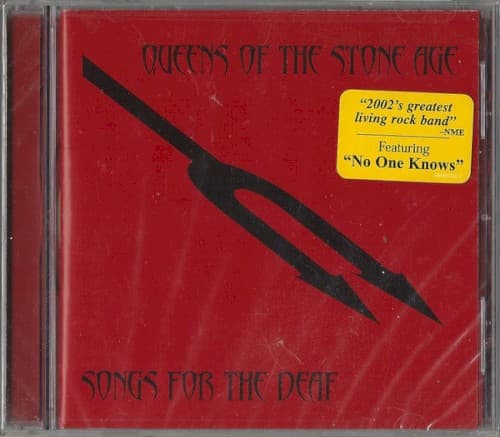
Songs for the Deaf arrived in 2002 as a creative and commercial peak. With Dave Grohl manning the drums and contributing his powerhouse style, the album combined QOTSA's established aesthetic with arena-ready ambition. Structured as a road trip through desert radio stations, it flows like a cohesive experience rather than a collection of singles. "No One Knows" became an inescapable rock radio staple, its circular riff and propulsive rhythm embodying everything that makes the band work. The album achieved widespread critical acclaim and platinum sales, proving that heavy, riff-based rock could still compete in an era increasingly dominated by rap-rock and post-grunge mediocrity. The sonic weight and compositional sophistication demonstrated that intelligent heavy music had a massive audience waiting for someone to deliver it properly.
Following that massive success, the band navigated lineup changes and stylistic evolution. Lullabies to Paralyze (2005) incorporated more electronic textures and atmospheric experimentation, while Era Vulgaris (2007) leaned into abrasive art-punk territory. These albums proved QOTSA wasn't interested in endlessly replicating their most successful formula. 2013's ...Like Clockwork emerged after a lengthy hiatus and Homme's near-fatal medical complications. Darker and more introspective than previous efforts, it featured guest appearances from Trent Reznor, Elton John, and Jake Shears—an eclectic roster that reflected Homme's broad musical connections and willingness to push boundaries. The album debuted at number one in the US, their first chart-topper, proving their audience had only grown during the absence.
Villains (2017), produced by pop svengali Mark Ronson, represented perhaps their boldest stylistic gambit. Incorporating disco rhythms and synth textures while maintaining their fundamental heaviness, it divided longtime fans but demonstrated QOTSA's refusal to calcify into self-parody. Whether the experiment fully succeeded remains debatable, but the willingness to risk alienating purists in pursuit of new sonic territory exemplifies why the band has remained vital across multiple decades. Throughout these evolutions, their live performances have consistently delivered—Homme leading a rotating cast through tight, powerful sets that translate studio precision into visceral physical experience.
Desert Rock's Mainstream Ambassadors and Genre Evolution
Queens of the Stone Age's most significant achievement is making heavy, riff-based rock viable in the mainstream without diluting its essential characteristics. In an era when alternative rock increasingly meant either polished pop-rock or aggressive nu-metal, QOTSA offered a third path—music that retained underground credibility while achieving commercial reach. Their influence ripples through contemporary heavy music, audible in bands from Royal Blood to Highly Suspect, artists who understand that hooks and heaviness aren't mutually exclusive.
Homme's collaborative approach—both through QOTSA's rotating lineup and his Desert Sessions project—has created a network of musical relationships that extends across genres. His work has connected stoner rock's underground with mainstream alternative rock, demonstrated productive partnerships between punk, metal, and pop musicians, and shown that genre boundaries exist primarily to be traversed. The willingness to recruit Dave Grohl, Trent Reznor, or Elton John isn't eclecticism for its own sake; it's recognition that great musicians elevate each other regardless of their typical contexts.
The band's catalog demonstrates remarkable consistency without stagnation. Unlike many of their '90s contemporaries who either vanished or became nostalgia acts, Queens of the Stone Age have released relevant, forward-looking music across three decades. They've proven that desert rock—initially a regional scene centered around Palm Desert generator parties—could become a globally influential aesthetic. Their production approach, emphasizing bass frequencies and groove over speed or aggression, has influenced how heavy rock is recorded and mixed. The blueprint they established continues shaping how intelligent heavy music sounds in the 21st century, and their refusal to repeat themselves ensures that blueprint keeps expanding.