The scorecard
8.5/10 · Essential
- Songwriting25%
- 8.5
- Production25%
- 9.0
- Performance15%
- 8.5
- Cohesion15%
- 8.0
- Originality10%
- 7.5
- Replay value10%
- 8.5
The riff work on 'Song for the Dead' and the melodic arc of 'No One Knows' show songwriting that builds tension through repetition and release rather than easy hooks.
Eric Valentine's drum recording process—cymbals tracked separately, booths isolated for claustrophobia—creates a focused, punchy sound that serves the desert-rock sprawl without losing the low end.
Grohl's drumming anchors the chaos, Homme's falsetto stretches without breaking on 'Go With the Flow', and Lanegan's baritone on 'Hangin' Tree' adds gravitas the band had only hinted at before.
The radio conceit holds the drive together, but 'Six Shooter' feels like an interlude stretched thin and the reprise at track thirteen interrupts the closing momentum.
Grohl's presence shifts the band's desert rock toward stadium heft without mimicking Nirvana or Foo Fighters, and the three-vocalist rotation is rare enough in stoner rock to register as invention.
The album has held up as the band's commercial and critical peak for two decades, with 'No One Knows' still a rock radio fixture and the deeper cuts aging better than most 2002 hard rock.
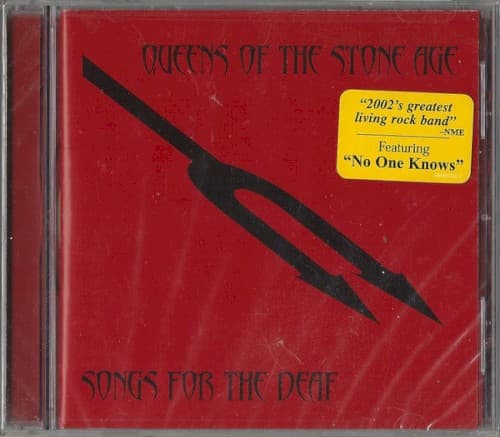
Queens of the Stone Age Songs for the Deaf — Desert Rock Finds the Radio It Hates
Songs for the Deaf argues that the widest reach demands the most focus. Queens of the Stone Age built their third album as a concept record about a desert highway drive, stitching fake radio bumpers between tracks, then recorded it in isolation booths with cymbals tracked separately from the kit to make every hit punchy and claustrophobic. The result is the least sprawling desert rock record to earn a gold certification, and the most aggressive album to spawn three charting singles.
The stakes were commercial: Interscope wanted a breakout after Rated R had built the cult, and the band wanted the mainstream without sanding down the riffs. The radio conceit was a jab at the format, but it also gave Josh Homme permission to sequence an hour of music that alternates between three singers and never settles into one tempo or mood.
The thesis plays out in the first two tracks. 'You Think I Ain't Worth a Dollar, but I Feel Like a Millionaire' opens with a drum fill that sounds like a jet engine in a concrete room, Nick Oliveri barking over a groove that swings and lurches at once, and no chorus to speak of. Then 'No One Knows' arrives with a riff borrowed from the Desert Sessions, a falsetto hook, and the cleanest verse-chorus structure the band had written. The album holds that tension for fifty-nine minutes: heavy enough to keep the Kyuss fans, melodic enough to win the alt-rock programmers, and recorded with enough precision that the sludge never blurs.
Three Singers, One Sound, No Wasted Space
The songwriting on Songs for the Deaf works because it treats repetition as architecture. 'Song for the Dead' builds its central riff across nearly six minutes, adding cymbal crashes and bass fills until the groove feels like it is collapsing inward, with Mark Lanegan's baritone holding the center. 'No One Knows' loops its main figure through verses and choruses, but the pre-chorus lifts just enough to make the return feel earned. 'Go With the Flow' rides a single rhythmic idea for three minutes, relying on Homme's falsetto to create the movement the chords refuse to provide.
When the writing falters, it is because the band mistakes brevity for economy: 'Six Shooter' is ninety seconds of Oliveri yelling over a one-riff stomp, more interlude than song, and 'The Sky Is Fallin'' stretches its central groove past the point where the dynamics still surprise.
Eric Valentine's production is the reason the album works as both a heavy rock record and a radio play. The drum sound—Grohl's kit recorded in a dead booth, cymbals tracked separately and blended back in—creates a tightness that most stoner rock avoids. The bass sits high in the mix without stepping on the guitars, and the vocal layers never crowd each other. Lanegan, Homme and Oliveri split lead duties across fourteen tracks, but the album never sounds like three different bands because the production keeps the tonal palette narrow: dry drums, hot bass, and guitars that chug without fuzz pedals turning them into mush.
The performances justify the studio work. Grohl's drumming is both technical and physical, the fills on 'First It Giveth' accenting the riff's odd meter without showing off, and his work on 'Song for the Dead' proving he can play behind a groove as well as he can front one. Lanegan's contributions—'Song for the Dead', 'Hangin' Tree', 'God Is on the Radio'—add weight the band had only borrowed on Rated R, his voice settling into the slower tempos without dragging. Oliveri's vocals are the wild card: effective in short bursts on the opener and 'Gonna Leave You', grating when they dominate a track like 'Another Love Song'.
The weakness is in the sequencing decisions that prioritize the concept over the songs. The radio bumpers between tracks are clever the first time and filler by the third listen, and the hidden-track reprise of an earlier single interrupts the album's closing stretch when it should be gaining momentum.
A Drive That Peaks Early and Coasts Long
The album front-loads its strongest material and then tests the listener's patience. The opening run establishes the three-vocalist rotation and moves between tempos without repeating a trick. The middle section offers the cleanest pop moment on the record, arriving late enough to feel like a reward.
After that, the pacing sags. The back half includes a six-minute slow-burn that would work as a closer but instead sits three tracks from the end, and the reprise that follows it kills the momentum. The actual closer is a worthwhile ballad, but it arrives after a fake ending and asks the listener to wait through silence to find it. The flow is more successful than not—most hard rock albums would collapse under this much variety—but the back half feels longer than its runtime.
The album earns its length when the songs justify it: one late track runs over six minutes and drags in the middle, but the payoff in the final two minutes, where the groove finally breaks open, makes the wait deliberate. When the length is not earned, as on the radio skits or the reprise, the album feels like it is prioritizing the concept over the material.
The Breakout That Became the Standard
Songs for the Deaf is the album that turned Queens of the Stone Age into a headliner and the one that still defines them two decades later. It ranks as the band's most cohesive record because it had the budget and the ambition to match the vision: Grohl's drumming gave the songs a precision they had not had before, Valentine's production made the heaviness legible to radio programmers, and the three-vocalist rotation kept the hour-long runtime from feeling monotonous. It is also the last time the band would have this particular lineup, and the only time they would attempt a concept album, which makes it both a peak and an endpoint.
The album is for listeners who want desert rock with momentum and melodies, and who can tolerate the occasional interlude or skit in exchange for the best riffs of the band's career. Skip it if you want the band's loosest or heaviest work: Rated R is rawer, and later albums like Lullabies to Paralyze push the sludge further. Start with 'No One Knows', 'Song for the Dead', and 'Go With the Flow'—the three singles are the three best tracks, and they represent the album's range. If those land, the deep cuts like 'First It Giveth' and 'Hangin' Tree' will reward the full listen.
For the next album, hear Lullabies to Paralyze, which keeps the studio precision but loses the pop ambition, or Rated R, which shows what the band sounded like before Grohl and the major-label budget arrived. Songs for the Deaf remains the rare hard rock album that figured out how to sound bigger without sounding softer, and the reason it still gets cited as the band's best is that they have not managed the same trick since.
Track by track
Track Listing
You Think I Ain’t Worth a Dollar, but I Feel Like a Millionaire
StandoutThe opener announces the album's terms: a drum explosion, a riff that swings like broken machinery, and Oliveri's sneer over a groove with no interest in hooks. The song is structured like a brawl, all aggression and no release, and it works because Grohl's drumming keeps the chaos on a grid. The lack of a proper chorus is a feature, not a bug—this is the band telling the listener that the pop moments will arrive on their terms. Originally a Desert Sessions track, the rewrite sharpens the edges and lets Oliveri's vocal sit forward in the mix, which makes the performance land harder than the earlier version.
No One Knows
StandoutThe breakthrough single is also the album's best song: a riff lifted from 'Cold Sore Superstars', a verse that builds through repetition, and a falsetto chorus that sticks without pandering. Homme's vocal performance is the key—he stretches the melody without overselling it, and the harmonies in the chorus are layered just enough to sound anthemic without going soft. The production is clean but not polite, the bass and drums locked in tight, and the guitar tone fat without fuzz. The structure is verse-chorus-verse, but the pre-chorus lift and the bridge breakdown make the simplicity feel earned. Two decades on, it is still the band's most recognizable song, and the reason is that it does not sound like compromise: the riff is heavy, the hook is undeniable, and the recording is punchy enough to work on rock radio or in a festival slot.
First It Giveth
StandoutA single-riff workout in an odd meter, anchored by Grohl's fills and Homme's vocal melody doing the work the chords will not. The song is three minutes of the same groove, and it holds because the rhythm section keeps finding new ways into the pattern. Released as a single, it is less immediate than 'No One Knows' but more representative of the album's refusal to write in straight lines. The guitar tone is dry and direct, the bass fills the gaps, and the vocals stay conversational. A strong example of the band's ability to make repetition feel hypnotic rather than lazy.
Song for the Dead
StandoutLanegan's baritone anchors the album's heaviest track, a near-six-minute riff that cycles through variations without ever fully releasing the tension. The drumming is relentless, Grohl playing behind the groove and letting the cymbals build the dynamics, and the bass and guitar lock into a chug that sounds like machinery grinding down. The song was performed live in 2001 with different lyrics and an all-Lanegan vocal, and the studio version tightens the structure without losing the menace. The production makes the claustrophobia work: every instrument is audible, but the space is small, and the effect is suffocating in the way the song demands. One of the album's peaks, and proof that the band could write long-form riff pieces that earn their runtime.
The Sky Is Fallin’
SolidSix minutes of a single groove that sags in the middle but redeems itself in the final two minutes, when the song finally opens up and the drums and bass break the pattern. The vocals are layered, Homme and Lanegan trading lines, and the melody is strong enough to carry the repetition until the track overstays its welcome around the four-minute mark. The payoff is worth the wait if you make it there, but this is the first moment on the album where the writing feels stretched. The production keeps the song from collapsing entirely: the bass tone is massive, the drums stay sharp, and the guitar accents the riff without crowding it. A solid track that would have been a great one at four and a half minutes.
Six Shooter
SolidNinety seconds of Oliveri yelling over a one-riff stomp, more interlude than song. The aggression is real, but the brevity keeps it from developing into anything beyond a palate cleanser. Not filler, exactly, but not essential either.
Hangin' Tree
StandoutLanegan's vocal performance is the song, his baritone turning a midtempo chug into something that feels older and weirder than the album around it. The riff is simple, the structure is verse-chorus, and the production is dry, which puts all the weight on the voice. Originally a Desert Sessions track, the album version benefits from the tighter recording and Grohl's drumming, which keeps the groove from dragging. A highlight of the slower material, and proof that Lanegan's contributions were more than decoration.
Go With the Flow
StandoutThree minutes of the album's cleanest pop songwriting, built on a single rhythmic idea and Homme's falsetto doing all the melodic lifting. The riff is minimal, the bass and drums stay locked, and the chorus is immediate without being obvious. The production is punchy and precise, the vocal layers are subtle, and the song never outstays its welcome. Released as a single, it charted and earned a Grammy nomination, and it remains one of the band's most reliable live tracks. The simplicity is the strength: no bridge, no breakdown, just verse and chorus repeated until the three minutes are up.
Gonna Leave You
SolidOliveri's vocal suits the blues-rock stomp, and the riff has enough swing to keep the two-fifty runtime from feeling rushed. A minor track, but it works as a transition between the singles and the back half, and the performance is committed enough to justify its place in the sequence.
Do It Again
SolidA four-minute rocker with a solid riff, a strong vocal melody from Homme, and a chorus that sticks without straining for anthem status. The song is well-constructed but not essential, a good example of the band's workmanlike songwriting when they are not reaching for a single. The production keeps it sharp, and the drumming keeps it moving, but it sits in the middle of the tracklist without demanding attention.
God Is on the Radio
StandoutLanegan's six-minute slow burn is atmospheric and patient, the riff unfolding over verses that build without rushing, and the vocal performance carrying the weight. The song works as a comedown from the heavier material, but its placement three tracks from the end interrupts the momentum rather than closing the album. The production is spacious, the bass and drums stay restrained, and the guitar layers add texture without crowding the vocal. A strong track that would have worked better as the finale than as the penultimate moment before a reprise and a hidden closer.
Another Love Song
WeakOliveri's vocal is grating here, the riff is serviceable, and the three-minute runtime feels longer than it is. The song does not add much to the album, and it would not be missed if it had been cut. Filler.
Song for the Deaf / Feel Good Hit of the Summer (reprise)
WeakThe reprise interrupts the closing stretch with a hidden outtake of an earlier single, the lyrics replaced with laughter. The idea is clever, but the execution kills the momentum that 'God Is on the Radio' had built, and the listener is left waiting through the joke to get to the actual closer.
Mosquito Song
StandoutThe hidden closer is a worthy ballad, Homme's vocal restrained and the arrangement spare, with keyboards and minimal drums supporting the melody. The song is quiet and patient, the lyrics are introspective without being vague, and the performance feels like an exhale after the hour that preceded it. The problem is the placement: arriving after a fake ending and a silence gap, it asks the listener to wait for a payoff that should have been the album's natural conclusion. A strong song that deserved a better spot in the sequence.