The scorecard
9.5/10 · All-time
- Songwriting25%
- 9.5
- Production25%
- 10.0
- Performance15%
- 9.0
- Cohesion15%
- 9.5
- Originality10%
- 9.5
- Replay value10%
- 9.5
Six-minute structures that never meander, verses that pile images instead of telling stories, melodies that sit between unease and beauty without collapsing into either.
Godrich and the band recorded 80 percent live in a mansion, used stone staircases for reverb, hacked drum samples on a Macintosh, and made guitars sound like they were negotiating with machines.
Yorke's first-take vocals dissolve from detachment into blood-clotted screams, the rhythm section locks in live takes at 3am, Jonny Greenwood writes string parts that sound like dying elephants instead of Eleanor Rigby.
Twelve tracks sequenced over two weeks, an arc from car crash rebirth to a closing crawl, no filler, a interlude that nearly opened the album before the band decided it was too off-putting.
Took the introspection of The Bends and pointed it outward at technology and transit, made guitars and samplers coexist in 1997 when Britpop was still chasing hooks, laid groundwork for a decade of melancholic British rock.
Dense enough that the arpeggios in different time signatures and the dub bassline stops reward each return, sequenced tightly enough that hearing one song prompts the whole album.
Radiohead OK Computer — Guitar Rock Finds the Off-Ramp
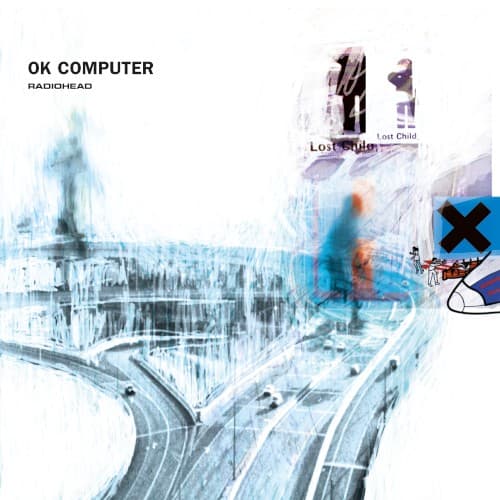
OK Computer argues that the sound of alienation in 1997 was not another verse about feeling sad but a drum loop hacked on a Macintosh, a bassline that stops when it should continue, a six-minute song in four sections with no chorus to return to. Radiohead and producer Nigel Godrich recorded most of this album live in a mansion near Bath, used its stone staircase for natural reverb, and made a record where guitars and samplers occupy the same room without one apologizing for the other. The thesis is in the first song: an airbag saves your life in a car crash, you feel reborn for a moment, and the illusion of safety is the same illusion that props up transit, technology, consumerism, the whole grid. The Bends was introspective; this one looks outward at what the infrastructure is doing to everyone in it.
The stakes were commercial as much as artistic. EMI deemed the album uncommercial and difficult to market, the band had rejected advice to make The Bends Part 2, and the question was whether a British rock band could move away from Britpop's verse-chorus optimism and still sell records. It reached number one in the UK, debuted at 21 in the US, went five-times platinum domestically and double platinum in America, and redirected British rock toward atmospheric melancholy for the next decade.
The album holds because the unease is in the construction, not the complaint: arpeggios in clashing time signatures, Mellotron choirs that enter after three minutes of acoustic guitar, feedback generated with a delay pedal, a synthesized voice reciting lifestyle slogans over samples from a 1975 political thriller. The songs do not tell you the world is broken; they sound like the frequency the world hums at when the infrastructure is everywhere and the exit is hypothetical.
Recording in Rooms Where the Machines Didn't Fit Yet
Godrich was the engineer on The Bends and had co-produced a handful of B-sides when Radiohead gave him a hundred thousand pounds for recording equipment and the co-producer credit. His role was part collaborator, part managerial outsider: he called takes, took up slack when no one else would commit, and kept the band objective when they jumped between songs without finishing them. The band recorded demos at Chipping Norton, worked in a converted shed near Didcot called Canned Applause until the proximity to home and the lack of bathrooms made it unbearable, then moved to St Catherine's Court, Jane Seymour's mansion near Bath, where they had stone staircases and ballrooms and no deadline.
Eighty percent of the album was recorded live, which means instruments playing together in real time instead of stacked in separate passes. The natural reverb on the stone staircase vocal for Exit Music, the 3am ballroom session for Let Down, the willingness to keep Yorke's first takes because a second attempt would make him think about it and sound lame—that approach produces a different record than overdubbed studio rock. The band extended instrumentation to include electric piano, Mellotron, glockenspiel, and a plate reverberator purchased from Jona Lewie.
They sampled Phil Selway's drumming for Airbag, edited it on a Macintosh to approximate DJ Shadow's style despite their programming inexperience, and built the song on a beat that stops and starts like 1970s dub. Jonny Greenwood wrote a 16-instrument string section for Climbing Up the Walls inspired by Penderecki's Threnody, recorded at Abbey Road, that was designed not to sound like Eleanor Rigby, which he said all string parts had sounded like for thirty years. The band cited Miles Davis's Bitches Brew as a starting point for the dense, terrifying sound, a record about building something up and watching it fall apart. They also cited Elvis Costello, REM, PJ Harvey, the Beatles' A Day in the Life, Ennio Morricone, Can, and the Beach Boys' Pet Sounds as touchstones for what they were attempting: an atmosphere that shocks on first listen, achieved by abusing the recording process.
Critics heard prog in the six-minute Paranoid Android and the dystopian scope, which the band disavowed but which was unavoidable once you write a lead single longer than six minutes with four distinct sections. Spin called it a DIY electronica album made with guitars, which is closer to what the structure delivers.
The weakness is that the exploratory approach occasionally led to tracks the band admitted they nearly finished at Canned Applause before moving on without reason. Electioneering is the most rock-oriented song here and also the least necessary, a heavy riff exercise that gestures at the poll tax riots and Chomsky but sounds more like Pablo Honey than the album it interrupts.
Sequencing a Crawl From Crash to Comedown
The band spent two weeks ordering the twelve tracks, and the sequencing matters more than the individual peaks. The first stretch opens with a car crash rebirth and the illusion of safety, sprawls through six minutes and four sections, slows into electric piano and fantasies of alien abduction, then starts with voice and acoustic guitar and climaxes with distorted bass through a fuzz pedal trying to sound like Portishead. The first full release arrives with arpeggios in conflicting time signatures and the Wall of Sound production O'Brien cited as the Spector influence. The first half closes with the repeated line for a minute there I lost myself, then feedback from a delay effect.
The middle section opens with a 117-second interlude of a Macintosh voice reciting lifestyle slogans over a sample from Three Days of the Condor—the band nearly opened the album with it before deciding it was too off-putting, which suggests they understood pacing better than provocation. The sag arrives next, a cowbell and distorted solo that breaks the atmosphere for three minutes of heavy riffing.
The back half restores tension with Penderecki strings and a scream, follows with the glockenspiel-driven comedown, then builds to the near-euphoric penultimate track that shaped the album's sound when they recorded it in five hours for a War Child compilation. The closing run ends at a crawl, five minutes of what O'Brien described as telling yourself to slow down. The arc earns its length because the pacing is sequenced, not accidental: the first half builds to its midpoint, the second half sustains unease through the string chaos and the lullaby and the fadeout.
Where It Ranks and Who Should Start Here
This is the album where Radiohead moved from British rock band with two solid records to a unit that redirected guitar music for a decade. It ranks above The Bends because it stopped looking inward and figured out how to make alienation architectural instead of emotional, and it ranks as the entry point into the catalog because it is the most fully realized statement before the band dissolved into pure experimentation. The album aged into the prescient document critics said it was—the technological anxiety, the consumerism, the sense that the infrastructure is everywhere and the exits are theoretical—but it holds because the argument is sonic, not lyrical.
The machines and the guitars coexist in the same room, the songs are dense enough to reward repeat listens, and the sequencing ensures that hearing one track triggers the whole album. It is for listeners who want guitar rock that thinks about what guitars can do when samplers and Mellotrons are in the same mansion, and it is not for anyone who needs choruses that resolve or lyrics that explain themselves plainly.
Start with Airbag for the thesis, Paranoid Android for the sprawl, Let Down for the peak, and Climbing Up the Walls for the collapse. If those four tracks work, the whole album works. The closest comparison in the catalog is The Bends for the guitar foundation, but that record was still writing about feelings; this one writes about the grid. Outside the catalog, hear In Rainbows next for where the experimentation led, and hear the Bends first if you want the introspective warmth before the architecture.
The album ends with The Tourist, a five-minute crawl that tells you to slow down, and the advice is the opposite of the velocity the album describes. That contradiction is the point: the record sounds like the hum of the infrastructure and argues for the off-ramp at the same time.
Track by track
Track Listing
Airbag
StandoutThe thesis in four minutes: a car crash, an airbag, the illusion of safety in modern transit, and a drum loop sampled from Phil Selway's playing and edited on a Macintosh to approximate DJ Shadow. The bassline stops and starts like dub, the guitars negotiate with the hacked-up programmed drums, and the lyric about being born again is undercut by the next line about being reborn in a car crash. Yorke wrote it after reading an article titled An Airbag Saved My Life and The Tibetan Book of the Dead, and the song establishes the key contradiction: the band is using modern recording technology to argue against what modern technology does to perception. The track opens the album because it names the problem—the infrastructure is everywhere and the safety is fake—without resolving it. The BBC noted J.G. Ballard's Crash as an influence on the automobile imagery, and the technical innovation matches the lyrical anxiety, which is the method for the entire record.
Paranoid Android
StandoutSix minutes in four sections, no chorus, a structure inspired by the Beatles' Happiness Is a Warm Gun and Queen's Bohemian Rhapsody, and a title referencing Douglas Adams. The song was written after Yorke spent an unpleasant night at a Los Angeles bar watching a woman react violently to a spilled drink, and the lyric channels that dislocation into fragmented images of ambition, rain, and kicking squealing Gucci little piggy. The first section is acoustic and tense, the second is a climbing guitar line, the third is the heavy Pixies-inspired midsection, and the fourth is the return to the opening melody. The unconventional structure works because the sections contrast instead of repeating, and the six-minute runtime never meanders. It is the album's most prog moment and the proof that Radiohead could write a lead single longer than six minutes and make it function as a single. The track is the sprawl after the opening statement, the first sign that the album will not resolve into verse-chorus-verse.
Subterranean Homesick Alien
StandoutThe first slowdown, electric piano and guitars attempting the dense atmosphere of Miles Davis's Bitches Brew. The title references Bob Dylan's Subterranean Homesick Blues, and the lyric describes an isolated narrator who fantasizes about alien abduction, speculates that his friends would not believe the story upon return, and accepts that he would remain a misfit. Yorke wrote it as an assignment from school to write Martian poetry, a British literary movement that recontextualizes mundane human life from an alien perspective. The track works as a breather after Paranoid Android and as a thematic bridge: the alienation is literal here, the narrator wants off the planet, and the electric piano creates the floating detachment the lyric describes. Not a peak, but a necessary shift in pacing that allows the next three tracks to build toward Karma Police.
Exit Music (for a Film)
StandoutCommissioned for Baz Luhrmann's Romeo + Juliet after the band watched the final thirty minutes, written in response to the scene where Claire Danes holds a Colt .45 to her head, and shaped into a song Yorke said was the first performance where every note made his head spin. The structure is voice and acoustic guitar for two minutes, Mellotron choir and electronic voices layered throughout, then drums and distorted bass through a fuzz pedal attempting to sound like Portishead in what Colin Greenwood called a more stilted, leaden, mechanical style. The song climaxes and fades back to voice, acoustic guitar, and Mellotron. The lyric is a broad summary of Romeo and Juliet's narrative, written from the perspective that they should have run away before the bad stuff started. Yorke compared the opening to Johnny Cash's At Folsom Prison, and the track functions as the album's first full catharsis, a build and release that the next three tracks will echo and complicate. The band said this song helped shape the direction of the album, and the evidence is in the willingness to spend four minutes on a single build.
Let Down
StandoutMultilayered arpeggiated guitars, electric piano, and Jonny Greenwood playing his guitar part in a different time signature from the other instruments. Ed O'Brien cited Phil Spector's Wall of Sound as the influence, and the production justifies the comparison: the track is dense, layered, and recorded live at 3am in a ballroom at St Catherine's Court. The lyric is about the fear of being trapped in transit, passing thousands of places and people while completely removed, and the line don't get sentimental it always ends up drivel is Yorke's critique of emotion for its own sake. He said sentimentality was characteristic of Generation X and informed the band's approach to the album, which explains why the track sounds euphoric and exhausted at the same time. This is the album's peak, the moment where the arpeggios and the time signature clash and the Wall of Sound production create a beauty that the lyric refuses to trust. The track earns its place as the first half's climax because it delivers the release the previous four tracks built toward, and because the clashing time signatures ensure the beauty never resolves into simplicity.
Karma Police
StandoutAcoustic guitar, piano, a chord progression indebted to the Beatles' Sexy Sadie, two alternating verses and a subdued break, then a different ending section starting at 2:34 with the repeated line for a minute there I lost myself. The song ends with feedback generated by a delay effect. The title comes from an in-joke during The Bends tour, when the band would say the karma police will catch up with someone behaving badly, and the lyric expands that joke into images of someone who talks in maths, buzzes like a fridge, and has a Hitler hairdo. The track is the most direct melody on the album and the closest thing to a traditional single after Paranoid Android, which is why it was released as the second single. The ending section is the album's second catharsis, a sustained release that mirrors Exit Music's build but replaces the distorted bass with feedback and repetition. The track closes the first half of the album and provides the transition into Fitter Happier, the interlude the band nearly used to open the record before deciding it was too off-putting.
Fitter Happier
SolidA 117-second interlude of a Macintosh SimpleText voice reciting lifestyle slogans over sampled music and a loop from the 1975 film Three Days of the Condor. Yorke wrote the lyric in ten minutes after a period of writer's block, described it as a checklist of slogans for the 1990s, and called it the most upsetting thing he had ever written. The words are delivered by a neutral synthesized voice the band called Fred, and the effect is a stream of received imagery: regular exercise at the gym, eating well, no more microwave dinners, a pig in a cage on antibiotics. The track functions as a palate cleanser between Karma Police and Electioneering, and it works because the interlude is unsettling instead of ambient. The band considered opening the album with this, which would have been a miscalculation; placed at the halfway point it resets the listener's expectations and prepares for the second half's descent.
Electioneering
WeakThe most rock-oriented track on the album, cowbell and a distorted guitar solo, and the song that sounds most like Pablo Honey. The lyric is directly political, inspired by the poll tax riots and Chomsky's Manufacturing Consent, focused on political and artistic compromise, and delivered in what Yorke called a preacher ranting in front of microphones. O'Brien said the song was about the promotional cycle of touring, feeling like a politician kissing babies all day, and the line cattle prods and the IMF is Yorke's oblique reference to arms sales and slave labor. The track is the album's weakest, a sag in the sequencing that breaks the atmosphere for three minutes of heavy riffing. It functions as a contrast to the surrounding tracks, but the contrast is not earned: the song is less sophisticated than the rest of the album, and the political anger is less effective when stated plainly than when embedded in the architecture of the other tracks. Necessary for pacing, but skippable on repeat listens.
Climbing Up the Walls
StandoutSixteen-instrument string section composed by Jonny Greenwood and inspired by Krzysztof Penderecki's Threnody to the Victims of Hiroshima, layered with ambient noise and repetitive metallic percussion, and described by Melody Maker as monumental chaos. Greenwood said he wanted to write string parts that did not sound like Eleanor Rigby, which he claimed all string parts had sounded like for thirty years, and the atonal strings and Yorke's distraught vocals dissolve into what Select called a fearful, blood-clotted scream and the sound of a million dying elephants. The lyric was drawn from Yorke's time working as an orderly in a mental hospital during the Care in the Community policy, and the track is the album's most harrowing moment, a descent that matches the dystopian themes of the lyrics. The Penderecki influence is audible in the dissonance, and the string arrangement is the album's most successful use of orchestration. The track restores tension after Electioneering and sets up the final three songs as a controlled descent rather than a collapse.
No Surprises
SolidGlockenspiel, a lullaby melody, and a lyric about a heart full of love, a job that slowly kills you, and a handshake of carbon monoxide. The track is the comedown after Climbing Up the Walls, and the juxtaposition between the gentle melody and the dark lyric is the album's most direct statement of the thesis: the infrastructure sounds pleasant and the infrastructure is killing you. The glockenspiel and the major-key melody make the song sound like a children's song, and the lyric undercuts that safety with images of government and suffocation. The track was released as the fourth single and functions as the album's most accessible moment, which is a miscalculation: the song is effective in context as a breather before Lucky, but isolated as a single it reads as too on-the-nose. Still, it earns its place in the sequencing by providing the melodic simplicity the album has avoided for forty minutes, and by preparing the listener for the final two tracks.
Lucky
StandoutRecorded in five hours for a War Child charity compilation in 1995, with Nigel Godrich engineering, and cited by Yorke as the first mark on the wall for the album's sound. The session left the band feeling euphoric, and the track became the template for the approach they would take at St Catherine's Court: live recording, minimal overdubs, natural reverb, and a willingness to move quickly. The lyric describes standing on the edge of a building, pulling out distant ribbon from your hair, and surviving a car crash where others died, which mirrors the themes of Airbag and Exit Music. The track is the album's penultimate moment, the closest thing to a release after the descent of Climbing Up the Walls and No Surprises, and it functions as a false resolution: the song sounds triumphant, but the lyric is about survival by luck rather than design. The guitar work is the most straightforward on the album, and the track's placement before The Tourist ensures the album ends on a slow fade rather than a climax.
The Tourist
StandoutFive minutes at a crawl, the slowest track on the album, and a lyric about telling yourself to slow down. Ed O'Brien described it as the band's instruction to themselves after two years of recording and touring, and the track functions as the album's closing statement: the infrastructure is fast, the record has been fast, and the exit is to stop moving. The tempo is deliberate, the arrangement is sparse, and the song fades out instead of resolving. The track earns its place as the closer because it provides the counterpoint to Airbag's opening: where Airbag described the illusion of safety in transit, The Tourist describes the refusal to move. The contradiction between the velocity of the album and the stillness of the closing track is the final articulation of the thesis, and the fadeout ensures the album does not resolve into an answer. Not a peak, but the correct ending: the record argues for the off-ramp and then stops before taking it.