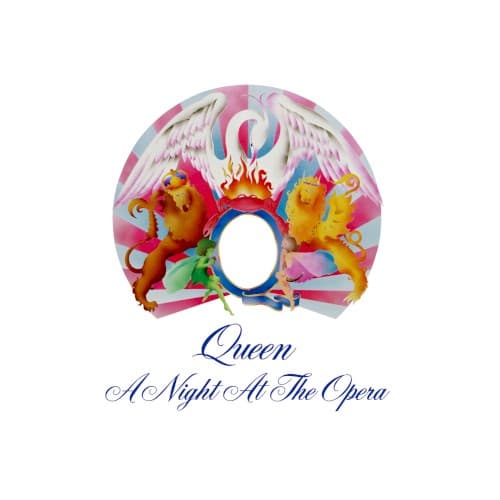
The scorecard
8.9/10 · Essential
- Songwriting25%
- 9.5
- Production25%
- 9.0
- Performance15%
- 8.5
- Cohesion15%
- 8.0
- Originality10%
- 8.5
- Replay value10%
- 9.0
Across forty minutes and a dozen tracks, every song introduces a new melodic or structural idea—time-signature shifts in Sweet Lady, canon fugue in The Prophet's Song, operatic multi-movement architecture in Bohemian Rhapsody—and all of it earned by songs that reward attention rather than fade into formula.
Roy Thomas Baker's 24-track work captures the multitracked vocal stacks without clutter, preserves the clarity of May's orchestrated guitars through the Deacy Amp, and makes space for double bass, ukulele and harp without turning the album into a museum exhibit; the hollow megaphone vocal on Lazing on a Sunday Afternoon and the tape delay canon in The Prophet's Song are production as composition.
Mercury moves from venom in Death on Two Legs to music-hall vaudeville in Seaside Rendezvous to operatic drama in Bohemian Rhapsody with authority on each; May's layered guitar orchestrations and Taylor's vocal imitations of brass show a band that treats performance as arrangement, not just execution.
The sequencing takes risks—moving from the one-minute Lazing on a Sunday Afternoon straight into the hard rock of I'm in Love With My Car, then pivoting to Deacon's piano ballad—and the pacing mostly works, though the stretch from Seaside Rendezvous through The Prophet's Song to Love of My Life sags slightly before Bohemian Rhapsody closes the proper album.
Against the mid-seventies rock mainstream of blues riffs and folk balladry, this album pulls from British music hall, Dixieland recreation via overdubbed guitar, science-fiction sea shanty and operatic theatre, all filtered through a production ambition that distinguished Queen from both the prog bands and the hard rock acts of the moment.
The craft in the writing and the specificity in the arrangements keep the album fresh across repeated listens; even the miniatures like Good Company reveal new details in May's guitar work, and the longer pieces sustain interest through genuine development rather than repetition padded to length.
Queen A Night at the Opera — The Album That Spent a Fortune Proving Bombast Could Be Precise
The argument for A Night at the Opera rests on what the band did with forty thousand pounds and seven studios: they made an album where a three-minute hard rocker about car maintenance sits two tracks away from an eight-minute prog epic about Noah's flood, and neither sounds like filler. This is the record where Queen stopped trying to be Led Zeppelin meeting Yes and started building their own architecture, one where Brian May could recreate a Dixieland jazz band using only his homemade guitar, where Freddie Mercury could sing a vaudeville miniature through a microphone pointed at a tin bucket, and where John Deacon's ode to his wife on a Wurlitzer could become a top ten single. The stylistic variety is not novelty—it is the album's structure. What makes it essential rather than merely eclectic is that every detour is executed with the same production detail and melodic intelligence. The songs do not share a sound; they share a standard.
The record arrived at the end of a legal war with Trident Studios that had left the band nearly broke despite two successful albums. Mercury wrote Death on Two Legs as a poison letter to their former manager, and the band recorded everywhere except Trident. The only exception is the closing instrumental God Save the Queen, tracked a year earlier. The rest was made in borrowed time across Rockfield, Olympic, Sarm and four other rooms, with producer Roy Thomas Baker and the band burning through what was reportedly the most expensive album budget in rock history to that point. The expense shows in the multitracked vocal harmonies, the 24-track tape used for the first time in their work, and the hours spent on details like the tape-delay vocal canon in The Prophet's Song. But the real cost was what they had already paid to get free.
Studio As Instrument, Song As Argument
The album's ambition is audible in the first three minutes. Death on Two Legs opens with a piano-and-vocal intro that sounds like chamber music, then detonates into a riff Mercury had sketched at the piano and handed to May to rebuild on guitar. The song is a curse set to hard rock, and it works because the venom in the lyric—blood-sucking leeches, decaying sewer rats—is matched by the precision in the arrangement. Mercury sings it with conviction, May's guitar doubles the vocal melody in the chorus, and the production never softens the attack. It is a hate letter that also functions as a statement of intent: this band will not settle for workmanlike rock.
Roy Thomas Baker's production and Mike Stone's engineering made the stylistic range possible. Baker had worked with Queen since the debut, and here he used the 24-track format to stack vocals without losing clarity and to layer May's guitar orchestrations—his term for the multitracked Red Special through Deacon's homemade Deacy Amp—into textures that sounded like strings or brass but retained the grain of the instrument. The vocal harmonies on Bohemian Rhapsody required over a hundred overdubs; the operatic section alone became dense enough that the tape was reportedly almost transparent from repeated passes. The Prophet's Song uses tape delay to turn Mercury's vocal into a self-harmonizing canon that runs for minutes without any instrumental accompaniment, a technical feat that Baker and Stone executed by syncing two reel-to-reel machines. These are not embellishments. They are the album's primary instruments.
The band also expanded the palette with instruments they had not used before. Deacon played double bass on '39 after May jokingly asked him to learn it, then found Deacon in the studio days later with the part ready. May used harp on Love of My Life by overdubbing it chord by chord, played ukulele on Good Company, and recreated a full Dixieland ensemble on his guitar by running it through the Deacy Amp and stacking takes.
Mercury contributed jangle piano on Seaside Rendezvous and used his voice to imitate a clarinet while Taylor hit a C6 imitating brass. These choices were not about showing off—they were about finding the exact sound each song required. When '39 needed the texture of a sea shanty, Deacon's double bass gave it that weight. When Good Company needed the warmth of a jazz combo, May built one out of his guitar.
The writing across the album is strong, but it is uneven in ways the band does not try to hide. Sweet Lady is a competent hard rocker in an unusual time signature, but it does not develop its central riff and ends up as connective tissue between stronger material. Seaside Rendezvous leans hard into music-hall pastiche, complete with Mercury and Taylor tapping thimbles on the mixing desk to simulate a tap dance, and while it is cleverly arranged it wears thin on repeat. The Prophet's Song, at over eight minutes, sustains interest through its shifting sections and the vocal canon, but the instrumental second half stretches longer than the ideas justify. These are not failures—each track is executed with care—but they expose the limits of the variety-show approach. When the writing is merely solid rather than exceptional, the production cannot carry it all the way.
Sequencing As Statement, Not Setlist
The album's flow is its biggest risk and its biggest success. Opening with the hard-rock fury of Death on Two Legs, then immediately cutting to the one-minute vaudeville, then jumping to the car-worship rocker could have felt like a stunt. Instead it establishes the terms: every track will be its own world, and the album will not smooth the transitions. The sequencing does not try to unify the material through sound or mood. It unifies through confidence, placing a folk ballad about relativistic time dilation next to a hard rocker in 3/4 time, then following both with a music-hall duet sung by two voices imitating instruments.
The second side is where the structure wobbles slightly. The middle stretch presents three ballads and mood pieces in a row, and while each is well-constructed the pacing sags before the closing suite arrives to finish the album proper. That final track earns its placement.
The operatic section, originally intended as a short interlude, grew into a multi-movement suite that contains the album's central tension: how far can a rock band push theatrical ambition before the songs collapse under the weight? It answers by making the ambition inseparable from the song. The operatic middle connects the ballad opening to the hard-rock finale not as a novelty but as the emotional pivot. It is the moment where the record's variety clicks into focus as a method rather than a collection.
Where Prog Discipline Met Music-Hall Nerve
A Night at the Opera sits at the top of Queen's catalog because it is the album where their influences stopped competing and started cooperating. The band had shown flashes of this integration on Sheer Heart Attack, but here they committed fully: no more chasing the heavy blues of their first two records, no more trying to out-prog the prog bands. Instead they took the production ambition of progressive rock, the melodic intelligence of British music hall and Tin Pan Alley, and the raw energy of hard rock, and recorded all of it with the same forensic attention to detail. The result is an album where a song about a space voyage told as a sea shanty, a Dixieland pastiche played on electric guitar, and a six-minute operatic suite all belong on the same record because they were all made with the same standard of craft.
This is an album for listeners who want rock music that does not settle for one idea of what rock music should sound like, and for anyone interested in how far studio production could be pushed in 1975 before digital tools made it easier. It is less useful for listeners who want consistent mood or genre, because the sequencing refuses to provide either. The weaknesses are real: Sweet Lady and Seaside Rendezvous are competent but not essential, and the second side's ballad-heavy stretch drags slightly before the finale. But the highs—Death on Two Legs, '39, The Prophet's Song, Bohemian Rhapsody—are among the most fully realized recordings in seventies rock, and even the lesser tracks were executed with care.
Nearly fifty years later the album has aged into an argument that still holds: bombast and precision are not opposites. Start with Bohemian Rhapsody if you only know the single and want to hear it in context, then move backward to Death on Two Legs and forward to '39. For the full picture of what Queen could do when they had the budget and the freedom, play it straight through. If this record works for you, the follow-up A Day at the Races applies the same method with slightly less urgency, and Sheer Heart Attack shows where they were heading before they arrived.
Track by track
Track Listing
Death on Two Legs (Dedicated to…)
StandoutThe album opens with Mercury's poison letter to the band's former manager, set to one of the hardest rockers they had recorded to that point. The piano-and-vocal introduction establishes the tone—this will not be polite—before May's guitar enters with a riff Mercury had originally sketched at the keyboard. The lyric pulls no punches: blood-sucking leeches, decaying sewer rats, and worse. Mercury sings it with enough venom that May reportedly felt uneasy about the words, but the performance never wavers. The arrangement is tight, the chorus hooks are strong, and the production captures the band at full force. It is both a statement of intent and a genuinely effective hard rock song, proof that the record's ambition would not come at the expense of intensity.
Lazing on a Sunday Afternoon
StandoutA one-minute vaudeville miniature sung entirely by Mercury with his voice recorded through a microphone pointed at a tin bucket, giving it a hollow megaphone tone. The lyric is light music-hall whimsy, the piano is period-appropriate, and the whole thing functions as a palate cleanser after the fury of the opening track. Baker recorded the guitar solo on the vocal track because they had run out of available tracks. It is clever and it does not overstay.
I’m in Love With My Car
SolidTaylor's first composition on a Queen album, initially dismissed as a joke by May until he heard the full arrangement. The song is a straightforward rocker with Taylor singing lead from the drum kit and May's guitar providing the main riff. The lyric is exactly what the title promises—a love song to a car, inspired by a roadie's devotion to his Triumph—and Taylor plays it straight. The Alfa Romeo engine sounds at the end are Taylor's own car. It works as a hard rock track and it served as the B-side to Bohemian Rhapsody, which later caused friction within the band because Taylor earned equal publishing royalties to Mercury despite the single's success being driven by the A-side. The song is well-constructed but not essential, a solid album track that benefits from Taylor's committed vocal.
You’re My Best Friend
StandoutDeacon's second song for the band and his first single, written for his wife while he was learning piano. He played the Wurlitzer electric piano himself—Mercury disliked the instrument—and overdubbed the bass later. The melody is warm and direct, the lyric is unpretentious, and the arrangement is clean enough to let the song breathe. It became a top ten hit in the UK and remains one of the band's most durable pop songs, proof that Deacon could write hooks that worked on radio without sounding calculated. The production is simpler than most of the album, which helps the song stand out in the sequence.
’39
StandoutMay's science-fiction sea shanty, told from the perspective of space explorers who return home after a year-long voyage to find a century has passed due to relativistic time dilation. The folk arrangement uses Deacon's double bass—learned at May's joking request—and May's acoustic guitar, with May singing lead on the album version. The melody is sturdy, the lyric is specific without overexplaining, and the song earns its conceit by treating it as an emotional story rather than a thought experiment. Mercury sang it live, and George Michael later cited it as his favourite Queen song. It is one of the album's most fully realised tracks, a song where the concept and the craft are inseparable.
Sweet Lady
SolidA fast hard rocker in an unusual 3/4 time signature that shifts to 4/4 in the bridge. May wrote it, and the riff is competent, but the song does not develop the idea beyond the initial groove. It functions as a bridge between the folk intimacy of '39 and the vaudeville of Seaside Rendezvous, but on its own terms it is the weakest track on the first side. The time signature is interesting, the performance is tight, but the writing does not give the band enough to work with.
Seaside Rendezvous
SolidMercury's music-hall pastiche, complete with a mock-instrumental bridge where he and Taylor use their voices to imitate clarinets, tubas, trumpets and kazoos, with Taylor hitting a C6 in the process. The tap-dance section was performed by tapping thimbles on the mixing desk. It is cleverly arranged and performed with commitment, but the novelty wears thin on repeat listens. Mercury plays both grand piano and jangle honky-tonk, and the whole thing feels like a sketch that was recorded with full production when a demo might have sufficed.
The Prophet’s Song
SolidMay's eight-minute prog epic, written after a dream about the Great Flood and structured around a vocal canon that uses tape delay to turn Mercury's voice into a self-harmonizing fugue. The first half builds tension through shifting dynamics and May's koto, the middle section is the a cappella vocal experiment, and the second half is instrumental guitar work that runs longer than the material justifies. The ambition is audible—the tape-delay canon required Baker and Stone to sync two reel-to-reel machines—but the song sags in the final minutes. It is Queen at their most progressive, for better and worse: technically impressive, conceptually interesting, and about two minutes too long.
Love of My Life
StandoutMercury's piano-and-vocal showcase, arranged by May to include harp overdubbed chord by chord and acoustic guitar. Mercury sings it with restraint, the classical piano solo in the middle is brief and elegant, and the production leaves space around the voice and instruments. It became a concert staple, especially in South America where audiences sang it back to Mercury loudly enough that he would stop singing and let them take over. The song has been covered widely, and it remains one of the band's most durable ballads. The writing is direct without being sentimental, and the performance is intimate without being precious.
Good Company
StandoutMay's Dixieland pastiche, played almost entirely on his Red Special through the Deacy Amp to recreate the sound of a jazz combo. May sings lead, plays ukulele, and overdubs the guitar parts to imitate clarinet, trombone and trumpet. Mercury does not appear on the track, one of the few Queen songs recorded without him. The writing is slight—a nostalgic lyric about aging—but the arrangement is the point. May's recreation of the Dixieland ensemble is both technically impressive and tonally accurate, and the song works as a brief interlude before the album's centrepiece. It is a novelty, but a well-executed one.
Bohemian Rhapsody
StandoutThe album's centrepiece and the song that became Queen's signature, a six-minute multi-movement suite that moves from piano ballad to operatic theatre to hard rock without a conventional chorus. Mercury wrote it and brought it to the band in blocks, sketching the guitar solo for May and writing the vocal arrangements on a phonebook using note names instead of notation. The operatic section—originally intended as a short interlude—grew into a dense ensemble of multitracked voices invoking Scaramouche, Galileo, Figaro and Beelzebub, with over a hundred vocal overdubs pushing the 24-track tape to near transparency. The band recorded their parts without knowing how the final mix would assemble them. Baker and Stone's production is the album's peak: the vocal stacks are clear, the transitions between sections are seamless, and the hard rock finale lands with full force after the operatic excess. The song was twice as long as the average 1975 single and initially received mixed reviews, but it topped the UK chart for nine weeks and became one of the most widely recognised recordings in rock history. The writing is theatrical but never aimless—the operatic middle serves as the emotional pivot between the ballad and the hard rock, and the structure makes sense as drama even when it defies pop convention. Mercury's vocal performance carries the song, from the intimate opening to the operatic histrionics to the final resigned lines. May's guitar solo in the hard rock section is one of his most memorable, and Taylor's drumming in that section drives the song to its conclusion. It is the album's thesis made audible: bombast and precision working together.
God Save the Queen
StandoutMay's instrumental arrangement of the British national anthem, recorded a year earlier at Trident Studios and added to close the album. He played a guide piano that was edited out later, then layered multiple guitar tracks to create the orchestration. It became a concert coda for nearly every Queen show afterward, and May later performed it on the roof of Buckingham Palace during the Queen's Golden Jubilee. As an album closer it works as a statement of Britishness and as a brief palate cleanser after Bohemian Rhapsody. It is not a song—it is a signature.
![[Led Zeppelin IV] by Led Zeppelin album cover](/_next/image?url=https%3A%2F%2F44shyya1tglz2lc3.public.blob.vercel-storage.com%2Fcovers%2Fled-zeppelin-led-zeppelin-iv.jpg&w=640&q=75)