The scorecard
8.5/10 · Essential
- Songwriting25%
- 9.0
- Production25%
- 8.5
- Performance15%
- 8.0
- Cohesion15%
- 7.5
- Originality10%
- 9.5
- Replay value10%
- 8.0
Subsections within each track build logically, whether the abrupt transitions of '21st Century Schizoid Man' or the medieval court imagery of the title track, showing compositional ambition that serves structure rather than spectacle.
Ian McDonald's layered Mellotron overdubs and the band's self-production through five tape generations achieve orchestral density without losing the bite of Fripp's guitar or the clarity of Lake's voice, though the 12-minute 'Moonchild' loses its way in extended passages.
Greg Lake's voice carries the dark lyrical content without overselling it, while Fripp's guitar shifts from precise classical phrasing to Hendrix-like distortion without sounding like imitation, though the rhythm section is more dutiful than innovative.
The sequencing alternates heavy and delicate tracks to showcase range, but the decision to stretch 'Moonchild' to over 12 minutes with ambient improvisation creates a sag that the strong opening and closing cannot fully overcome.
In October 1969 no rock album had combined Mellotron-driven classical arrangements, jazz-inflected improvisation, and heavy distortion with this level of compositional rigor, establishing the progressive rock template in a single 42-minute statement.
The first and last tracks retain their force decades later, but the extended passages in 'Moonchild' and the gentleness of 'I Talk to the Wind' can feel like interruptions rather than chapters on repeated listens.
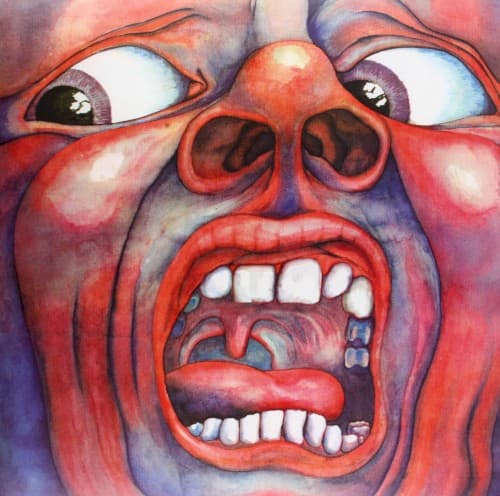
King Crimson In the Court of the Crimson King — The Album That Made Prog Possible
In the Court of the Crimson King works because it commits fully to an idea that did not yet exist. Released in October 1969, the album assembled elements that were drifting through late-1960s rock — Mellotron strings, extended song structures, jazz-rock hybrids, classical arrangement — and locked them into five tracks that demanded to be taken as composed pieces rather than expanded jams. The distorted, multi-sectioned aggression of opening track '21st Century Schizoid Man' announced that this was not art rock as decoration but as architecture, and the album that follows treats rock music as material for design rather than raw expression. Whether it succeeds on those terms is a question each section of the record answers differently.
The ambition is not in doubt. Robert Fripp's guitar moves between precise, classical-influenced phrases and sustained distortion without sounding derivative of either discipline. Ian McDonald spent the sessions at Wessex Sound Studios layering Mellotron parts and woodwinds through five tape generations, creating orchestral density without an orchestra.
The band produced the album themselves after initial sessions with Tony Clarke failed, and the result is a record that sounds like it was made by people who knew exactly what they wanted and had no template to follow. That clarity of purpose gives the album its authority. The weakness is that the band occasionally chooses to highlight its range at the expense of the songs, most audibly in the 12-minute 'Moonchild,' where extended improvisation substitutes for development. But the thesis holds: this is the album where progressive rock became a method rather than an aspiration, and where the studio became an instrument rather than a place to capture a performance.
Classical Rigor, Rock Force, and the Mellotron as the Third Guitar
The album's design is built on Ian McDonald's Mellotron, an instrument that dominates the arrangements by providing string and choir textures that no rock band of 1969 could otherwise afford or control. On 'Epitaph,' McDonald recorded two separate Mellotron parts and shifted their volumes against each other during the mix to create motion within sustained chords, a technique that keeps the track from collapsing into static grandeur. The Mellotron also anchors the title track's medieval atmosphere, where flute arabesques and bombastic drum rolls create a sense of ceremony that the lyrical imagery of crimson kings and fire witches requires but does not explain. The instrument is fierce and overpowering, as the FACT SHEET notes, and the decision to treat it as a lead voice rather than a background effect is what allows the album to sound orchestral without losing the directness of a rock band.
Robert Fripp's guitar work balances two modes: the distorted, angular riffing of '21st Century Schizoid Man,' which anticipates heavy metal's vocabulary of sustained power and abrupt stops, and the clean, arpeggiated figures that anchor 'Epitaph' and the title track, where his playing functions more like a lute than a lead instrument. This range is the album's central tension. Fripp never sounds like he is imitating Hendrix or mimicking classical music; instead, he uses both languages to serve the compositional structure of each track. The rhythm section of Greg Lake on bass and Michael Giles on drums is tight but not inventive, providing the foundation that allows McDonald and Fripp to build upward rather than contributing ideas of their own. Lake's voice, plaintive and clear, delivers Peter Sinfield's portentous lyrics — societal collapse, war, alienation — without overselling the doom, which keeps the album from tipping into self-parody.
The production, engineered by Robin Thompson with the band producing themselves, uses the studio as a compositional tool. The decision to overdub extensively and work through multiple tape generations creates depth but also introduces compromises. The original master tapes went missing after 1969, and subsequent reissues until 2004 were made from copies with audible hiss and EQ problems. Even with the 2004 recovery of the first-generation masters, the album retains a slightly distant quality, as if the orchestration is happening behind a scrim. This may be intentional — the album's themes of alienation and societal breakdown benefit from a sense of remove — but it also means that the raw energy of '21st Century Schizoid Man' and the intimacy of 'I Talk to the Wind' are not as immediate as they could be. The album's sonic ambition is its greatest strength, but the technical limits of 1969 multitracking mean that not every idea translates with the force the band likely imagined.
How the Album Moves — Peaks, Sags, and the Problem of 'Moonchild'
The sequencing alternates between heavy and delicate tracks to demonstrate range, but the structure reveals a band more interested in showcasing its capabilities than in building momentum across an album. '21st Century Schizoid Man' opens with a statement of force, followed by the gentle 'I Talk to the Wind,' written for predecessor group Giles, Giles and Fripp and retained to show the band's soft side. The contrast works because the collision is stark enough to feel deliberate. 'Epitaph,' a ballad with timpani and layered Mellotron, follows as the emotional center of side one, and the pacing through the first three tracks feels earned.
Side two is where the album loses its way. 'Moonchild' stretches to over 12 minutes, and the back half of the track is an improvised ambient-jazz interlude that substitutes atmosphere for ideas. The track's opening section is a spooky pastoral love song, as the FACT SHEET describes it, but once the band moves into extended improvisation the structure dissolves. The decision to include this passage may have been intended to display the band's jazz influences, but the result is filler that the album's 42-minute runtime cannot absorb. The title track recovers by returning to composed structure, with subsections that invoke medieval imagery and bombastic drumming, but the sag in the middle of side two means the album finishes strong rather than building to a peak. The sequencing is deliberate, but the length is not always justified.
Where It Stands, Who It's For, and Whether the Blueprint Ages Well
In the Court of the Crimson King is the most influential progressive rock album because it established the genre's method in a single debut, but influence and quality are not identical. The album's peaks — '21st Century Schizoid Man,' 'Epitaph,' and the title track — demonstrate that rock music could borrow from classical and jazz traditions without losing its force, and that the studio could be used to create arrangements that no live band could reproduce. The weaknesses are equally clear: the 12-minute runtime of 'Moonchild' is not justified by what happens in the back half of the track, and the decision to alternate between heavy and delicate songs to display range occasionally feels like a checklist rather than a sequence. As a debut, it is astonishing. As a listening experience, it is essential for anyone interested in how rock became progressive, but it is not a record without dead space.
This album is for listeners who want to hear the moment when rock music became architecture, when songs stopped being vessels for performance and started being designs to be built. It is also for fans of heavy guitar who can tolerate extended Mellotron passages, and for fans of art rock who can tolerate distortion. Skip it if you need momentum across an album, or if extended improvisation without development sounds like pretension rather than exploration. The album has aged better than most of its immediate imitators because it does not sound like it is trying to be progressive — it simply is — but the sonic distance introduced by the production means it will never sound raw.
Start with '21st Century Schizoid Man' for the heaviest statement, 'Epitaph' for the orchestral ambition, and the title track for the medieval atmosphere. If those three tracks work, the album's weaknesses will be tolerable. If they do not, the gentleness of 'I Talk to the Wind' and the extended passages of 'Moonchild' will confirm that this is not for you. For a more concise statement of similar ideas, try the Moody Blues' Days of Future Passed, which uses orchestration without the distortion, or Jethro Tull's Thick as a Brick, which commits to extended structure without the segmented approach. But this is the album that made both of those records possible, and that fact alone makes it required listening for anyone tracing the history of rock as a composed form.
Track by track
Track Listing
21st Century Schizoid Man (including Mirrors)
StandoutThe opening track establishes the album's heaviest mode and remains the most influential seven minutes of the record. Fripp's distorted guitar riff, angular and repetitive, anticipates heavy metal's vocabulary of sustained power and abrupt stops, while McDonald's saxophone lines weave through the verses with a jazz-rock aggression that keeps the track from settling into a single genre. The lyrical content — war, societal alienation, schizoid paranoia — is delivered by Greg Lake's voice with enough force to match the instrumental attack, and the track's subsections shift between tight, composed verses and improvised passages without losing coherence. The 'Mirrors' subsection introduces a brief, quieter interlude before the main riff returns, demonstrating the band's interest in multi-part structures that function as chapters within a single track. This is the track that brought King Crimson attention when they opened for the Rolling Stones in Hyde Park before an estimated 250,000 to 500,000 people in July 1969, and it remains the album's most forceful statement. The production captures the rawness of the guitar and the density of the saxophone without muddying the mix, and the track's influence on later progressive and metal acts is audible in nearly every bar.
I Talk to the Wind
SolidWritten for predecessor group Giles, Giles and Fripp, this track was retained to showcase the band's softer side, and it functions as a necessary contrast to the aggression of the opener. Ian McDonald's flute carries the melody over Greg Lake's acoustic strumming and plaintive vocal, creating a pastoral atmosphere that Peter Sinfield has cited as influenced by Joni Mitchell. The lyrical content — addressing someone who refuses to listen — is delivered with restraint, and the track's gentle pacing allows the album to breathe after the intensity of the first seven minutes. The decision to include this track is strategic rather than inspired; it works as a demonstration of range but does not develop ideas that could not have been conveyed in four minutes instead of six. The production is clear and the performance is assured, but the track's purpose is structural rather than essential.
Epitaph (including March for No Reason and Tomorrow and Tomorrow)
StandoutThe emotional center of the album and its strongest composed piece. Ian McDonald's two Mellotron parts, shifted in volume against each other during the mix, create a sense of motion within sustained chords that keeps the track from collapsing into static grandeur, a technique McDonald described as giving 'a sense of motion' to chords that would otherwise 'sound rather flat sonically.' The timpani, played by Michael Giles, adds weight to the arrangement without overwhelming the vocal melody, and Greg Lake's delivery of Sinfield's lyrics about the futility of human effort and the inevitability of death is restrained enough to let the orchestration carry the emotional force. Robert Fripp's clean guitar figures function as counterpoint to the Mellotron, and the track's subsections — 'March for No Reason' and 'Tomorrow and Tomorrow' — introduce tempo shifts that develop the central theme rather than simply restating it. The production is dense but clear, with each layer of Mellotron and woodwind audible in the mix, and the track's eight minutes feel earned because the arrangement continues to develop rather than repeat. This is the track that demonstrates the album's compositional rigor most convincingly, and it remains one of the strongest examples of how Mellotron-driven orchestration can serve a song rather than decorate it.
Moonchild (including The Dream and The Illusion)
WeakThe album's weakest track and the clearest example of ambition exceeding execution. The opening section, 'The Dream,' is a spooky pastoral love song with McDonald's vibraphone and Fripp's clean guitar creating a delicate, almost fragile atmosphere that supports Lake's vocal melody. This section works because it is concise and focused, and it demonstrates the band's ability to create intimacy within the album's larger orchestral scope. The problem is 'The Illusion,' an extended improvised ambient-jazz interlude that stretches the back half of the track to over 12 minutes without developing ideas or building toward a resolution. The improvisation may have been intended to showcase the band's jazz influences, but the result is atmosphere without structure, and the track sags under its own length. The decision to include this passage feels like a miscalculation, as if the band believed that extended runtime alone would convey depth. The opening minutes justify the track's inclusion, but the back half is filler that the album's 42-minute runtime cannot absorb. This is the track to skip on repeated listens.
The Court of the Crimson King (including The Return of the Fire Witch and The Dance of the Puppets)
StandoutThe title track closes the album with a return to composed structure and medieval atmosphere. McDonald's flute arabesques and Fripp's harpsichord-like guitar figures create a sense of ceremony, while Michael Giles' bombastic drum rolls and Lake's vocal delivery of Sinfield's imagery — crimson kings, fire witches, dancing puppets — anchor the track in the album's thematic concerns of power, corruption, and societal collapse. The subsections, 'The Return of the Fire Witch' and 'The Dance of the Puppets,' introduce tempo and dynamic shifts that develop the central melody rather than simply repeating it, and the track's nine minutes feel justified because the arrangement continues to build toward a conclusion. The Mellotron is fierce and overpowering here, as it is throughout the album, and the decision to end with this track rather than a heavier statement like '21st Century Schizoid Man' demonstrates the band's confidence in their orchestral mode. The production captures the density of the arrangement without losing clarity, and the track's medieval invocation — part folk, part baroque, part rock — remains one of the album's most distinctive moments. This is the track that best represents the album's ambition, and it succeeds because the structure supports the grandeur rather than simply displaying it.