
The Ever-Shifting Architecture of Rock's Most Uncompromising Ensemble
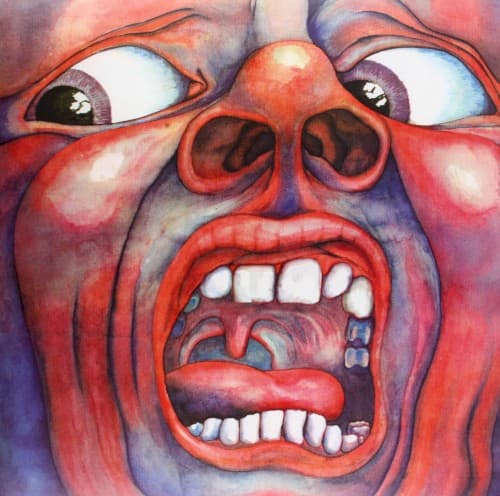
When King Crimson unleashed their debut album in October 1969, they didn't just enter the rock conversation—they rewrote its grammar. Founded by guitarist Robert Fripp alongside lyricist Peter Sinfield, the British ensemble operated less as a traditional band and more as a conceptual framework, a vessel through which Fripp could explore the outer limits of what rock instrumentation could express. Their arrival coincided with a moment when rock was fragmenting into a thousand possibilities, yet few took the leap into genuine avant-garde territory with such conviction.
Across more than five decades, King Crimson existed in multiple iterations, each one dissolving and reforming with new personnel and radically different sonic approaches. The only constant was Fripp's architectural vision: rock as a discipline rather than entertainment, composition as craft, and the band as a working laboratory. From the symphonic grandeur of their early incarnation through the abrasive improvisation of the 1970s lineups and into the interlocking precision of their 1980s and beyond configurations, King Crimson remained defiantly outside the mainstream's gravitational pull.
What separated King Crimson from their progressive rock peers wasn't technical virtuosity alone—though they possessed that in abundance—but their willingness to abandon successful formulas entirely. Where most bands evolved incrementally, King Crimson underwent complete metamorphoses, sometimes leaving fans bewildered but always pushing the boundaries of what organized sound could achieve within a rock context.
Controlled Chaos: The Sonic Vocabulary of Disciplined Experimentation
King Crimson's musical approach defied easy categorization because it refused to stay still long enough to be pinned down. Their 1969 debut established a template of sorts: Mellotron-drenched atmospherics colliding with sudden explosive passages, jazz-informed drumming supporting classical structures, and Fripp's guitar work oscillating between lyrical beauty and jagged dissonance. Yet this was merely one face of a multifaceted entity.
Fripp's concept of "disciplined improvisation" became the band's philosophical core. Unlike the freeform wandering of some experimental acts, King Crimson's improvisations operated within strict parameters—controlled explosions rather than random detonations. The interplay between saxophone, violin, and guitar in early lineups created textures more associated with contemporary classical music than rock, while the rhythm section often worked in odd time signatures that destabilized any sense of conventional groove.
By the mid-1970s, the sound had hardened into something more menacing. The violin disappeared, replaced by more guitar and the addition of David Cross's electric violin and later John Wetton's muscular bass work. The 1980s brought another transformation: interlocking guitar patterns influenced by Balinese gamelan music, driving rhythms that flirted with new wave energy without ever fully embracing pop accessibility, and Adrian Belew's processed guitar textures adding a layer of technological exploration. Each era sounded distinctly like King Crimson while sharing little surface similarity with what came before.
Five Decades of Creative Destruction and Reinvention
The band's trajectory began with explosive impact. Their debut album arrived at a cultural moment when rock was reaching for artistic legitimacy, and its combination of accessible melody and unsettling experimentation provided a roadmap others would follow. The opening track established them as something unprecedented: a rock band that could move seamlessly from pastoral beauty to apocalyptic intensity, all while maintaining compositional rigor that demanded serious listening.
That initial success proved both blessing and curse. Co-founder Ian McDonald and drummer Michael Giles departed almost immediately, leaving Fripp to rebuild. What followed was a period of constant flux. Each subsequent early 1970s album featured different personnel, different sonic directions, yet maintained an unmistakable identity. "Lizard" incorporated jazz players and big band arrangements. "Islands" leaned into melancholy and introspection. When Fripp dissolved the band in 1974 after "Red," it seemed a definitive ending—a recognition that the project had exhausted its possibilities.
The seven-year hiatus ended with the 1981 lineup featuring Belew, bassist Tony Levin, and drummer Bill Bruford alongside Fripp. This configuration lasted longer than any previous incarnation and produced work that influenced post-punk and alternative rock in ways rarely acknowledged. Albums like "Discipline" and "Three of a Perfect Pair" demonstrated that King Crimson could absorb contemporary influences without sacrificing their experimental edge. The interlocking guitar patterns Fripp and Belew developed became a signature sound, mathematical precision creating an illusion of controlled chaos.
Another dissolution, another resurrection. The 1990s saw King Crimson return as a double trio—two drummers, two bassists, and the familiar guitar pairing. This configuration allowed for even more complex rhythmic explorations, though commercial indifference suggested the music world had moved on. Fripp seemed unbothered, treating King Crimson as an ongoing research project rather than a career vehicle. Later iterations expanded to seven or even eight members, creating a wall of interlocking parts that could replicate the complexity of earlier recordings while adding new dimensions in live performance.
Throughout these transformations, Fripp maintained absolute control over the band's identity and business operations. He pioneered direct-to-fan sales models, fought against music industry conventions, and treated King Crimson's catalog with curatorial precision. This approach earned him a reputation as difficult, uncompromising, even autocratic—labels he seemed to wear as badges of honor. For Fripp, King Crimson was never a democracy but a benevolent dictatorship in service of the music's integrity.
The Architecture of Influence: How King Crimson Rewired Rock's Possibilities
King Crimson's influence operates on two levels: the obvious and the subterranean. The obvious lineage runs through progressive rock—bands who took the technical ambition and compositional complexity as permission to expand rock's vocabulary. But the deeper influence appears in unexpected places: the rhythmic experiments of post-punk bands, the structural ambition of alternative rock acts, the willingness of metal bands to incorporate dissonance and unusual time signatures.
Fripp's guitar approach alone spawned countless imitators and innovators. His use of controlled feedback, his integration of tape loops and processing, and his philosophical approach to the instrument as a tool for sound design rather than mere virtuosity opened pathways others would explore for decades. The interlocking guitar patterns he developed with Belew influenced everyone from minimalist composers to math rock bands, demonstrating that complexity could coexist with accessibility.
What makes King Crimson's legacy particularly fascinating is how it exists outside traditional metrics of success. They never achieved the commercial heights of peers like Pink Floyd or the cultural ubiquity of Led Zeppelin. Their albums don't dominate classic rock radio. Yet their influence on musicians—the people who make the music rather than just consume it—remains profound. Artists across genres cite them as formative, not for specific songs but for the permission they granted to pursue difficult, uncompromising visions. In an industry increasingly driven by algorithmic playlists and instant gratification, King Crimson stands as a monument to the possibility of rock as a serious artistic endeavor, uninterested in compromise and indifferent to commercial validation.