
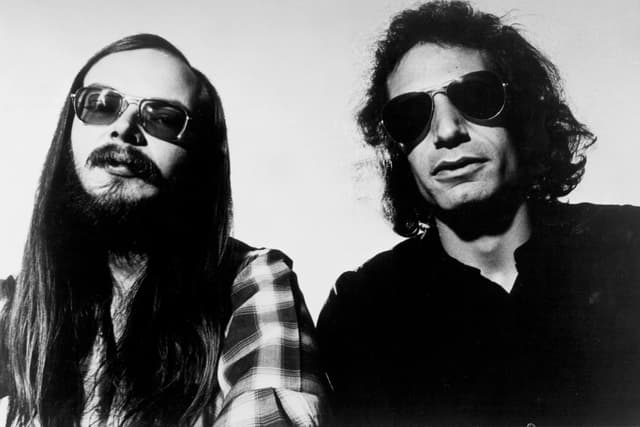
The Studio Craftsmen Who Brought Jazz Complexity to Rock Radio
When Steely Dan's "Reelin' in the Years" hit FM radio in 1972, most listeners had no idea they were hearing a radical experiment disguised as a catchy single. Walter Becker and Donald Fagen—two Bard College jazz obsessives who met in 1967—had smuggled bebop chord changes, literary references, and cynical social commentary into what sounded like accessible rock. The name itself, borrowed from a William S. Burroughs novel, hinted at their subversive intentions.
Steely Dan emerged from the same New York scene that produced Lou Reed's downtown avant-garde, but Becker and Fagen moved in the opposite direction: toward Los Angeles session studios, where they could chase sonic perfection with unlimited takes and rotating casts of jazz virtuosos. By 1974, they'd abandoned touring entirely, transforming Steely Dan from a touring band into a studio entity—essentially a brand name for Becker and Fagen's increasingly elaborate production experiments.
What set them apart wasn't just technical prowess but a deeply ironic sensibility that dissected American culture from the inside. Their songs populated lounges, golf courses, and corporate offices with aging hipsters, failed revolutionaries, and emotional con artists—all set to music so polished it became the sound of 1970s upward mobility itself.
Jazz Harmonies Meet Rock Arrangements: Decoding the Steely Dan Sound
The Steely Dan sonic signature rests on deliberate contradiction. Becker and Fagen built songs around jazz harmonies—altered dominants, sus chords, tritone substitutions—that would sound at home in a Bill Evans composition, then dressed them in pristine rock production that made complexity feel effortless. A casual listener hears smooth grooves and memorable hooks. A musician hears Larry Carlton navigating chord changes that would challenge most jazz guitarists.
Their rhythm section work redefined what groove meant in rock context. Rather than the straight-ahead pulse of most 70s rock, Steely Dan employed session masters like Bernard Purdie, Jeff Porcaro, and Rick Marotta to create pockets that breathed with jazz swing while maintaining rock's forward drive. The bass lines—often performed by Chuck Rainey or Walter Becker himself—walked through changes with melodic sophistication that owed more to Ron Carter than to typical rock bassists.
Fagen's vocals became another instrument in this precise sonic architecture. His nasal, conversational delivery—equal parts Ray Charles soul and Bob Dylan deadpan—created deliberate distance from the emotional directness of most rock singing. He sounded like he was reporting on scenes rather than living them, a narrator too smart to believe his own stories. Combined with cryptic lyrics that referenced everything from Nabokov to Horace Silver, the overall effect was rock music for listeners who'd outgrown rock's usual certainties.
From Touring Band to Studio Auteurs: The Evolution of Creative Control
Becker and Fagen's path to complete creative autonomy began conventionally enough. After working as staff songwriters for ABC/Dunhill, they assembled a touring band in 1972 that included guitarist Denny Dias, drummer Jim Hodder, and vocalist David Palmer. Early albums like "Can't Buy a Thrill" and "Countdown to Ecstasy" featured this lineup, though even then the core remained the Becker-Fagen songwriting partnership.
By "Pretzel Logic" in 1974, the shift was clear. The duo started hiring session specialists rather than maintaining a fixed band, chasing particular timbres and techniques for each song. Jeff "Skunk" Baxter's pedal steel on "Pearl of the Quarter" gave way to session guitarists like Larry Carlton and Robben Ford as the production grew more surgical. When they stopped touring after 1974, Steely Dan became purely a studio project—unprecedented for a supposedly rock act at commercial peak.
The middle period produced their most uncompromising work. "The Royal Scam" (1976) tackled darker themes with more dissonant arrangements, while "Aja" (1977) represented the apex of their studio perfectionism. Recording "Aja" required over a year, multiple studios, and exhaustive musician auditions—drummer Steve Gadd's performance on the title track allegedly took dozens of takes. The album's fusion of rock accessibility and jazz sophistication earned both commercial success and critical respect, a combination rock perfectionists rarely achieve.
"Gaucho" (1980) pushed the studio obsessiveness to breaking point. Becker struggled with personal tragedies and substance issues while Fagen's perfectionism grew more demanding. Recording sessions stretched across two years, budgets ballooned, and the partnership showed strain. The album's glacial production—every snare hit processed, every guitar tone debated—resulted in their most extreme statement: rock music that sounded hermetically sealed from human spontaneity.
After "Gaucho," the duo split for nearly two decades. Fagen released solo albums that continued the Steely Dan aesthetic under his own name, while Becker produced records for other artists and eventually released solo work. Their 2000 reunion with "Two Against Nature" won four Grammy awards and proved the aesthetic hadn't dated—if anything, younger musicians had spent twenty years catching up to their harmonic vocabulary. They continued touring and recording sporadically until Becker's death in 2017, with Fagen maintaining the name for live performances.
How Studio Perfectionism and Jazz Literacy Changed Rock's Possibilities
Steely Dan's most profound impact may be permission—proof that rock could accommodate jazz sophistication without sacrificing commercial viability. Countless artists from Radiohead to Thundercat cite them as models for pursuing complexity within pop frameworks. The current generation of jazz-influenced indie artists, from Dirty Projectors to Vampire Weekend, operates in territory Becker and Fagen mapped in the 1970s.
Their studio methodology became blueprint for a particular kind of obsessive craft. The willingness to fire musicians mid-session, demand endless takes for microscopic improvements, and spend whatever time necessary to achieve a specific sonic vision—these approaches influenced everyone from Brian Eno to Dr. Dre. In hip-hop particularly, their records became sample goldmines precisely because the production was so immaculate; producers recognized kindred spirits in Becker and Fagen's studio fanaticism.
Culturally, Steely Dan occupies complicated space. The "yacht rock" label often applied to their smoother moments can feel reductive, missing the lyrical darkness and harmonic adventurousness beneath the polished surfaces. Yet they undeniably soundtracked a particular moment of American affluence, when studio budgets were unlimited and FM radio could support seven-minute jazz-rock instrumentals. Their music became synonymous with a certain educated, ironic, culturally literate listener—the stereotype persists for reason. What survives that context is the songwriting itself: melodies strong enough to withstand any amount of overproduction, chord progressions that still challenge musicians decades later, and lyrics that reward obsessive parsing. Steely Dan proved rock could be a vehicle for genuine compositional ambition without losing its essential identity. That remains their sharpest trick.