The scorecard
8.9/10 · Essential
- Songwriting25%
- 9.5
- Production25%
- 9.0
- Performance15%
- 8.5
- Cohesion15%
- 8.0
- Originality10%
- 8.5
- Replay value10%
- 9.0
Songs like the title track and Rock 'n' Roll Suicide prove Bowie could build verses that moved somewhere instead of circling, with hooks that earned their place rather than announcing it.
Ken Scott and Bowie captured Ronson's guitar as both weapon and color, letting Five Years and Rock 'n' Roll Suicide escalate naturally while Suffragette City hits without clipping.
Bowie sang with enough conviction to sell both the apocalyptic numbness of Five Years and the camp provocation of Suffragette City, though his range is modest and the Spiders lock in without being remarkable players.
The record flows from dread to spectacle to collapse, but It Ain't Easy interrupts the arc and several tracks (Star, Hang On to Yourself) fill space rather than advance the argument.
The androgynous alien rockstar conceit was new in early 1972, and the fusion of glam theatrics with proto-punk energy had not been codified yet, though Bolan and Iggy Pop supplied obvious parts.
The best songs (Moonage Daydream, the title track, Rock 'n' Roll Suicide) reveal new details on repeat, though the mid-album sag becomes more obvious once the shock wears off.
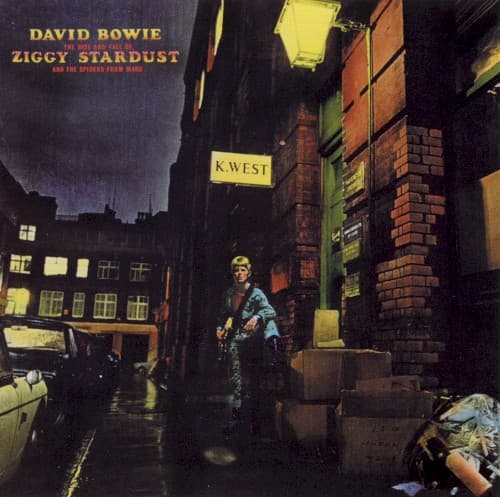
David Bowie Ziggy Stardust — The Alien Who Made British Rock Safe for Theatre
Ziggy Stardust works because Bowie understood that glam needed a script. Marc Bolan had the look and the riffs, but Bolan sold sex and glitter as feeling; Bowie sold it as a character study, complete with a rise, a peak and a scripted death. The conceit — bisexual alien messiah arrives to save Earth, becomes a rock star, gets devoured by fame — was sketched after most of the songs were recorded, but the album holds together because the best tracks sound like someone performing a role rather than confessing. That distance is what makes it durable.
Bowie's influences were obvious in mid-1972: Iggy Pop's recklessness, Lou Reed's deadpan, Vince Taylor's messianic breakdown, and the Velvet Underground's art-rock austerity. What he added was the willingness to treat rock stardom as a costume that could be put on, inhabited, and discarded. British rock had produced larger-than-life personalities (Jagger, Townshend, Daltrey), but none had treated fame as a theatrical fiction that the audience was invited to watch collapse.
The album announces its apocalyptic premise in the first verse of Five Years, builds to Ziggy's self-introduction in Moonage Daydream, stages his coronation in Starman, and ends with his public disintegration in Rock 'n' Roll Suicide. The narrative is loose — several songs were written before the concept existed, and others (It Ain't Easy, Soul Love) sit outside the arc — but the sequencing creates a trajectory from dread to spectacle to ruin. The stakes are clear: this is about what happens when an outsider uses rock music to gain acceptance and then discovers that acceptance requires erasure. That theme would recur in British rock for the next decade (Roxy Music, early Suede, Pulp), but Bowie was the first to state it plainly and build an album around it.
Ronson's Guitar and the Thinness Beneath the Gloss
The sound is guitar-led, sparse and theatrical, closer to the Stooges than to the piano-based introspection of Hunky Dory. Mick Ronson played electric guitar through a Marshall amplifier and wah-wah pedal, and his work dominates the louder tracks: the churning riff in Moonage Daydream, the staccato stabs in Suffragette City, the economical solo in the title track. Ronson also handled the string arrangements, which anchor Five Years and Rock 'n' Roll Suicide, and played piano on several tracks, though his electric work is what defines the record.
Bowie played acoustic rhythm guitar throughout, audible in the verses of Star and in the opening of Rock 'n' Roll Suicide. Trevor Bolder's bass is functional, and Mick Woodmansey's drumming is steady without being inventive. The band recorded most tracks live, with Bowie humming Ronson's solos to him in advance. Ken Scott co-produced and captured the sessions quickly; most of Bowie's vocals were first takes.
The production is clean but not lush. Scott gave Ronson's guitar enough presence to carry the attack without overwhelming Bowie's voice, and the mix leaves room for details: the bongos and hand-claps in Soul Love, the harpsichord (played by an uncredited Rick Wakeman) in It Ain't Easy, the ARP synthesizer in Suffragette City. The orchestral swell at the end of Rock 'n' Roll Suicide is the album's one moment of outright grandeur; elsewhere the arrangements are economical, built around Ronson's guitar and Bowie's voice. The sound is theatrical in construction but not in execution — there are no sound effects, no spoken-word interludes, no obvious studio tricks. What makes it glam is the performance, not the recording.
The songwriting borrows from Chuck Berry and Eddie Cochran (Hang On to Yourself, Suffragette City), Little Richard (Suffragette City again), and the Velvet Underground (the droning verses in the title track). Bowie uses American slang and pronunciations throughout (news guy, cop, TV instead of newsreader, policeman, telly), which gives the record a transatlantic gloss that was still unusual for British rock in 1972. The best songs develop rather than repeat: Five Years builds from numb observation to orchestral panic, Rock 'n' Roll Suicide escalates from acoustic strum to full-band catharsis, Moonage Daydream shifts from verse to chorus without losing momentum. The weaker tracks (Star, Hang On to Yourself, It Ain't Easy) are competent but formulaic, closer to Arnold Corns demos than to finished statements. Bowie wrote Star as a reflection on his own ambitions, but the lyric is vague and the melody is generic early-1970s rock. It Ain't Easy, a cover of a Ron Davies song originally slated for Hunky Dory, has nothing to do with the Ziggy narrative and sits awkwardly in the sequence.
How the Record Moves From Countdown to Curtain Call
The sequencing follows the Ziggy arc from apocalypse to arrival to collapse, but the middle sags. The opening stretch introduces the five-year countdown to Earth's destruction and sets the tone: dread building to hysteria, with strings pushing the vocal into the final verse. The early material develops the pre-apocalyptic environment, establishing the outsider messiah character who will become the album's doomed protagonist. The first side ends weakly, with filler that disrupts the narrative momentum.
The second side begins with a melancholy piano track that presents the character in both male and female pronouns, followed by two competent but unremarkable songs about stardom and performance. The back half arrives at track nine and delivers the album's thesis: the protagonist rises, his ego consumes him, his band abandons him. The next track has nothing to do with the narrative but provides a jolt of energy before the closing number, which ends the album with the character's public death. The final stretch justifies the sequencing; the material before it feels like B-sides stretched to fill space. A tighter version of this album would run nine or ten tracks, but the 1972 album format required filler, and Bowie supplied it.
Where the Alien Landed in the British Catalogue
Ziggy Stardust is the first British rock album to treat stardom as a fate rather than a reward, and the first to build an entire record around the performance of a character rather than the expression of a self. That makes it a landmark, but it is not flawless. The songwriting is uneven, the narrative is sketched rather than developed, and the Spiders from Mars, while competent, are not a great band — Ronson's guitar and arrangements are the only instrumental performances that demand attention. What holds the record together is Bowie's understanding that glam could be more than escapism; it could be a critique of the machinery that produces and destroys rock stars. That idea was new in 1972, and it remains the album's lasting contribution.
It ranks as Bowie's first fully realized statement, the moment when his ambitions and his abilities converged. Fans who want the androgynous alien spectacle should start here; fans who want the Berlin-era experimentalism or the Hunky Dory songcraft should go elsewhere. The record has aged well because the theatricality is baked into the concept — it is supposed to sound like a performance, and time has not diminished that.
Start with Five Years, Moonage Daydream, the title track and Rock 'n' Roll Suicide; if those four songs work, the rest of the album is worth hearing. If they do not, try Hunky Dory or Low instead. For listeners interested in the British glam tradition, this is the foundational text, the one that made it permissible for rock stars to admit they were playing a role. Roxy Music, Suede and Pulp all started here.
Track by track
Track Listing
Five Years
StandoutThe album's opening and best track, Five Years announces the apocalypse in the first verse and spends four minutes escalating from numb observation to orchestral panic. Bowie sings the first two verses from the perspective of a child hearing the news for the first time, and the specificity (a cop kneeling to kiss a priest, a girl with mousy hair) gives the lyric weight that the later, more abstract tracks lack. Ronson's strings enter halfway through and push the vocal toward the final verse, where Bowie's voice cracks and the arrangement swells. The heartbeat-like drum pattern and the gradual build make this the album's most cinematic moment, and the one that best justifies the apocalyptic premise.
Soul Love
SolidA transitional track that shifts from the panic of Five Years to the self-introduction of Moonage Daydream. The bongos, hand-claps and Bowie's saxophone solo give it a mellow, almost jazz-inflected sound that contrasts with the heavier tracks around it. The lyric is vague, addressing love in the shadow of apocalypse without advancing the Ziggy narrative. Competent but not essential.
Moonage Daydream
StandoutZiggy's self-introduction, and the album's most aggressive track. The lyric is a catalog of provocations (alligator, mama-papa, space invader, rock and rollin' bitch, pink-monkey-bird), delivered over Ronson's churning guitar riff and a wah-wah-drenched solo. The chorus melody is strong, and the arrangement shifts between verse and chorus without losing momentum. Bowie's vocal is arch and theatrical, leaning into the androgynous alien conceit without overplaying it. One of the four tracks that justifies the album's reputation.
Starman
SolidWritten last, after RCA requested a single, and it shows. The melody borrows from Over the Rainbow, and the lyric (Ziggy bringing hope to Earth's youth via radio) is the album's most optimistic moment, which makes it feel disconnected from the dread of Five Years and the aggression of Moonage Daydream. Ronson's Mellotron and the ascending chorus melody are effective, and the song works as a standalone single, but it interrupts the album's flow. The track that made Bowie a star after the Top of the Pops performance, but not one of the record's best songs.
It Ain’t Easy
WeakA Ron Davies cover left over from the Hunky Dory sessions, and it has nothing to do with the Ziggy narrative. Rick Wakeman's uncredited harpsichord and Dana Gillespie's backing vocals give it a different texture than the rest of the album, but the song itself is filler. Placed at the end of side one, it saps momentum.
Lady Stardust
SolidA melancholy piano ballad that presents Ziggy in both male and female pronouns, emphasizing the character's androgyny. Ronson's piano playing is more prominent here than his guitar, and the string arrangement recalls Hunky Dory. The lyric is impressionistic, offering snapshots of Ziggy without a clear narrative. The melody is pretty but the song meanders, and it feels like an outtake stretched to fit the concept. Solid but not among the album's best.
Star
WeakOriginally titled Rock 'n' Roll Star, and the lyric reflects Bowie's own ambitions rather than advancing the Ziggy story. The verses are vague, the chorus is generic, and the melody is competent early-1970s rock without a memorable hook. Filler.
Hang On to Yourself
SolidA Chuck Berry and Eddie Cochran-influenced rocker that emphasizes the metaphor of rock as sex. The riff is simple, the tempo is fast, and the song works as a live track, but on record it feels underwritten. Bowie recorded an earlier version with Arnold Corns, and this version does not improve much on the demo.
Ziggy Stardust
StandoutThe central piece of the narrative, and the album's clearest statement of its thesis. The lyric presents Ziggy's birth-to-death chronology in three minutes: well-hung, snow-white-tanned, left-hand guitar player rises to fame with the Spiders from Mars, lets his ego consume him, alienates his fans, loses his band. Ronson's guitar solo is economical, the melody is strong, and the vocal is detached enough to suggest that the narrator might be Ziggy remembering himself or a fan looking back. The Velvet Underground influence is audible in the verse melody, and the song works as both a standalone track and as the album's narrative pivot.
Suffragette City
StandoutA Little Richard-influenced rocker with a false ending and the phrase wham bam, thank you, ma'am. Ronson's ARP synthesizer is one of Bowie's earliest uses of the instrument that would define the Berlin Trilogy, but here it is a texture rather than a structural element. The song has nothing to do with the Ziggy narrative, but the energy justifies its placement before Rock 'n' Roll Suicide. Effective as a palate cleanser.
Rock ’n’ Roll Suicide
StandoutThe album's closing track and its second-best song, after Five Years. Ziggy's public death, presented as a plea to the audience: give me your hands because you're wonderful. The song begins with Bowie's acoustic guitar and builds to a full-band arrangement with strings and a lush orchestral swell. The escalation is gradual and earned, and the final verse (you're not alone, give me your hands) lands because the preceding ten tracks have established Ziggy as someone who needs the audience to exist. Bowie's vocal is restrained until the final minute, when he lets it crack. One of his best endings.