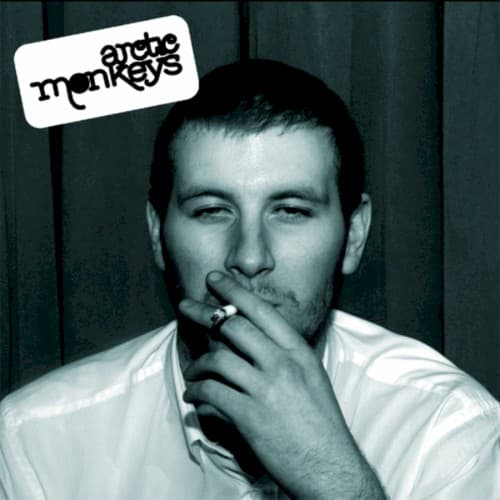
From Digital Natives to Rock's Shape-Shifters
Arctic Monkeys arrived in 2005 not through traditional industry channels but via burned CDs and MySpace file-sharing, a grassroots digital wave that made them the first band whose internet fanbase forced the music business to pay attention. Four teenagers from High Green, Sheffield — Alex Turner, Jamie Cook, Matt Helders, and Andy Nicholson (later replaced by Nick O'Malley) — built their reputation in northern England's working men's clubs before their demo tracks spread online without label support or mainstream radio play. Their rise rewrote the promotional playbook at precisely the moment when social media was beginning to erode traditional A&R power.
What set them apart wasn't just the distribution method but the specificity of Turner's observational songwriting: kitchen-sink realism delivered with Northern wit, documenting taxi queues, last-minute club entries, and the gap between teenage bravado and actual experience. They emerged during the mid-2000s indie landfill era but transcended it immediately, selling over 360,000 copies of their debut album in its first week — a UK record that still stands. More crucially, they've refused to repeat themselves across two decades, shape-shifting from garage-rock documentarians into lounge-inflected experimentalists, maintaining commercial viability while continually alienating portions of their audience through deliberate reinvention.
Their significance extends beyond sales figures or streaming dominance. Arctic Monkeys demonstrated that a band could bypass industry gatekeepers entirely, build a devoted following through peer-to-peer distribution, then leverage that fanbase into mainstream success without compromise. They became the template for artist-fan relationships in the digital age, proving that authenticity and commercial success weren't mutually exclusive if you controlled your own narrative from the beginning.
Sonic Restlessness and the Refusal of Formula
The band's musical identity has fractured across distinct eras, each phase a deliberate negation of what preceded it. Early Arctic Monkeys operated within post-punk revival frameworks — tightly wound guitars, motorik drumming, Turner's rapid-fire Yorkshire delivery turning mundane observations into kinetic narratives. Producer Jim Abbiss captured the rawness of their live energy on Whatever People Say I Am, That's What I'm Not, preserving the sweat-soaked urgency of their club performances while tightening the arrangements just enough for radio play. The production was deliberately lo-fi by major-label standards, guitars competing for frequency space, Helders' drums pushed forward in the mix to drive the relentless tempo.
By their third album, Humbug (2009), they'd abandoned the winning formula entirely. Recording in the Mojave Desert with Queens of the Stone Age's Josh Homme, they introduced darker textures, slower tempos, and psychedelic flourishes that alienated fans expecting Another Whatever People Say. The guitars grew thicker, more distorted, the arrangements sparser and more menacing. AM (2013) refined this evolution into streamlined rock-hop grooves, incorporating R&B rhythms and hip-hop production techniques beneath Turner's increasingly stylized vocal delivery — falsetto flourishes, affected crooning that split critical opinion.
Their most recent work has embraced lounge-jazz affectations, Badalamenti-esque orchestrations, and prog-rock complexity that seems designed to frustrate casual listeners. Turner's lyrics have moved from documentary realism to surrealist abstraction, his delivery from naturalistic to theatrical. The sonic through-line isn't consistency but curiosity — a restless intelligence that treats each album as a self-contained aesthetic statement rather than a chapter in a predictable discography. They've systematically dismantled every expectation, using their commercial capital to fund increasingly uncommercial experiments.
The Arc from Dancefloor Observers to Conceptual Auteurs
The band formed in 2002 when the members were barely teenagers, learning instruments together and playing covers before Turner's songwriting developed quickly enough to fill setlists with originals. Their first gigs in Sheffield venues like The Grapes and Boardwalk built a local following, but the national breakthrough came through accidental distribution — fans burned demos and uploaded tracks without the band's active participation. By the time labels came calling, Arctic Monkeys had already cultivated an audience that viewed them as authentically independent, unbeholden to industry machinery.
Whatever People Say I Am, That's What I'm Not became the fastest-selling debut in British history, its success built on specificity rather than universality. Songs like "I Bet You Look Good on the Dancefloor" and "When the Sun Goes Down" captured particular moments in British youth culture with documentary precision — the former's garage-rock urgency soundtracking indie disco nights, the latter addressing street prostitution in Sheffield with uncomfortable directness. Turner was nineteen when he wrote these observations, his youth lending credibility that older songwriters attempting similar social commentary couldn't match. The album's success established them as spokespeople for a generation, a role they immediately began resisting.
Favourite Worst Nightmare (2007) refined rather than redefined their sound, but even this consolidation felt purposeful — proving the debut wasn't a fluke while buying time to plan their escape from expectations. Humbug's sharp left turn into desert rock and psychedelia confused the mainstream audience but expanded their creative palette. If the first two albums documented Sheffield's nightlife, Humbug abandoned that reportage for impressionistic mood-building, songs like "Crying Lightning" and "Cornerstone" introducing ambiguity where earlier work had offered clarity.
Suck It and See (2011) softened some of Humbug's edges without retreating to the debut's formula, balancing accessibility with the newly expanded sonic range. But AM (2013) became their second commercial peak, unexpectedly bridging indie credibility with pop ubiquity. "Do I Wanna Know?" and "R U Mine?" found enormous streaming success by grafting rock instrumentation onto R&B rhythms, Turner's falsetto and the songs' patient builds creating earworms that worked equally well in stadiums and on radio playlists. The album's retro-futuristic aesthetic — visually and sonically referencing 1970s rock while incorporating contemporary production — made Arctic Monkeys festival headliners capable of drawing audiences beyond indie rock's core demographic.
Then came Tranquility Base Hotel & Casino (2018), their most polarizing statement. Abandoning guitars almost entirely in favor of Wurlitzer organs, string arrangements, and lounge-jazz atmospherics, the album unfolded as a conceptual suite about a lunar resort, Turner's lyrics dense with satirical commentary on technology, consumerism, and fame itself. Critics split between celebrating their ambition and mourning the loss of their visceral energy. The album's commercial performance fell short of AM's heights but remained substantial, proof that their fanbase would follow them into increasingly esoteric territory. The Car (2022) continued this trajectory, embracing orchestral arrangements and prog-rock complexity that completed their transformation from scrappy indie outfit to sophisticated art-rock proposition.
Redefining Artist Autonomy in the Streaming Era
Arctic Monkeys proved that the internet could democratize music distribution without sacrificing artistic integrity or commercial viability. Their 2005-2006 breakthrough predated Spotify, streaming culture, and the full dominance of social media, yet their rise demonstrated principles that became standard: build your audience directly, maintain creative control, let the music spread organically. Every bedroom-produced artist who bypasses labels and cultivates followers through SoundCloud, Bandcamp, or TikTok operates in a landscape Arctic Monkeys helped normalize.
Their influence on British guitar music is simultaneously obvious and complicated. They inspired countless imitators trying to replicate Whatever People Say's observational specificity and Northern character studies, spawning a micro-genre of indie bands fixated on regional accents and mundane narrative detail. But Arctic Monkeys themselves abandoned that template so quickly that followers were left mining a sound the originators had already rejected. Their more significant legacy might be the permission they granted for continual reinvention — demonstrating that a band could maintain commercial relevance while refusing to become a heritage act performing their greatest hits on autopilot.
Culturally, they occupy a strange position: simultaneously one of the last guitar bands to achieve genuine mainstream penetration and a group whose experimental tendencies place them outside mainstream rock radio entirely. They headlined Glastonbury multiple times, yet their recent output challenges festival crowds expecting singalong anthems. This tension — between their commercial scale and their artistic restlessness — makes them uniquely positioned in contemporary rock, proving that popular success and creative ambition can coexist if you're willing to risk alienating portions of your audience with each new phase. They remain a litmus test: casual listeners know AM and the early singles; devoted followers defend Tranquility Base as their masterpiece. Both camps are correct, which is precisely the point.