
How Four RISD Students Turned Anxiety Into Art Rock's Most Radical Experiment
When Talking Heads took the CBGB stage in 1975, they looked like they'd wandered into the wrong venue. While peers thrashed through three-chord fury, David Byrne, Tina Weymouth, Chris Frantz, and Jerry Harrison dissected rock with surgical precision, turning nervous energy and intellectual curiosity into a new language. Formed at the Rhode Island School of Design in 1973 before relocating to New York's downtown scene, the band approached rock as conceptual art—something to be deconstructed, reimagined, and rebuilt from unexpected components.
Their trajectory from 1977's jittery debut through 1988's pop-oriented swan song traced rock's transformation from punk minimalism to global fusion. Talking Heads didn't just ride new wave—they defined its cerebral edge, proving that dance music could engage the mind as vigorously as the body. Where punk sought raw emotion, Talking Heads pursued calculated deconstruction. Byrne's twitchy vocals and oblique lyrics transformed mundane observations into existential inquiries, while the rhythm section borrowed from funk, Afrobeat, and disco without irony or pastiche.
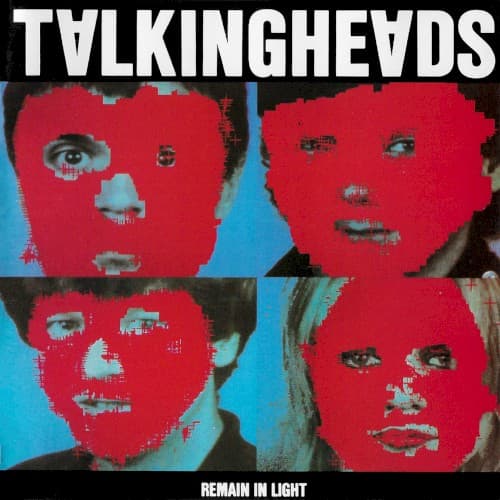
Their commercial peak coincided with their most experimental phase. Working with producer Brian Eno, they created dense polyrhythmic landscapes that shouldn't have worked on radio but did. They shot concert films that became art-house classics, designed album covers that doubled as visual manifestos, and performed in oversized suits that turned stage presence into performance art. By the time they dissolved in 1991, Talking Heads had demonstrated that intelligence and accessibility weren't opposing forces but complementary ones.
Nervous Systems: The Architecture of Talking Heads' Sound
Talking Heads built their sonic identity on controlled tension. Early recordings stripped rock to its skeletal frame—Byrne's jagged guitar lines, Frantz's metronomic drums, Weymouth's melodic bass that often carried more hook than the vocal line. Songs like "Psycho Killer" weaponized awkwardness, turning social discomfort into rhythmic propulsion. This wasn't the raw power of punk but something more unsettling: the sound of overthinking set to a backbeat.
The Eno collaboration fundamentally rewired their approach. Starting with 1978's More Songs About Buildings and Food and culminating in Remain in Light, the band absorbed African polyrhythms, funk's syncopated basslines, and ambient music's textural depth. They stopped writing songs in traditional verse-chorus structures, instead building tracks through loops, repetition, and gradual accumulation. Byrne's vocals became one element in a larger percussive system rather than the focal point. Guitar and bass interlocked with multiple keyboard layers and auxiliary percussion, creating cyclical grooves that felt both mechanical and organic.
What made this fusion work was the band's refusal to treat non-Western influences as exotic decoration. They studied Fela Kuti's rhythmic mathematics, absorbed the structural logic of Afrobeat's extended vamps, and applied those principles to their own neurotic energy. The result was music that sounded like New York—polyglot, densely layered, slightly paranoid—but moved like Lagos. Production choices emphasized space and separation; each instrument occupied its own frequency band, allowing complex arrangements to remain transparent. By Speaking in Tongues (1983), they'd learned to make avant-garde techniques sound like pop hits, a trick few bands before or since have managed.
From Art-Punk Minimalism to Stadium-Ready Afrobeat: Talking Heads' Evolution
The band's first two albums, Talking Heads: 77 and More Songs About Buildings and Food, established their intellectual credentials while revealing their pop instincts. "Psycho Killer" became an unlikely underground hit, its French-language bridge and neurotic protagonist capturing punk's alienation through an art-school lens. But it was the decision to bring in Brian Eno—then fresh from David Bowie's Berlin trilogy—that unlocked their full potential. Eno understood that Talking Heads' rhythmic foundation could support far more ambitious structures than conventional rock allowed.
Fear of Music (1979) marked the transition. Songs like "Life During Wartime" and "Mind" replaced guitars with clattering percussion and anxious keyboard stabs, while "Heaven" proved they could do minimalist beauty as effectively as nervous energy. The album sounded like it was recorded in a bunker during some unnamed crisis, which was precisely its appeal. Critics heard Brian Eno's influence; listeners heard rock music grappling with modern anxiety in real time.
Then came Remain in Light in 1980, the album that redefined what rock bands could attempt. Recorded with an expanded ensemble including guitarist Adrian Belew and additional percussionists, it was less a collection of songs than a suite of interlocking grooves. "Once in a Lifetime" became their signature track almost by accident—its stream-of-consciousness lyrics and Byrne's herky-jerky performance on the accompanying video captured something essential about middle-class existential dread. "Born Under Punches" and "The Great Curve" pushed even further, building entire compositions from single rhythmic cells that mutated across five or six minutes.
The album's recording process nearly destroyed the band. Creative tensions between Byrne and the rhythm section erupted over credit attribution and musical direction. A planned tour was cancelled. When they reconvened for Speaking in Tongues (1983), they'd stepped back from the experimental edge just enough to create their most commercially successful work. "Burning Down the House" gave them an MTV staple, while retaining enough rhythmic complexity to satisfy longtime fans. The subsequent concert film Stop Making Sense, directed by Jonathan Demme, captured the band at their performing peak—Byrne in his famous big suit, the stage gradually filling with musicians and equipment, the songs building from solo acoustic anxiety to full-band groove architecture.
Later albums revealed the limitations of the formula. Little Creatures (1985) and True Stories (1986) leaned toward Americana and straightforward song structures, which made them accessible but less distinctive. Naked (1988) attempted to recapture the adventurous spirit of their Eno period, incorporating Latin percussion and returning to collaborative grooves, but it felt like a band looking backward rather than forward. By then, Byrne's solo career was pulling him toward multimedia projects and world music collaborations that didn't require group consensus.
The breakup was gradual and bitter. Byrne announced the band was on "hiatus" in 1988; the remaining members released one album as The Heads in 1996, making the split permanent. Legal disputes over the band name and legacy dragged on for years. When they finally reunited for a single performance at their Rock and Roll Hall of Fame induction in 2002, it felt less like reconciliation than acknowledgment of what they'd accomplished despite themselves.
Rewiring Rock's Cultural Circuitry: Talking Heads' Lasting Impact
Talking Heads proved that rock could assimilate global influences without resorting to tourism or appropriation. Their approach to African rhythms—scholarly, respectful, transformative—established a template that artists from Vampire Weekend to Radiohead would follow. They demonstrated that polyrhythmic complexity and pop accessibility weren't mutually exclusive, that songs built on interlocking loops rather than chord changes could still connect emotionally.
Their influence operates on multiple levels. Musically, the Eno-era albums became foundational texts for post-punk, art rock, and indie's more adventurous edges. LCD Soundsystem built their entire aesthetic on the tension between Talking Heads' nervous energy and disco's release. TV on the Radio, Yeah Yeah Yeahs, and dozens of Brooklyn bands in the 2000s revival drew directly from the Heads' playbook: rhythm-first construction, oblique lyrics, art-school conceptualism grounded in danceable grooves. Even electronic producers cite Remain in Light's production techniques—the layered loops, the way rhythmic elements phase in and out—as pioneering work in arrangement as composition.
Culturally, they expanded rock's acceptable vocabulary. Byrne's performance style—deliberately awkward, intellectually engaged, physically unconventional—gave permission to be weird on mainstream stages. Stop Making Sense remains the gold standard for concert films precisely because it understood performance as theatrical construction rather than documentary capture. The band's visual aesthetic, particularly their collaborations with graphic designers and video directors, established that rock bands could engage seriously with visual art without abandoning pop ambitions. They were among the first to treat music video as art form rather than promotional tool, working with directors who understood that MTV could be an experimental platform.
Their legacy includes the uncomfortable truth that brilliant music doesn't require interpersonal harmony. The creative tension that produced their best work also made continued collaboration impossible. Unlike The Beatles' mythology of collective genius, Talking Heads remind us that some artistic partnerships function best under stress, that the friction between individual visions can generate more heat than comfortable collaboration. David Byrne's solo career explored the world music territories the band had mapped; Weymouth and Frantz's Tom Tom Club pursued pure pop pleasure. Neither fully recaptured what the four of them achieved together, which only reinforces the original achievement's singularity.