The scorecard
8.7/10 · Essential
- Songwriting25%
- 8.5
- Production25%
- 9.5
- Performance15%
- 8.0
- Cohesion15%
- 8.0
- Originality10%
- 9.0
- Replay value10%
- 8.5
Stream of consciousness lyrics driven by rhythm rather than narrative create a purposeful disorientation that matches the polyrhythmic grooves, though the detached delivery sometimes trades meaning for atmosphere.
Brian Eno's loop-based process and the Lexicon 224 reverb create a dense, interlocking sound where every percussion hit and guitar texture occupies its own space without clutter, making funk precision sound alien.
Byrne's vocal approach shifts from anxious yelp to preacher cadence, supported by Nona Hendryx's backing layers, but the performance serves the rhythmic machinery more than it commands attention on its own.
The first half builds intensity through three extended rhythmic workouts, but the second side's shift to introspection creates a deliberate sag that never fully recovers the momentum.
The album brought Afrobeat polyrhythms into post-punk without pastiche by treating the band as human samplers, creating a template for art rock's engagement with non-Western music that avoided mere appropriation.
The grooves lock in harder on repeat as the individual layers emerge from the mix, though the conceptual density and detached vocals make it demanding rather than immediately pleasurable.
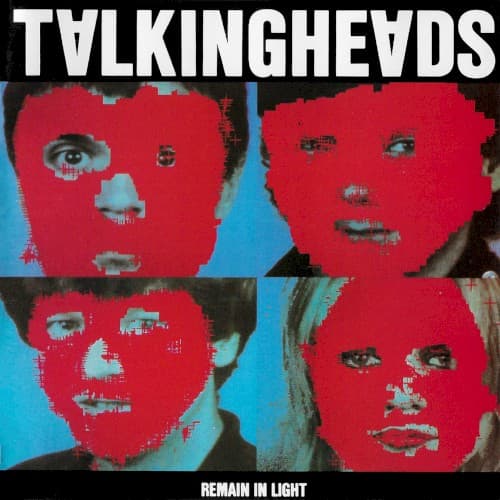
Talking Heads Remain in Light — The Groove as Generator, Not Decoration
The claim Talking Heads make on Remain in Light is that funk rhythm can power art rock without either the irony or the jamming. Most punk-descended bands that turned to funk in 1980 treated the groove as a device, something to drop in for contrast or to prove range. Here the groove is the structure. David Byrne, Jerry Harrison, Tina Weymouth and Chris Frantz, working again with Brian Eno, built eight tracks by looping instrumental jams until patterns locked, then stacked more loops on top. The result plays like precision engineering that never sits still, polyrhythms clicking into place while Adrian Belew's guitar skids across them and Byrne rants about autopilot lives and government hands. It earned a place in the National Recording Registry not because it smoothed over post-punk's jagged edges but because it proved the edge could be rhythmic instead of loud.
The stakes were whether a band that made its name on neurotic minimalism could absorb Fela Kuti's Afrobeat without turning into tourists. Talking Heads had been tightening the groove since More Songs About Buildings and Food, but Remain in Light goes further by surrendering the verse-chorus-verse anchor entirely. Most of these tracks work on one chord, the movement coming from counter-melodies and percussion layers rather than harmonic shifts. That choice makes the album more radical than its reputation as a crossover success suggests. The songs do not resolve so much as they stop, and Byrne's stream of consciousness lyrics, influenced by early rap and African ethnomusicology, refuse to cohere into statements. The method risks monotony, and on the second side it occasionally succumbs, but when the loops interlock the album makes a case for rhythm as the organizing principle instead of melody or words.
Loops, Layers and the Limits of the One-Chord Groove
The production is the argument. Brian Eno set up the Compass Point sessions in the Bahamas to run on instinct and spontaneity, the band recording instrumental sections as long loops without a clear sense of where the final songs would land. Rhett Davies quit partway through because Eno pushed for speed over precision, and the engineer who replaced him, Steven Stanley, brought in a Lexicon 224 digital reverb unit, one of the first in commercial use, that gives the album its spatial depth. Every drum hit and bass note occupies a distinct pocket in the mix, the polyrhythms stacking without turning to mud.
The result is funk architecture: tight, methodical, and more concerned with how the parts fit than with whether any single part grabs you. When Byrne says the band were human samplers, working before computers could loop reliably, he describes both the process and the sound. The loops do not swing or breathe the way a live funk band would; they tick forward with a mechanized drive that makes the Afrobeat influence feel less like homage and more like rewiring.
The songwriting, such as it is, depends on whether you consider a locked groove with a vocal part on top a song. Most of these tracks were conceived as single-chord jams, the band isolating the best eight or sixteen bar sections and layering them into compositions. That method works best on the opening trio, where the density and forward drive justify the extended length. It works less well when the album shifts to introspection on the second side, where the lack of harmonic movement can feel like treading water.
Adrian Belew's guitar solos, recorded in a single day, provide the closest thing to melodic release. His work uses delay, distortion and flanger to create textures that arc over the rhythm section's grid, but the solos are more about colour than development. They add tension without resolving it, which fits the album's refusal to offer easy payoffs but also means the longer tracks can feel like exercises in how much repetition a listener will tolerate.
Byrne struggled with writer's block during the sessions and ended up improvising vocals over rough mixes on a cassette recorder, a scattered style he borrowed from early rap and from his reading on African drum language. The lyrics that resulted, stream of consciousness fragments about unconscious lives and invisible forces, match the rhythmic dislocation but rarely cohere into meaning. When he shouts or rants, the words function more as percussive elements than as statements, which is the point but also a limitation. The album works hardest when Byrne adopts a preacher cadence, where the diatribe about waking up in a life you do not remember choosing lands because the repetition and the call-and-response structure give it shape. Elsewhere the detachment that makes the album feel visionary also keeps it at arm's length, the vocals serving the grooves rather than driving them.
Front-Loaded Momentum and a Second Side That Never Catches Up
The album peaks in its first stretch and never recovers that intensity. The opening run locks into extended rhythmic workouts that build through layering rather than variation, each adding guitar, keyboards, percussion and brass until the grooves feel overstuffed but still precise. The sequencing makes sense as a statement of intent, three dense polyrhythmic pieces that establish what the album can do, but it also means the remaining tracks play as a long comedown. The middle section shifts the energy from manic to hypnotic, with preacher delivery and melodic lift giving it a centre of gravity the surrounding tracks lack.
After that the album sags. The back half has brass and solid grooves but no real hooks, a spoken word piece over minimal backing, and closing stretches that extend to nearly eleven minutes combined without the rhythmic invention to justify the length. The introspection is deliberate, a shift from external groove to internal monologue, but the lack of harmonic development makes the pacing feel inert rather than contemplative. The final track ends with industrial clang and a slower tempo, clearly aiming for a closing statement, but after forty minutes of polyrhythmic density a six-and-a-half-minute trudge feels like a concession that the band ran out of ideas. The album would have been stronger at six tracks, cutting the spoken piece and the closer entirely and letting the penultimate track end on a quieter note. As it stands, the sequencing front-loads the excitement and asks the listener to stick with a second half that does not earn its length.
Essential for What It Proved, Not for How It Plays Straight Through
Remain in Light ranks as the most important Talking Heads album because it proved post-punk could absorb non-Western rhythm without collapsing into either world music pastiche or jam band sprawl. The loop-based production and single-chord grooves created a template for how art rock bands would engage with funk and Afrobeat for the next two decades, and the album's influence on everything from LCD Soundsystem to Radiohead's Kid A is audible in the priority it gives to texture and rhythm over melody and verse structure. That historical significance is deserved. Whether the album plays as well today as its reputation suggests depends on your tolerance for conceptual density and repetition. The first side is extraordinary, three tracks that lock into grooves so intricate they reveal new layers on every listen. The second side is half filler, well-intentioned but saggy, and the detached vocal style that makes the album feel visionary also makes it hard to love.
This is the starting point for listeners interested in Talking Heads' move away from neurotic minimalism and toward rhythmic complexity, but it is not an easy entry. The grooves do not swing and the lyrics do not resolve, which means the album rewards attention more than it provides pleasure. Start with "Crosseyed and Painless" and "Once in a Lifetime", the two tracks that balance the polyrhythmic ambition with something approaching a hook, then decide whether the rest justifies the homework. For a more immediate version of the band's funk experiments, Fear of Music offers similar ideas with tighter songs. For the Afrobeat influence without the art rock detachment, go straight to Fela Kuti's Afrodisiac, the album Talking Heads used as a template. Remain in Light is essential because of what it opened up for other bands, but it is not the most pleasurable record in the catalog it launched.
Track by track
Track Listing
Born Under Punches (The Heat Goes On)
StandoutThe album opens with its thesis: rhythm as structure, not decoration. The track builds from a single bass and drum loop, adding keyboards, percussion, guitar and vocals in layers that interlock without ever shifting harmony. Byrne's vocal, shouted and half-sung, borrows the cadence of preaching and ranting, the line about government hands rewriting a lyric from the band's 1977 debut. The guitar solo, often credited to Adrian Belew, is actually Byrne manipulating a digital delay unit, the sound skittering across the groove without breaking it. At nearly six minutes the track earns its length through density rather than development, each new layer adding texture without clutter. The Heat Goes On refrain, borrowed from a New York Post headline, functions as a rhythmic anchor rather than a hook, which captures both the album's ambition and its refusal to offer easy pleasures. This is the sound of a band that decided the groove could carry the entire song, and for five minutes and forty-nine seconds it does.
Crosseyed and Painless
StandoutThe album's tightest fusion of polyrhythm and something resembling a pop structure. The track locks into a bass and drum pattern that clicks forward without variation, Belew's guitar solo adding arcing textures over the grid, while Byrne rants about facts in a delivery influenced by Kurtis Blow's early rap. The rhythmical rant, shouted rather than sung, works because the repetition and call-and-response give it shape, the words functioning as percussion but also landing as a statement about how information overwhelms meaning. The groove is relentless, the layers stacking without turning to mud, and the track ends after four minutes and forty-eight seconds before the one-chord structure turns monotonous. This is the clearest example of what the album does well: taking a single idea and locking it in so tightly that the lack of harmonic movement feels like precision rather than limitation.
The Great Curve
SolidThe longest and densest track on the first side, built around Belew's extended guitar solos and a lyric about the world moving on a woman's hips, borrowed from a book on African art. The groove is the most overtly Afrobeat-influenced on the album, polyrhythmic layers of bass, drums, keyboards and percussion stacking until the mix feels overstuffed but still controlled. Belew recorded his solos using distortion, preamp, equalizer and flanger, the sound bending and arcing over the rhythm section's grid without breaking the lock. At six minutes and twenty-eight seconds the track pushes the one-chord method to its limit, the density justifying the length but also making the repetition feel like an endurance test. The vocal is more chant than melody, Byrne and Nona Hendryx layering lines that function as texture rather than statement. This is the album's most ambitious rhythmic construction, but it is also where the lack of harmonic development starts to feel like a choice that boxes the band in rather than freeing them.
Once in a Lifetime
StandoutThe album's most famous track and its most accessible, built around two alternating eight-bar riffs and a preacher cadence borrowed from early rap and evangelical diatribes. The vocal delivery, call-and-response and repetitive, gives the track a centre of gravity the surrounding songs lack, the line about waking up in a life you do not remember choosing landing because the structure supports it rather than scattering it across the groove. The music borrows from the Velvet Underground, a hypnotic pulse that shifts between two riffs without ever resolving, and the track works because the repetition feels purposeful rather than arbitrary. Byrne has said the lyrics are meant literally, a statement about unconscious lives, and the preacher delivery makes the point without turning it into a slogan. At four minutes and nineteen seconds the track is the album's tightest and most replayable, the one song that balances the polyrhythmic ambition with something approaching a hook. This is the entry point for listeners who find the rest of the album too dense or detached.
Houses in Motion
SolidA solid groove with Jon Hassell's brass adding melodic texture, but the track lacks the rhythmic invention of the first side or the focus of "Once in a Lifetime". The one-chord structure works well enough when the layers are dense, but here the relative sparseness makes the lack of harmonic movement feel like stasis rather than hypnotic drive. Hassell's trumpet lines, recorded as overdubs after the instrumental tracks were complete, provide the closest thing to a melodic hook, but the lines float over the groove without anchoring it. At four minutes and thirty-three seconds the track does not overstay its welcome, but it also does not justify its place in the sequence. This is competent work that would stand out on a lesser album but here plays as filler between the peaks.
Seen and Not Seen
WeakA spoken word piece over minimal backing, Byrne delivering a monologue about self-image and transformation in a flat, detached tone. The track has no groove to speak of, just a sparse keyboard figure and occasional percussion, and at three minutes and twenty-five seconds it functions more as an interlude than a song. The concept is interesting, a meditation on how people reshape themselves to match an imagined ideal, but the execution is too slight to support the idea. This is the album's weakest track, an experiment that might have worked as a brief bridge between songs but instead breaks the momentum entirely. Skip it.
Listening Wind
StandoutThe second side's most fully realized track, with Belew's guitar adding textural content via delay and volume swells while the rhythm section locks into a groove influenced by Arabic music. The lyrics, which sympathetically portray an anti-American terrorist, are the album's most narrative and most politically risky, Byrne describing the character's motivations without endorsing or condemning them. The track works because the groove has enough forward drive to support the four-minute-forty-three-second length, and because the vocal delivery, more sung than shouted, gives the words space to land. Belew's guitar, bending the sound up and down while working the delay and volume control, provides the melodic tension the one-chord structure cannot, and the track ends on a note of unresolved ambiguity that fits the subject matter. This is the second side's only track that feels essential rather than conceptual.
The Overload
WeakThe album's closing track, a six-and-a-half-minute trudge with industrial beats and Belew's atmospheric guitar, clearly aiming for a grand statement but landing as an endurance test. The tempo is slower than anything else on the album, the rhythm section's tribal-cum-industrial clang replacing the polyrhythmic precision of the first side with a one-dimensional pound. The track was conceived as a homage to Joy Division, a band Talking Heads had not actually heard, and the attempt to evoke post-punk gloom without understanding the source material results in a sketch rather than a song. At six minutes and twenty-five seconds the track overstays its welcome by at least three minutes, the lack of harmonic or rhythmic development making the repetition feel arbitrary rather than hypnotic. This is the album's most obvious misstep, a closing track that saps the momentum rather than providing resolution. The album would have been stronger ending with "Listening Wind".