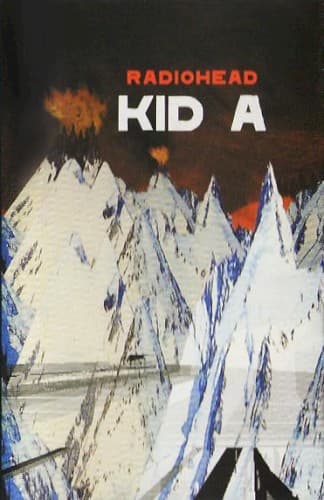
The scorecard
9.0/10 · Essential
- Songwriting25%
- 9.0
- Production25%
- 9.5
- Performance15%
- 8.5
- Cohesion15%
- 9.0
- Originality10%
- 9.0
- Replay value10%
- 8.5
Songs abandon verse-chorus structure for texture and space, from the Piano Etude-like opening to the collaged mantra of Morning Bell, with enough melodic anchors to survive repeated listens.
Godrich and the band turn a barn in Oxfordshire into a laboratory: Prophet-5 synths scrubbed in Pro Tools, ondes Martenot ring-modulated, guitar loops digitally processed into ambient beds, brass sections recorded like traffic jams.
Yorke treats his voice as texture rather than narrative voice, vocoded and processed and half-buried, while the rhythm section learns to serve sequences and loops instead of leading them.
Ten tracks sequenced to feel inevitable, opening with synthesiser and ending with pedal organ, the ambient interlude Treefingers placed exactly where the listener needs to exhale.
A guitar band walks away from guitar rock in 2000 when that move still carried risk, incorporating Warp IDM and Krautrock and Mingus into something no peer was attempting.
The album that divided listeners on arrival has settled into a document of what a rock band could become when it stopped trying to be a rock band, with enough detail to justify the next hundred listens.
Radiohead Kid A — The Album That Walked Away From Rock
Kid A opens with Thom Yorke alone at a Prophet-5 synthesiser, playing block chords and singing about being unable to speak, and in four minutes the thesis is stated: Radiohead would not repeat themselves. The album that followed OK Computer could have been OK Computer louder, or OK Computer with strings, or OK Computer stripped to acoustic guitars and regret. Instead Yorke bought a house in Cornwall, stopped writing on guitar, and decided melody embarrassed him. The rest of the band considered quitting. The result divided critics and fans in 2000, some hearing pretension and others hearing a band that understood the difference between ambition and safety.
The stakes were never just musical. After OK Computer made Radiohead the biggest guitar band in the world, Yorke suffered writer's block and burnout and watched imitators sell the sound back to him. He spent a year listening to Aphex Twin and Autechre, reading about Penderecki and Messiaen, and walking cliffs in Cornwall until he wrote a song on piano. The album that followed used modular synthesisers, ondes Martenot, Pro Tools, and a year of tense studio sessions in Paris, Copenhagen and Gloucestershire where the band came close to breaking up. The question was whether a guitar band could absorb Warp IDM, Krautrock, Mingus and Beta Band without becoming a pastiche. The answer is here in the grooves, recorded and sequenced with Nigel Godrich, who had to be convinced that abandoning the band's strength made sense.
Machines and Rooms
The production on Kid A is the argument made audible. Godrich and the band spent 18 months figuring out how to record electronic instruments collaboratively, and the album sounds like the process: loops and sequences layered with live playing, synthesisers scrubbed and manipulated in Pro Tools, vocals processed with ring modulators and vocoders. Everything in Its Right Place was recorded as a full-band arrangement in Copenhagen and Paris without results; in Gloucestershire, Yorke and Godrich transferred it to the Prophet-5 and built the song from two-handed chords and a vocal run through a scrubbing tool. The National Anthem started with a bassline Yorke wrote in school, layered with ondes Martenot and radio-static samples and a brass section recorded in November 1999 with instructions to sound like organised chaos, inspired by Charles Mingus. The result is a controlled mess: horns blaring over a locked groove, the arrangement wide enough that every element has space.
Jonny Greenwood wrote the string arrangement for How to Disappear Completely by multitracking his ondes Martenot, then handed the score to the Orchestra of St John's, who laughed because it was impossible. They recorded it anyway in a 12th-century church five miles from the Oxfordshire studio, and the performance has the grain of a room, strings bending and sliding around Yorke's vocal. Idioteque is the opposite approach: a drum machine pattern Greenwood made on a modular synthesiser, a sample from Paul Lansky's Mild und Leise, and 50 minutes of Greenwood's improvisation edited down to a short section by Yorke. The production captures the exploding-beat sound of a club PA loud enough to damage hearing, all treble and percussion and no bottom.
The album uses guitar on most tracks, but never as the lead instrument. Ed O'Brien ran his guitar through sustain units, loopers and delay pedals to create synthesiser-like textures; Treefingers is his guitar loops processed into an ambient wash, no playing audible. The sequencing balances the synthetic and the acoustic: the Prophet-5 that opens the album gives way to the pedal organ that closes it, inspired by Tom Waits and early Disney soundtracks. The weakness is that some of the experiments are more interesting than memorable: Treefingers serves as an interlude but offers nothing on repeat, and the title track's vocoder melody is a trick that does not develop.
How Ten Songs Become One Argument
The album is sequenced like a statement: open with the thesis, follow with proof, place the ambient interlude exactly where the listener needs to breathe, close with the song Yorke wrote before Creep. The opener had to come first, and the band knew it; once that was decided, the rest followed. The third and eighth tracks are the album's peaks, both built on locked grooves and both chaotic in different ways, placed far enough apart that the tension does not collapse. The fourth track is the only song that sounds like it could have appeared on OK Computer, arriving late enough that the album has made its case but early enough to remind the listener what the band left behind.
The pacing sags slightly in the second half. The seventh track is solid but neither as abrasive as what follows nor as melodic as what precedes it, and it arrives at a point where the album needs a peak. The ninth track is stronger, with its stop-start drums and its cut-up lyrics about parking the car and cutting the kids in half, but it cannot carry the weight of being the penultimate track. The closer earns its seven-minute runtime by building slowly, adding harp samples and double bass until the arrangement sounds like a lullaby, but the hidden track that follows adds nothing. The album would be tighter at 45 minutes instead of 50, but the length is not filler, just the sound of a band learning what it needs to say.
Where It Ranks and Who Should Start Here
Kid A sits just below OK Computer in the Radiohead catalog, and the gap is narrow. OK Computer is the more assured album, every song written to completion before the band entered the studio; Kid A is the more radical one, built from scraps and loops and sequences that Yorke assembled at random. The earlier album is the one to start with if you want to hear Radiohead as a guitar band at full strength. This one is the album that explains what came after: In Rainbows, The King of Limbs, A Moon Shaped Pool.
It is not a pleasant listen in the way OK Computer can be pleasant, and it will not reward listeners who want verse-chorus-verse and a hook they can sing. The album aged better than anyone expected in 2000. The electronic influences that sounded like a band chasing Warp and Autechre now sound like a band that understood where guitar rock was headed and walked away before the collapse. The vocal processing that sounded like affectation now sounds like a choice, Yorke using his voice as texture because the songs needed texture, not confession.
The fans who dismissed it as pretentious on release have mostly come around; the ones who still call it derivative have not explained what it derives from. Start with Everything in Its Right Place and Idioteque and How to Disappear Completely. If those three tracks work, the rest of the album will follow. If they do not, go back to The Bends and stay there. After Kid A, hear Amnesiac, the album built from the same sessions and released a year later, which is looser and weirder and proves the band was not done experimenting."}"standoutTracks":"The album is sequenced like a statement: open with the thesis, follow with proof, place the ambient interlude exactly where the listener needs to breathe, close with the song Yorke wrote before Creep. The opener had to come first, and the band knew it; once that was decided, the rest followed. The third and eighth tracks are the album's peaks, both built on locked grooves and both chaotic in different ways, placed far enough apart that the tension does not collapse. The fourth track is the only song that sounds like it could have appeared on OK Computer, arriving late enough that the album has made its case but early enough to remind the listener what the band left behind.
The pacing sags slightly in the second half. The seventh track is solid but neither as abrasive as what follows nor as melodic as what precedes it, and it arrives at a point where the album needs a peak. The ninth track is stronger, with its stop-start drums and its cut-up lyrics about parking the car and cutting the kids in half, but it cannot carry the weight of being the penultimate track. The closer earns its seven-minute runtime by building slowly, adding harp samples and double bass until the arrangement sounds like a lullaby, but the hidden track that follows adds nothing. The album would be tighter at 45 minutes instead of 50, but the length is not filler, just the sound of a band learning what it needs to say."}
Track by track
Track Listing
Everything in Its Right Place
StandoutYorke alone at a Prophet-5, playing two-handed block chords with the left hand sustaining and the right hand shifting, his vocal about depression and being unable to speak run through a Pro Tools scrubbing tool. The song was written first and became the template for the album: texture over melody, space over density, Yorke's voice as one instrument among several. The band tried recording it as a full arrangement in Copenhagen and Paris without success; in Gloucestershire, Yorke and Godrich stripped it to synthesiser and voice, and the decision unlocked the rest of the record. The production is stark, almost no reverb, the synth patches warm and analog. It is the thesis statement, and it works because the song is strong enough to carry the experiment.
Kid A
SolidYorke's vocal is vocoded with the ondes Martenot to create a melody that sounds like a machine singing, the rhythm built from drum machines and electronic percussion. The title came from a filename on one of Yorke's sequencers, and he liked the non-meaning. The track is more texture than song, and it functions as a bridge between the piano-based opener and the chaos that follows. The vocoder effect is striking on first listen but does not develop, and the track is the weakest of the album's first four.
The National Anthem
StandoutColin Greenwood's bassline was written when the band was in school, recorded with drums in 1997 as a potential B-side for OK Computer, then revisited for Kid A. Jonny Greenwood added ondes Martenot and radio-static samples, Yorke's vocal was ring-modulated, and in November 1999 the band recorded a brass section with instructions to sound like a traffic jam, inspired by Charles Mingus. The result is organised chaos: the bassline locked in a groove, the horns blaring and sliding over the top, the arrangement wide enough that nothing is buried. The production captures the feeling of a big band losing control, every horn player improvising at once, and it is one of the album's two peaks.
How to Disappear Completely
StandoutThe only track that could have appeared on OK Computer, and the only one built from acoustic instruments without electronic processing. Jonny Greenwood wrote the string arrangement by multitracking his ondes Martenot, then handed the score to the Orchestra of St John's, who recorded it in Dorchester Abbey, a 12th-century church near the Oxfordshire studio. The strings slide and bend around Yorke's vocal, which repeats the refrain Michael Stipe gave him to relieve tour stress: I'm not here, this isn't happening. The performance has the grain of a room, and the arrangement builds slowly, adding strings in layers until the song feels like it is dissolving. It is the album's most melodic track, and it arrives at the exact moment the listener needs a melody.
Treefingers
SolidAn ambient interlude made by digitally processing Ed O'Brien's guitar loops, no playing audible. The track serves as a palate cleanser between the melodic first half and the rhythmic second half, and it succeeds as sequencing. As a standalone piece it offers nothing on repeat: no development, no tension, just two minutes of processed guitar wash.
Optimistic
SolidThe most straightforward rock song on the album, built on a guitar riff and a steady drum pattern, with Yorke's vocal relatively untreated. The refrain—try the best you can, the best you can is good enough—came from Yorke's partner Rachel Owen when Yorke was frustrated with the band's progress, and the lyric functions as reassurance. The production is clean, the arrangement open, and the track proves the band did not abandon traditional songwriting entirely. It is solid but not essential, and it works better as a breather between the ambient interlude and the more experimental second half than as a peak.
In Limbo
SolidA mid-tempo track with treated guitars and a brushed-drum pattern, Yorke's vocal half-buried in the mix. The song has a hypnotic quality, the rhythm cycling without much variation, and the arrangement is sparse. It is neither as abrasive as Idioteque nor as melodic as Optimistic, and it arrives at a point where the album needs a peak. The track is not weak, but it is not strong enough to carry the weight of the second half, and it sags slightly.
Idioteque
StandoutBuilt from a drum machine pattern Jonny Greenwood made on a modular synthesiser, a sample from Paul Lansky's electronic composition Mild und Leise, and 50 minutes of Greenwood's improvisation edited down to a short section by Yorke. The production is all treble and percussion, no bottom, designed to capture the exploding-beat sound of a club PA loud enough to damage hearing. Yorke's vocal is panicked, the rhythm relentless, and the arrangement is dense without being cluttered. The track is the album's second peak, and it works because the rhythm is locked tight and the energy never drops. It is the clearest example of the band absorbing Warp IDM without becoming a pastiche.
Morning Bell
SolidA stop-start rhythm with cut-up lyrics about parking the car and cutting the kids in half, Yorke's vocal delivered in short phrases that do not connect. The song was assembled from fragments, and the production emphasises the disjunction: the rhythm hesitates, the vocal phrases are separated by silence, and the arrangement feels deliberately unfinished. The track is stronger than In Limbo, with more tension and a clearer sense of unease, but it cannot carry the weight of being the penultimate track. It is a solid closer to the body of the album, but it does not feel like a climax.
Motion Picture Soundtrack
StandoutYorke recorded the song on a pedal organ, influenced by Tom Waits, with harp samples and double bass added to emulate the soundtracks of 1950s Disney films. The song was written before Creep and recorded during the OK Computer sessions on piano; this version is slower and sadder, the arrangement building in layers until it sounds like a lullaby. The track earns its seven-minute runtime by taking its time, and the production is warm and analog, a deliberate contrast to the digital processing that dominates the rest of the album. The hidden track that follows at 4:18 adds nothing, and the 1:51 of silence before it is a miscalculation. The song itself is a strong closer, the album ending where it began: Yorke alone at a keyboard.