The scorecard
8.4/10 · Great
- Songwriting25%
- 9.0
- Production25%
- 8.5
- Performance15%
- 8.5
- Cohesion15%
- 7.5
- Originality10%
- 8.0
- Replay value10%
- 8.5
Songs discard conventional structures and embrace abrasive contrasts, from the Beatlesque calm of "Dumb" to the frenzied noise of "Milk It", with lyrics that move beyond teen angst into darker, more focused thematic territory.
Albini's raw, room-recorded approach captures the band as a live unit with spatial depth and natural reverb, refusing the polished compression of Nevermind in favor of a visceral sound that serves the songs' extremes.
Cobain's vocals range from whispered fragility on "All Apologies" to overtaking screams on "Rape Me", while Grohl's drums hit with acoustic force and the band locks in despite the deliberately sparse arrangements.
The album alternates between accessible singles and punishing noise with little middle ground, creating an uneven arc that reflects intentional extremes rather than careful sequencing, though the length is earned.
The album rejects the radio-ready template of Nevermind and pushes toward experimental noise rock territory occupied by Albini's previous work, advancing the band's sound without reinventing grunge itself.
The rawness that initially alienates reveals new details on repeat listens, from room ambience to vocal intensity, making it the kind of record that rewards rather than exhausts familiarity.
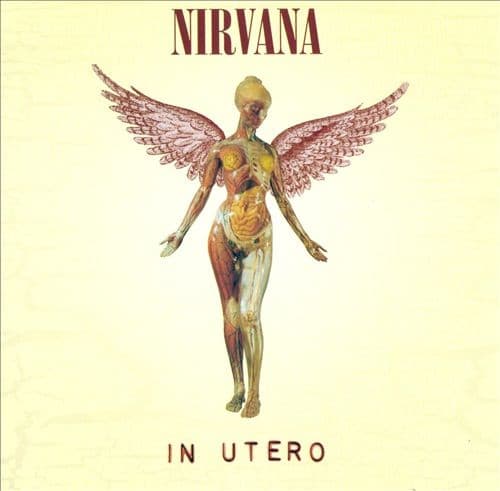
Nirvana In Utero — The Refusal That Became the Record
In Utero is what happens when a band decides commercial success is the problem to solve rather than the goal to repeat. Nirvana hired Steve Albini specifically to undo the polished sound of Nevermind, and the result is an album that weaponizes discomfort: spare drum recordings that capture room reverb instead of radio punch, vocals tracked dry and single-take in a resonant space, and songs that lurch between Beatlesque melody and abrasive noise with no interest in the middle ground. The thesis is in the choice of producer and the choice to release what he delivered with minimal compromise. This is the sound of a band that would rather lose half its audience than repeat the formula that made them unavoidable.
The stakes were higher than artistic credibility. Nevermind had made Nirvana the biggest rock band in the world by accident, and the follow-up would either validate that success or reveal it as a fluke. The record label wanted another Nevermind. Cobain wanted the opposite, and In Utero is the argument he won.
Albini recorded the band as a live unit in February 1993 at Pachyderm Studios in Minnesota, completing basic tracks in six days with a philosophy of minimal intervention. DGC balked at the rough mixes, calling the sound unlistenable and the songwriting weak. Nirvana eventually hired Scott Litt to remix the three most commercial tracks for single release, but the rest of the album remained as Albini delivered it: raw, spatial and deliberately unflattering to anyone expecting hooks wrapped in studio sheen. The album debuted at number one anyway, sold six million copies in the US, and remains the clearest document of what Nirvana sounded like as a working band rather than a radio phenomenon.
The Room as Instrument
Albini built In Utero around the idea that a good band in a good room needs no embellishment. He surrounded Dave Grohl's drum kit with thirty microphones to capture natural reverb instead of adding it artificially, and the result is a drum sound that breathes and decays rather than punches and compresses. The kit on "Tourette's" sounds like it is recorded in a kitchen because it was, and the space gives the short blast of aggression a resonance that a tight, dead-room recording would kill. The same principle applies to Cobain's vocals, which Albini refused to double-track.
On "Milk It", Cobain's voice is tracked so dry and so loud at the end that it overtakes the entire band, a moment of pure intensity that a standard mix would have tucked into balance. Albini treated the studio as documentation rather than construction, and the album sounds like three people playing together in real time because that is mostly what it is.
The songwriting moves in two directions at once. Tracks like "Heart-Shaped Box" and "All Apologies" are structured enough for radio and were remixed by Litt to make them more palatable, but even in their original form they are fully realized songs with clear verses, choruses and dynamics. The former builds tension through a quiet-loud structure that was already a Nirvana signature, while the latter pairs a lullaby melody with self-effacing lyrics that undercut any hint of grandiosity.
Then there are the noise tracks: "Scentless Apprentice", "Milk It", "Radio Friendly Unit Shifter". These are less interested in conventional hooks than in sustained dissonance and rhythmic punishment. "Scentless Apprentice", inspired by a novel about a perfumer's apprentice who murders women for their scent, locks into a grinding riff and stays there, with Cobain's vocal shifting between sung melody and guttural screams. "Very Ape" is less than two minutes of blunt-force punk with no bridge, no solo, no elaboration.
The band described "Gallons of Rubbing Alcohol Flow Through the Strip" as just messing around, and it sounds like it: six minutes of instrumental jam with disconnected vocal fragments and bursts of feedback.
Cobain worked on the lyrics throughout the recording process, and they are more direct than the impressionistic fragments of Nevermind. "Serve the Servants" opens with the line "Teenage angst has paid off well, now I'm bored and old", a blunt acknowledgment of the career trap Nirvana had entered. The song also addresses his father directly, dismissing the media narrative about his parents' divorce and stating plainly that he does not hate him but has no interest in contact. "Frances Farmer Will Have Her Revenge on Seattle" was inspired by a biography of the actress, and the title itself is a reaction to alternative rock bands using single-word names.
"Dumb" is the closest the album comes to tenderness, a slow, acoustic-driven ballad that Michael Azerrad described as Beatlesque, and it sits next to "Milk It" without any attempt to bridge the tonal gap. The sequencing reflects the internal conflict rather than resolving it.
The production dispute is part of the album's story but not its failure. Albini's original mixes were judged too raw by the label, and the band eventually brought in Litt to remix "Heart-Shaped Box", "All Apologies" and "Pennyroyal Tea". Albini was vocal in his disapproval, and he later said the final product did not sound much like the record he made.
The truth is that the Litt remixes are more listenable but not fundamentally different, and the rest of the album remained untouched. The dispute revealed how little common ground existed between what Nirvana wanted to make and what their label expected to sell, and the fact that the album succeeded commercially anyway is the point. In Utero is the sound of a band that got what it wanted and discovered that even that was not enough to escape the machinery of success.
The weakness is in the sequencing. The album alternates between accessible and abrasive without building momentum, and the lack of a middle ground means the flow is uneven. "Dumb" and "All Apologies" offer relief, but they are isolated moments rather than part of a coherent arc. The experimental tracks are necessary to the album's argument, but they are not all equally strong.
"Tourette's" is a minute and a half of shouting over a thrash riff with no development. "Radio Friendly Unit Shifter" earns its nearly five-minute runtime through sheer repetition, but it tests patience. The album is forty-one minutes long, and it feels longer because the extremes do not resolve into a unified statement. That may be intentional, but it is still a cost.
Noise and Lullabies Without a Bridge
In Utero does not build toward a climax or follow a narrative arc. It moves between poles, refusing to reconcile extremes. The pacing reflects the refusal to compromise rather than an inability to do so. The album opens with a mid-tempo track that establishes the tone as neither aggressive nor accessible, then immediately shifts into one of the noisiest songs on the record.
The sequencing makes no effort to ease the listener in, and the rest of the album follows the same logic: sharp contrasts with no transitions.
The peaks are the three tracks remixed for single release and the one that should have been. The most complete song on the record builds tension through dynamics and a central image disturbing enough to linger. The closing track offers resignation rather than triumph, a lullaby that refuses to provide comfort. The overlooked moment of beauty is a slow track driven by cello and acoustic guitar, and it works because it does not try to compete with the noise around it.
The sags are the tracks that commit to abrasiveness without the songwriting to justify the length. One five-minute piece is built on repetition, and the repetition does not reveal new layers so much as test endurance. The shortest burst of aggression is over quickly enough that it does not matter, but it also does not add much. The album is frontloaded with its strongest material, and the back half drags until the final track salvages the close.
The length is earned because the extremes are the point, but the record would be tighter at thirty-five minutes.
The Last Argument and the Last Record
In Utero is the better album and the worse record. It is better because it is more honest, more adventurous and more willing to fail than Nevermind, which succeeded by accident and has been overrated ever since. Nevermind captured a moment; In Utero captured a band. It is worse because it is harder to love, harder to return to, and harder to recommend without qualification.
The production is the album's greatest strength and its barrier to entry. Albini's sparse, room-recorded approach gives the songs spatial depth and raw power, but it also means the album sounds unfinished to ears trained on studio polish. The extremes are intentional, but they make for an uneven listen. This is not an album that builds goodwill through accessibility and then cashes it in on experimentation.
It front-loads the noise and dares you to stay.
In the catalog, In Utero ranks above Nevermind for ambition and honesty, but below it for songwriting consistency and replay value. Nevermind is the album that defined a genre; In Utero is the album that rejected the definition. Both are essential for different reasons. This one is for listeners who value the attempt over the result, the argument over the compromise, and the sound of a band deciding what it will not do.
It is not for casual fans or anyone looking for grunge's greatest hits. The singles are strong, but they are not the album, and the album is not the singles.
Start with "Heart-Shaped Box", "Dumb" and "All Apologies" to understand the range, then decide whether the noise tracks justify the full experience. If they do, the entire record rewards attention. If they do not, Nevermind is still there, and it still works. For what to hear next, Bleach is the obvious choice for listeners who want more raw Nirvana, while the Pixies' Surfer Rosa and PJ Harvey's Rid of Me show what Albini's production philosophy sounds like applied to other bands.
In Utero is the sound of a band that knew what it did not want to be and recorded that knowledge as clearly as possible. That it became a commercial success anyway is the final irony, and Cobain did not live long enough to see whether the irony was on him or on everyone else.
Track by track
Track Listing
Serve the Servants
SolidThe album opens with Cobain acknowledging the trap: "Teenage angst has paid off well, now I'm bored and old." The song is mid-tempo and direct, built on a simple riff that shifts into a louder chorus without much dynamic range. Lyrically, it is the most autobiographical moment on the record, dismissing the media's obsession with his parents' divorce and addressing his father with the line "I just want you to know that I don't hate you anymore." The guitar solo is brief and functional. The track sets the tone for the album as neither aggressive nor accessible, a statement of purpose delivered without enthusiasm.
Scentless Apprentice
StandoutWritten about a novel in which a perfumer's apprentice kills women to harvest their scent, the song locks into a grinding, dissonant riff and refuses to let go. Cobain's vocal alternates between sung melody and raw screaming, and the intensity builds through repetition rather than structure. Grohl's drums hit hard, recorded with enough room ambience to give the track spatial depth. The song is one of the noisiest on the record and one of the most effective at sustaining aggression without collapsing into formlessness. It is also exhausting, which is the point.
Heart‐Shaped Box
StandoutThe most complete song on the album and the most obvious single. The quiet-loud dynamic is familiar from Nevermind, but the production is rawer and the central image is darker: an umbilical noose, a plea to be eaten by cancer. The verse is restrained, the chorus explodes, and the structure is tight enough to work on radio despite the disturbing lyrics. Scott Litt's remix smoothed some of the rough edges for single release, but even in Albini's original mix the song is fully realized. The guitar solo is one of Cobain's most melodic, and the track holds up as one of the band's best.
Rape Me
StandoutA two-chord provocation that Cobain insisted was written before his public struggles with addiction, though the timing invites interpretation. The song is structurally similar to "Smells Like Teen Spirit" and lyrically blunt, with Cobain's vocal building from a whisper to a scream that overtakes the band at the end. Albini's production emphasizes the rawness of the performance, and the track works as both a middle finger to the media and a functional punk song. It is brief, direct and effective, though not as musically adventurous as the album's best moments.
Frances Farmer Will Have Her Revenge on Seattle
SolidNamed after a biography of the actress that Cobain read in high school, the song features one of the album's most memorable riffs and a structure that shifts between verse and chorus without much elaboration. The title is deliberately long, a reaction to alternative bands using single-word names, and the lyrics are more impressionistic than the album's other biographical tracks. The production captures the band as a live unit, with Grohl's drums hitting hard and Cobain's guitar cutting through the mix. The track is solid but not exceptional, a strong mid-album moment that does not reach the peaks of the singles.
Dumb
StandoutThe album's moment of tenderness, a slow ballad driven by cello and acoustic guitar that sits in stark contrast to the noise around it. Azerrad compared it to the Beatles, and the comparison is earned: the melody is simple and direct, the arrangement is spare, and the vocal is quiet and vulnerable. Lyrically, the song pairs self-deprecation with a refusal to elaborate, and the brevity keeps it from tipping into sentimentality. The track is one of the album's best and one of its least representative, a reminder that Nirvana could write a lullaby when they chose to.
Very Ape
SolidLess than two minutes of blunt-force punk with no bridge, no solo and no elaboration. The riff is simple, the tempo is fast, and the song ends before it has time to develop. Rolling Stone compared it to Los Brujos, and the comparison fits: this is garage punk recorded with room ambience and minimal production. The track works as a burst of aggression but does not justify repeated listens. Functional filler.
Milk It
StandoutOne of the most experimental and uncompromising tracks on the album, built on dissonance and repetition rather than conventional structure. Cobain described it as an example of the aggressive direction the band's music had been moving, and the lyrics are among the darkest on the record: "I am my own parasite" and "Her milk is my shit, my shit is her milk," merging themes of nurturance and disease in disturbing ways. Albini's production captures Cobain's vocal at the end as a dry, loud scream that overtakes the band, a moment of pure intensity that a standard mix would have buried. The track is difficult and rewards patience, though it tests the limits of how much noise the album can sustain.
Pennyroyal Tea
StandoutA simple, folk-inflected song about self-medication and exhaustion, with a melody that sticks and lyrics that are direct without being obvious. The track was remixed by Scott Litt and intended as a single, but the release was canceled after Cobain's death. The production is restrained, with Cobain's vocal sitting low in the mix and the arrangement built around acoustic guitar and minimal percussion. The song is one of the album's most accessible moments and one of its saddest, pairing resignation with a melody that could have been a radio hit in another context.
Radio Friendly Unit Shifter
SolidNearly five minutes of repetition that builds intensity through sheer duration rather than development. The riff is simple and the structure is minimal, with Cobain's vocal shifting between sung and shouted phrases over a locked-in rhythm section. The title is sarcastic, and the track is anything but radio-friendly: it is abrasive, relentless and testing. Albini's production gives the song spatial depth, but the repetition wears rather than reveals. The track works as a statement of intent but not as a song that rewards repeat listens.
Tourette’s
WeakA minute and a half of shouting over a thrash riff with no development and no point beyond aggression. Brief enough that it does not overstay its welcome, slight enough that it does not add much. Filler.
All Apologies
StandoutThe album closes with resignation rather than triumph, a lullaby that refuses to offer comfort. The melody is simple and direct, the lyrics are self-effacing, and the arrangement is built around cello and restrained guitar. Cobain's vocal is quiet and defeated, and the repetition of "all in all is all we are" functions as a shrug rather than a statement. Scott Litt's remix smoothed the track for single release, but even in Albini's original mix it is one of the band's most affecting songs. The track is the perfect closer for an album that rejects catharsis, ending on exhaustion rather than resolution.