The scorecard
8.3/10 · Great
- Songwriting25%
- 9.0
- Production25%
- 8.5
- Performance15%
- 8.5
- Cohesion15%
- 6.5
- Originality10%
- 8.0
- Replay value10%
- 8.5
Three years of outtakes could have diluted the set, but the eight new tracks match the band's best work and the older material—'Houses of the Holy,' 'The Rover,' 'Down by the Seaside'—holds its own against them.
Recording at Headley Grange gave Bonham's drums their trademark room ambience, though mixing sessions from three different years and four different studios makes the sonic consistency impressive rather than seamless.
Bonham dominates the sessions, leading arrangements on 'In My Time of Dying' and reshaping 'Trampled Under Foot' into funk, while Plant sings 'Ten Years Gone' and 'Kashmir' with the command of someone who knows he has nothing left to prove.
The expanded running time earns its length on sides one through three, but side four drags through 'Night Flight' and 'Boogie with Stu' before closing strong with 'Sick Again.'
'Kashmir' and 'Trampled Under Foot' pushed the band into orchestral rock and funk territory they had only gestured toward before, though the blues workouts and acoustic interludes revisit ground the band had already covered on previous albums.
The highlights—'Kashmir,' 'In My Time of Dying,' 'Trampled Under Foot,' 'Ten Years Gone'—became permanent fixtures in the live set for good reason, while the weaker tracks are easy to skip without losing the thread.
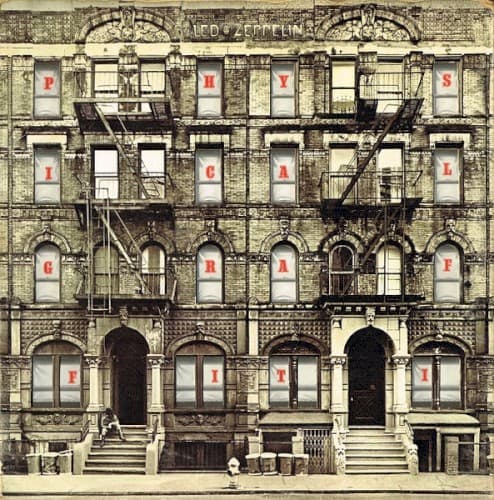
Led Zeppelin Physical Graffiti — The Band Clears the Vault and Finds Its Peak
Led Zeppelin spent three years recording Physical Graffiti without meaning to. The eight tracks they cut at Headley Grange in early 1974 filled nearly three sides of vinyl, so Jimmy Page raided the vaults and pulled seven outtakes from the sessions that produced their third, fourth and fifth albums. The result was a double album that could have been a bloated victory lap but instead became the band's most ambitious and confident statement, a set that proved Zeppelin could stretch across hard rock, funk, orchestral grandeur and acoustic folk without losing the thread. The thesis here is simple: Physical Graffiti is the sound of a band so deep in its prime that even its castoffs are better than most peers' A-material, and the new songs show a group still pushing into territory it had only hinted at before. The question is whether eighty minutes of Zeppelin is too much Zeppelin, and whether mixing material from four years and four different studios holds together as an album or just as a collection.
The album debuted at number three in the United States and hit number one the following week, staying there for six weeks. It went platinum on advance orders alone and eventually shipped eight million copies in the US. The band promoted it with a ten-week US tour and a five-night residency at Earl's Court that sold out in four hours. Robert Plant later called it his favourite Zeppelin album and the band at its creative peak; Page called it a high-water mark. The critical response was strong at the time and has only grown: Rolling Stone ranked it among the greatest albums ever made, and the consensus now treats it as the definitive Zeppelin document, the one record that captures everything the band could do. The album earns that reputation on the strength of its peaks, but the length and the inclusion of older material mean it is not as tight or as perfectly sequenced as the fourth album, and the verdict here is that Physical Graffiti is the better highlight but the fourth album is the better record.
Eight New Songs and Seven Outtakes That Sound Like One Band
The production spans three years and four studios—Headley Grange, Island Studios, Olympic Studios, Stargroves—but engineer Ron Nevison and mixer Keith Harwood made the seams nearly invisible. The 1974 tracks recorded at Headley Grange carry the band's signature live-room sound, with John Bonham's drums captured in full ambience and the guitars and bass allowed to breathe. The older material was recorded with different engineers (Eddie Kramer on 'Houses of the Holy,' uncredited on the 1970 and 1971 sessions) and in tighter spaces, but Page's overdubs in 1974 and Harwood's mixing work at Olympic Studios brought the sound into line. The result is a double album that does not sound like a patchwork, even if close listening reveals the differences: 'Bron-Yr-Aur' has the intimate microphone placement of an early-Seventies folk session, while 'Kashmir' has the sweep and separation of a mid-Seventies rock production with orchestral overdubs.
The songwriting covers the band's full range. The hard rock tracks—'Custard Pie,' 'The Rover,' 'The Wanton Song,' 'Sick Again'—are built around Page riffs and Bonham's lock with John Paul Jones, with Plant's vocals riding the groove rather than fighting it. 'Trampled Under Foot' started as a jam driven by Jones on Hohner Clavinet, and Bonham reshaped it from what the band called a "souly" arrangement into a funk track, telling Page to play a repeating riff instead of chords. The result is the album's tightest and most propulsive rocker, a song that became a live staple and later a solo-tour fixture for Plant. 'Kashmir' came from a Page and Bonham instrumental demo in late 1973, with Plant adding lyrics he wrote in Morocco and Jones arranging strings and brass for session musicians. The orchestration is spare and modal, closer to minimalist film scoring than to the symphonic rock Zeppelin's peers were attempting, and the song's length is earned by the hypnotic riff and the way the arrangement builds in layers rather than repeating verses.
The acoustic and folk-influenced material is where the outtakes justify their inclusion. 'Bron-Yr-Aur' is a solo acoustic piece Page recorded in mid-1970, named after the Welsh cottage where he and Plant wrote much of the third album. 'Down by the Seaside' was written at the same cottage in 1970 as an acoustic track influenced by Neil Young, then reworked as an electric number in 1971 with tempo shifts that Page and Bonham led. 'Black Country Woman' was recorded in the garden at Stargroves in 1972, with an airplane passing overhead left in for effect. None of these tracks are revelations, but they show the band's range and give the album breathing room between the heavier songs.
The weak points are real and mostly clustered on side four. 'Boogie with Stu' is a 1971 jam session with Rolling Stones pianist Ian Stewart, based on Ritchie Valens's 'Ooh My Head,' and it sounds exactly like a loose jam that was never meant to be released. 'Night Flight' has a solid Hammond organ part from Jones and a Leslie-speaker guitar tone from Page, but Plant's lyrics about a news headline never cohere and the track meanders. These songs were included because the album needed a fourth side, not because they were essential, and the sequencing suffers for it.
A Double Album That Peaks Early and Sags in the Middle
The album front-loads its strongest material with a confident opening stretch that establishes the band's range. The first side closes with an eleven-minute blues-rock exploration recorded live, with Bonham leading the arrangement and deciding where the stop-start sections would fall. The ending includes his off-mic cough and his shout, 'That's got to be the one, hasn't it?,' left in to show the band at work. It is the album's longest track and the one that most clearly captures the improvisation and room sound that made the Headley Grange sessions productive.
The second side is the album's peak: a 1972 track left off the album of the same name because it was too similar to another song, followed by a funk-inflected rocker and an orchestral centerpiece. Those three tracks in sequence make the case for Physical Graffiti as the band's definitive work, a twenty-minute stretch that moves from melodic hard rock to funk to orchestral grandeur without a weak moment. The third side holds its own with a progressive track that went through several rehearsals to work out its structure, and a Plant lyric about an old love affair combined with a Page instrumental featuring overdubbed electric and acoustic guitars. The acoustic instrumental and the tempo-shifting number that follow are solid but not essential.
The final side is where the album loses momentum. A straightforward rocker built around a Page riff opens the stretch, and the closer, written about the groupies the band met on the 1973 tour, features Bonham's drumming and Page's riffs driving the track. But the three songs between them are the weakest stretch on any Zeppelin album, and the sequencing does them no favours. The album is eighty minutes long, and those three tracks make it feel longer.
The Best Showcase, Not the Best Album
Physical Graffiti ranks just below the fourth album in the Zeppelin catalog. The fourth album is tighter, better sequenced, and has no weak tracks; Physical Graffiti has higher peaks and a wider range but also more filler and a running time that tests patience on side four. If you want one Zeppelin album that shows everything the band could do, this is it. If you want the one that does not waste a moment, go with the fourth album. The choice depends on whether you value ambition and range over focus and consistency, and both answers are defensible.
The album is for listeners who want Zeppelin at full scope: the blues, the folk, the hard rock, the funk, the orchestral experiments, the acoustic interludes, all in one place. Skip it if you want the band at its most focused, or if eighty minutes feels like too much of any one thing. The album has aged well because the production was recorded live and mixed without studio tricks that would date it, and because the best songs—'Kashmir,' 'Trampled Under Foot,' 'In My Time of Dying,' 'Ten Years Gone'—are among the band's most played and most covered. The weaker tracks have not improved with time, but they are easy to skip.
Start with side two: 'Houses of the Holy,' 'Trampled Under Foot,' 'Kashmir.' If that sequence works, move to side one for 'In My Time of Dying' and then to side three for 'Ten Years Gone.' Side four is optional unless you are a completist. For the next album, go to Houses of the Holy to hear the sessions that produced 'Houses of the Holy,' 'The Rover' and 'Black Country Woman,' or to Presence to hear where the band went after this peak. Physical Graffiti is the sound of Zeppelin with nothing left to prove and no reason to hold back, and the result is a double album that justifies its length most of the time.
Track by track
Track Listing
Custard Pie
StandoutThe album opens with a strut, not a statement. Page plays the guitar solo through an ARP synthesiser, giving it a nasal, compressed tone that cuts through Jones's Hohner Clavinet and Plant's harmonica. The first take was faster, with improvised vocals, but the band slowed it down and tightened the arrangement. It is a strong opener that sets the tone without overselling the album, a confident mid-tempo rocker that does its job and gets out.
The Rover
StandoutWritten in 1970 at Bron-Yr-Aur, recorded as an acoustic demo that year, reworked as an electric track in 1972, and finished with Page's guitar overdubs in 1974, this song took four years to complete and sounds like it was cut in one session. The production hides the seams, and the song has the melodic clarity and the dynamic range of the band's best mid-tempo rockers. It is not a highlight, but it is proof that the outtakes were worth saving.
In My Time of Dying
StandoutEleven minutes of blues-rock built around a traditional song Dylan had recorded in 1962, expanded into a full-band arrangement with stop-start sections that Bonham led. The track was recorded live, with Page adding slide guitar overdubs later, and the performance has the feel of a band working out an idea in real time. Bonham's off-mic cough at the end and his shout—'That's got to be the one, hasn't it?'—were left in to show the process. The length is earned by the dynamics and the way the arrangement builds and releases tension, though the song could have ended two minutes earlier without losing anything. It is the clearest example of the improvisation and room sound that made Headley Grange productive, and it became a live staple for good reason.
Houses of the Holy
StandoutRecorded in May 1972 as the title track for the album of the same name, left off because it was too similar to 'Dancing Days,' and included here with no further overdubs or remixing. The song has a bounce and a melodic clarity that make it one of the album's most accessible tracks, and it was the right call to leave it off the fifth album—it would have been redundant there—and the right call to include it here, where it balances the heavier material on side two.
Trampled Under Foot
StandoutA jam session driven by Jones on Clavinet, reworked by Bonham into a funk arrangement after he decided the original version was too souly. Bonham told Page to play a repeating riff instead of chords, and the result is the album's tightest and most propulsive track, a funk-rock hybrid that became a live staple and a solo-tour fixture for Plant. The lyrics are double entendres about driving and cars, delivered with enough swagger that they work. The song was released as a single in the US and became a top forty hit, and it is the most accessible track on the album without being a compromise.
Kashmir
StandoutAn instrumental demo from late 1973, expanded with Plant's lyrics written in Morocco and Jones's string and brass arrangements played by session musicians. The orchestration is spare and modal, closer to minimalist film scoring than to symphonic rock, and the song's eight-and-a-half-minute length is earned by the hypnotic riff and the way the arrangement builds in layers. The song became one of the album's most critically acclaimed tracks and was played at every show from 1975 onward. Page and Plant revived it for their 1994 tour, and it was reworked in 1998 by Sean 'Puffy' Combs for his single 'Come With Me,' which featured Page on guitar. It is the album's signature track and one of the band's defining songs, a piece that proved Zeppelin could work at extended length without losing focus.
In the Light
SolidOriginally called 'In the Morning,' this track went through several rehearsals and takes to work out a structure, with Page adding a drone and chant introduction later. The song has the ambition and the length of a progressive rock piece, with shifting sections and a build that earns its eight-and-a-half-minute running time. It is not as immediately compelling as 'Kashmir,' but it is a solid example of the band working out complex arrangements in the studio, and it holds up on repeat listens. The track never became a live staple, which suggests the band knew it was more of a studio piece than a performance showcase.
Bron‐Yr‐Aur
SolidA solo acoustic piece by Page, named after the Welsh cottage where he and Plant wrote much of the third album. Recorded at Island Studios in mid-1970 and later used as background music in the band's film The Song Remains the Same. It is a brief instrumental that serves as a breather between the longer tracks on side three, pleasant but not essential.
Down by the Seaside
SolidWritten at Bron-Yr-Aur in 1970 as an acoustic track influenced by Neil Young, then reworked as an electric number in 1971 with tempo shifts from slow to fast and back. Page and Bonham led the arrangement, and the shifts work, giving the song a dynamic range that keeps it interesting over five minutes. It is not a highlight, but it is a solid example of the band's acoustic and folk-influenced work, and it fits the album's range.
Ten Years Gone
StandoutPlant wrote the lyrics about an old love affair, and Page combined them with an instrumental piece featuring overdubbed electric and acoustic guitars. When the band played the track live, Jones used a triple-neck guitar with mandolin, six-string and twelve-string to reproduce the overdubs. The song is one of the album's most accomplished pieces, a ballad that builds without losing its intimacy, and it shows Plant singing with the control and conviction of someone who has nothing left to prove. It is the strongest track on side three and one of the album's lasting highlights.
Night Flight
WeakRecorded at Headley Grange in 1971 for the fourth album, with Jones on Hammond organ and Page playing guitar through a Leslie speaker. Plant wrote the lyrics after reading a news headline about a nuclear damage test threat, and the song never finds a focus. The organ and guitar tones are interesting, but the track meanders and the lyrics do not cohere. It is filler.
The Wanton Song
SolidBuilt around a Page riff and straightforward to arrange, unlike some of the other 1974 Headley Grange tracks. The song is a solid hard rocker with Bonham driving the groove and Plant delivering the vocals with swagger. It is not a highlight, but it does its job and keeps side four from collapsing entirely. The track was never a live staple, which suggests the band knew it was not top-tier material.
Boogie With Stu
WeakA 1971 jam session with Rolling Stones pianist Ian Stewart, based on Ritchie Valens's 'Ooh My Head.' The track was recorded during the same session that produced 'Rock and Roll' for the fourth album, and it sounds exactly like a loose jam that was never meant to be released. It is filler, and it drags side four down.
Black Country Woman
SolidRecorded in the garden at Stargroves in 1972 for Houses of the Holy, with an airplane passing overhead left in for effect. The track is a loose acoustic number with a country-rock feel, pleasant but slight. It is the weakest of the outtakes included on the album, and it would not be missed if it had been left off.
Sick Again
StandoutWritten about the groupies the band met on the 1973 tour, with Bonham's drumming and Page's riffs driving the track. The arrangement was worked out before recording, and the song is a straightforward hard rocker that closes the album on a strong note. It is not a highlight, but it is a solid closer that reminds the listener of what the band does best after a side that sags in the middle. The track became a live staple and was a regular part of the setlist from 1975 onward.