The scorecard
8.8/10 · Essential
- Songwriting25%
- 8.5
- Production25%
- 9.5
- Performance15%
- 8.5
- Cohesion15%
- 9.0
- Originality10%
- 7.0
- Replay value10%
- 9.5
Riffs lock in instantly and Johnson's lyrics turn every song into a blunt declaration, though some verses repeat the same sexual metaphor three different ways.
Lange compresses every element into one unified attack—guitars, bass and drums hit like a single instrument, dry and massive, still the reference standard in hard rock studios.
Johnson screams through every line with conviction that sells even the dumbest double entendre, and the Young brothers play with the locked-in precision that defines the band.
Ten tracks, forty-two minutes, no ballads, no experiments: the album moves at one unrelenting pace and earns the length by never letting up.
The band sharpened the blueprint Highway to Hell established rather than breaking new ground, but the laser focus on groove over blues made arena rock leaner than anyone else attempted in 1980.
Four decades on, the riffs still hit immediately and the production has not dated—this is the rare classic rock album that sounds exactly as heavy now as it did on release.
AC/DC Back in Black — The Album That Answered Death With a Power Chord
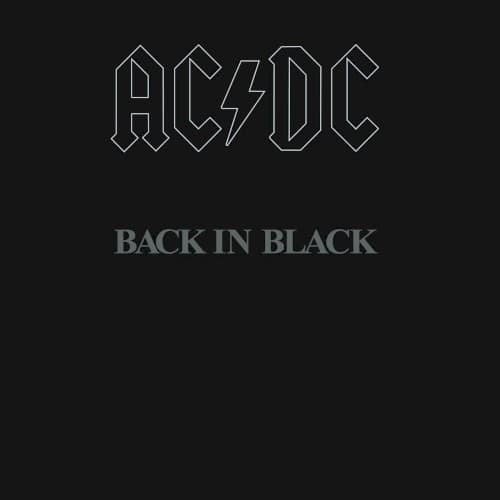
AC/DC responded to tragedy by refusing to mourn. Six months after Bon Scott died in a car after a London drinking binge, the band released an album that sounds like nothing ever happened—ten songs of strutting, unrepentant hard rock that never once acknowledge loss, doubt or introspection. The all-black cover was a sign of mourning, but the music inside is pure forward motion: riffs that lock in on the first beat, drums that punch through the center of the mix, and a new singer who screams every line like he has something to prove. Back in Black is the sound of a band that could have broken up instead deciding to make the leanest, meanest record of their career.
The thesis here is simple: this is the album where AC/DC perfected the one thing they do. They had been building toward it since Let There Be Rock, and Highway to Hell got them halfway there with producer Robert John "Mutt" Lange tightening the sound. But Back in Black is where every element—riff, rhythm, vocal, mix—compresses into a single, unified attack. There are no blues jams, no filler, no detours. Just forty-two minutes of groove-driven hard rock played with absolute precision and recorded so well that studios still use it to test acoustics. The album sold fifty million copies worldwide, making it the second-best-selling album in music history, and it has not aged a day because it never tried to be anything other than exactly what it is.
How Lange Turned Five Men Into One Machine
The guitar sound is the foundation. Angus Young's lead tone, captured in part through the Schaffer-Vega wireless system that added a signal boost, cuts through the mix without ever stepping on Malcolm Young's rhythm parts. Malcolm plays the same riff Angus plays, but lower in the register and slightly behind the beat, so the two guitars sound like a single, thicker instrument. Producer Robert John "Mutt" Lange compressed that combined guitar tone into something dry and compact, then locked it to Phil Rudd's drums so tightly that the kick drum and the rhythm guitar hit on the same beat with no air between them. The result is a sound that punches straight forward: no reverb, no space, no room for anything to drift. Tony Platt, the engineer, was initially dismayed to find that the rooms at Compass Point Studios in the Bahamas were not sonically complementary to this approach, but Lange made it work by refusing to let any element bleed or soften.
Brian Johnson, the former Geordie singer recruited three weeks before recording began, had never worked with the band and felt the pressure. Lange demanded perfection on every vocal take, insisting that even the breaths be placed so precisely that no listener could suspect a drop-in. Johnson later said Lange drove him nuts, but the results justify the method: his voice is raw and committed on every line, selling lyrics that often amount to one sustained sexual metaphor. The writing here is riff-first, with verses and choruses built to demonstrate the groove rather than develop an idea. That works on the stronger tracks, where the hooks are immediate and the riffs are distinct, but it becomes a weakness when the band repeats the same verse structure for the third or fourth time in a row. Several songs—"What Do You Do for Money Honey," "Given the Dog a Bone," "Let Me Put My Love Into You"—are built on the same formula, and while the riffs differentiate them, the songwriting does not.
Lange pushed the band further away from blues-based rock than they had been on Highway to Hell. The grooves here are tighter, the tempos more controlled, and the solos shorter. Angus still plays with the pentatonic vocabulary that defined the band's earlier records, but the solos are now concise statements rather than extended workouts. The album benefits from the focus: nothing outstays its welcome, and the songs that work do so because they waste no time. The production has had an enduring impact—studios in Nashville used the album to check room acoustics in the years after its release, and Motörhead used it to tune their sound system. It remains the reference standard for how to record hard rock with clarity and power.
Forty-Two Minutes With No Breaks and One Gear
The album sustains one unrelenting pace for ten tracks and never shifts tone. There are no ballads, no acoustic interludes, no tempo changes. Every song is a mid-tempo rocker built on a single riff, and the sequencing does nothing to vary the formula.
That should be a fatal flaw, but the band earns the length by committing completely to the approach. The first stretch establishes the template, and the rest of the album delivers variations on it without ever breaking stride. The middle section hits harder than anything around it and resets the energy just when the formula starts to wear. The seventh track is the closest thing to a single and the only song with a chorus designed for radio rather than for the stage.
The back half sags slightly. Two consecutive tracks are solid but not essential, and the album would have been leaner at eight or nine tracks. But the band closes strong with a final declaration that restates the thesis one more time and ends the record on a riff instead of a fadeout. The pacing is relentless rather than dynamic, and that works because the band never pretends otherwise. This is an album designed to do one thing for forty-two minutes, and it does that thing with absolute conviction.
Where It Ranks and Who It's For
Back in Black is AC/DC at their most focused and their most successful, and it is the best place to start with the band. It improves on Highway to Hell by tightening the production and sharpening the riffs, and it avoids the indulgence that occasionally dragged down their earlier records. Whether it is their best album depends on whether you value precision or raw energy: Highway to Hell has more personality, and Let There Be Rock has more chaos, but nothing else they recorded sounds this clean or this heavy at the same time. The album has aged better than almost any other hard rock record from 1980 because Lange's production avoided the reverb-heavy trends of the era and because the band played to their strengths without chasing radio or experimenting.
Skip this if you need variety in your rock albums or if you find the sexual metaphors tedious after the third song. The lyrics are not the point, but they are also not invisible, and some tracks—"Given the Dog a Bone," "What Do You Do for Money Honey"—rely on double entendres that were already stale in 1980. Start with "Hells Bells," "Back in Black," and "You Shook Me All Night Long," which are the three tracks that define the album and the three that still dominate rock radio. If those work, the rest of the album will work. If they do not, nothing else here will change your mind.
After this, hear Highway to Hell for a slightly looser version of the same approach, or hear Let There Be Rock for the band before Lange cleaned them up. For a different take on hard rock from the same year, hear Motorhead Ace of Spades, which attacks from a faster, rawer angle. Back in Black is the album that proved AC/DC could survive the loss of their singer and come back with the biggest record of their career, and it remains the hard rock album against which all others are measured for clarity, power and focus.
Track by track
Track Listing
Hells Bells
StandoutThe opening track sets the template for the entire album: a single riff, repeated and developed over five minutes, with Johnson screaming over the top. The bell that opens the song was custom-cast at a foundry after initial recordings of a church bell captured too many birds. The bell tolls for nearly a minute before the guitars enter, and when they do, the riff locks in with the drums so tightly that the two sound like one instrument. Johnson wrote the opening lines in response to the tropical storms that hit Nassau while the band was recording: the thunder, rain and lightning imagery is specific to that moment. The song builds tension by repeating the same riff with slight variations in dynamics, and the solo at the three-minute mark is one of Angus Young's most controlled performances, staying inside the pentatonic box but using space and phrasing to create drama. This is the strongest track on the album and the one that best demonstrates what Lange's production achieved.
Shoot to Thrill
StandoutThe second track is built on a riff that moves in the opposite direction of the first: where "Hells Bells" descends, this one climbs. The verse riff is a simple two-chord pattern, but Malcolm Young plays it with enough swing that it never sounds mechanical. Johnson's vocal melody in the verse is more interesting than most of the album's other melodies, moving up and down in response to the riff rather than sitting on top of it. The chorus is a shout rather than a hook, but it works because the band plays the riff harder underneath it. The solo is short and stays in the pocket. Solid opener that establishes momentum.
What Do You Do for Money Honey
WeakThe riff here is weaker than the first two tracks, and the sexual metaphor in the title and chorus is the least subtle on an album full of blunt lyrics. Johnson sings about a woman who will do anything for money, and the verse does not develop the idea beyond restating it three different ways. The groove is tight, and the band plays with the same precision as everywhere else, but the song does not have a hook strong enough to justify the repetition. Filler.
Given the Dog a Bone
SolidAnother riff built on the same mid-tempo groove, another lyric built on one sexual metaphor. The verse riff has some swing to it, and the pre-chorus riff adds a slight variation, but the song does not go anywhere. Johnson sells the lines with enough conviction that the performance works even when the writing does not, but this is one of the weaker tracks on the album. The solo is competent but unremarkable.
Let Me Put My Love Into You
StandoutThis is the track where Bon Scott played drums on the demo, though none of his contributions made it to the final recording. The riff is one of the album's best: a descending pattern that locks in with the bass and drums to create a groove that sounds heavier than anything else in the first half. Johnson's vocal melody in the verse is more dynamic than most of the other tracks, and the chorus has an actual hook rather than just a shout. The lyrics are still built on one extended metaphor, but the music is strong enough to carry them. The solo is short and melodic, and the band plays the outro riff with enough energy to make the fade feel earned.
Back in Black
StandoutThe title track is the heaviest song on the album and the one that best demonstrates the band's ability to build a song around a single riff. The opening riff is one of the most recognizable in rock history: four chords, played in a descending pattern, with Malcolm Young hitting the downbeat slightly behind Angus so the two guitars sound like one massive instrument. The verse riff is the same as the intro riff, and the chorus is just the band playing the riff louder while Johnson screams the title. That should not work, but it does, because the riff is that good and because the band plays it with absolute conviction. The production here is dry and compact, with no reverb and no space, so every element hits at the same time. The solo is short and melodic, and the band plays the outro with enough energy to make the repetition feel like a climax rather than a loop. This is the second-best track on the album and the one that defines the sound.
You Shook Me All Night Long
StandoutThe closest thing to a pop song on the album, and the only track with a chorus designed for radio rather than for the stage. The riff is simpler than most of the others, and the verse melody is more singable, with Johnson staying in a lower register and letting the words breathe. The chorus is the hookiest moment on the album: a two-line refrain that repeats twice, with the guitars dropping out so the vocal sits on top of the bass and drums. The production here is slightly less compressed than the rest of the album, with more space around the vocals, and the result is a track that sounds lighter and more accessible. The solo is melodic and concise, and the outro plays the chorus riff one more time before fading. This became the band's first Top 40 hit in the United States, and it remains the most recognizable song on the album for casual listeners.
Have a Drink on Me
SolidThis is the other track where Bon Scott played drums on the demo. The final version is a mid-tempo rocker built on a riff that sounds like a variation on the "Back in Black" riff, with the same descending pattern but a different rhythm. The lyrics are about drinking, and Johnson delivers them with the same conviction he brings to the rest of the album, but the song does not have a strong enough hook to stand out. Solid but not essential.
Shake a Leg
SolidThe riff here is built on a shuffle rhythm, which gives the song a slightly different feel from the rest of the album, but the verse and chorus follow the same formula as most of the other tracks. The lyrics are about dancing, or possibly about sex, and Johnson shouts them with the same energy he brings to every other song. The solo is short and stays in the pentatonic box. The track works as part of the album's sequencing, but it does not have a hook strong enough to justify listening to it on its own.
Rock and Roll Ain't Noise Pollution
StandoutThe closing track restates the album's thesis one more time: rock and roll is loud, it is simple, and it does not apologize. The riff is one of the album's best, with a syncopated rhythm that gives it more swing than most of the other tracks. Johnson sings the verses with conviction, and the chorus is a shout that works because the band plays the riff harder underneath it. The title came from a story Bon Scott had told the band, but Brian Johnson wrote the lyrics. The solo is melodic and concise, and the band plays the outro riff with enough energy to end the album on a high note. This is the right way to close the record: a final declaration that restates the argument and ends on a riff instead of a fadeout.