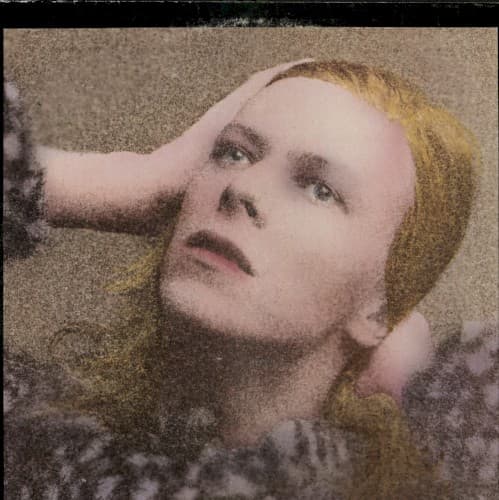
The scorecard
8.7/10 · Essential
- Songwriting25%
- 9.5
- Production25%
- 8.5
- Performance15%
- 8.5
- Cohesion15%
- 7.5
- Originality10%
- 8.5
- Replay value10%
- 9.0
Bowie's piano compositions achieve rare melodic grace while tackling reinvention, Nietzschean philosophy and occultism with conversational clarity—only the slight Dylan tribute sags.
Ken Scott captures warm piano tones and Ronson's first string arrangements with studio precision; the acoustic guitar layering on Quicksand and the one-take Life on Mars? vocal show technical command.
Bowie's voice moves from the passionate chorus of Life on Mars? to the nasal verses and unsettling starkness of Oh! You Pretty Things, finding a range that suits each song's purpose.
The three tribute songs cluster awkwardly on side two and Fill Your Heart feels like borrowed brightness, but the sequencing otherwise builds from Changes through Quicksand without obvious filler.
The shift from guitar-driven hard rock to piano-led art pop distinguishes it from The Man Who Sold the World and most 1971 British rock, though the Velvet Underground and Beatles debts are audible.
Changes, Life on Mars? and Oh! You Pretty Things remain essential fifty years on, and even the cryptic Bewlay Brothers rewards repeat listens more than most album closers.
David Bowie Hunky Dory — The Piano That Bought Him Time
Hunky Dory is the album where David Bowie stopped guessing and started writing from a position he could defend. After the hard rock of The Man Who Sold the World sold poorly and left him without a band or a clear direction, he retreated to Haddon Hall with a piano and emerged three months later with three dozen songs, eleven of which became this record. The thesis is in the opening track: artistic reinvention as compulsion, distancing oneself from the rock mainstream by embracing melodic accessibility. Where his previous albums chased trends or disguised ambition in genre exercises, Hunky Dory states its purpose in the first two minutes and spends the next forty arguing that pop craft and intellectual ambition are not opposites.
The stakes were commercial survival. RCA inherited Bowie from Mercury with little faith he would sell, and the label's instinct proved correct when Hunky Dory failed to chart on release in December 1971. What the album did instead was establish the voice—conversational, literary, unafraid of Nietzsche or Aleister Crowley—that would make Ziggy Stardust possible six months later. The sound is piano-led art pop, warmer than the guitar crunch of its predecessor, closer to the orchestral ambition of British glam than to the folk-rock Bowie had abandoned by 1970. The songs range from occult philosophy dressed as nursery rhyme to tribute songs for Andy Warhol, Bob Dylan and Lou Reed, all written after a February 1971 American radio tour that convinced Bowie his future lay in mythmaking rather than authenticity. The album works because the myths are built on melodies strong enough to carry the weight, and because Bowie sings them as if he believes them.
Switching Instruments, Finding the Room
The piano made the difference. Bowie had written on guitar for his first three albums, and the results varied from competent folk-rock to the muddled hard rock of The Man Who Sold the World. Hunky Dory's songs were composed at Haddon Hall on piano, an instrument that encouraged clearer harmonic movement and melodic lines that could survive without distortion or production tricks. The opening riff of Changes is built around a descending piano figure that repeats throughout the song, simple enough to hum but sophisticated enough to support multiple key changes. Life on Mars? uses the same chord sequence as Frank Sinatra's My Way for its opening bars—Bowie wrote
The Sequence That Holds and the Tribute Block That Sags
The album's pacing earns its forty-two minutes through the first six tracks, which move from the pop clarity of Changes through the occult warnings of Oh! You Pretty Things and Quicksand without repeating a mood or structure. Eight Line Poem provides a two-minute breather between the Nietzschean doctrine and the filmic sweep of Life on Mars?, and Kooks offers a moment of lightness before Quicksand closes side one with five minutes of acoustic guitar layers and Buddhist references. The sequencing builds toward that longest track rather than front-loading the singles, and the result is a side that justifies the album format.
Side two struggles under the weight of three tribute songs in a row. Andy Warhol, Song for Bob Dylan and Queen Bitch are positioned as a thematic block—three American icons observed from across the Atlantic—but the songs themselves vary wildly in quality and the block kills momentum. The Warhol tribute works as a character sketch built on acoustic guitar riffs, but the Dylan song is the album's weakest moment, a half-hearted pastiche that Buckley calls
Where It Ranks and Who Should Start Here
Hunky Dory sits just below Ziggy Stardust in Bowie's early seventies peak, and the gap is narrow. Ziggy is the concept album that delivered the commercial breakthrough and the fully realized persona; Hunky Dory is the better collection of individual songs and the more consistent listen front to back if you subtract the tribute block. It lacks Ziggy's thematic unity and the guitar firepower that Mick Ronson would unleash six months later, but it has two songs—Changes and Life on Mars?—that belong in any argument about Bowie's best work, and Oh! You Pretty Things and Quicksand are not far behind. For listeners new to Bowie's catalog, this is the second album to hear after Ziggy, and for some it will be the one they return to more often.
The album's flaw is the three-song tribute sequence on side two, which reads as Bowie working through his influences in public rather than synthesizing them into something new. Skip Song for Bob Dylan entirely; the Warhol and Reed tributes are worth hearing once but neither ranks with the side one material. Start with Changes, Life on Mars? and Oh! You Pretty Things, which capture Bowie at his most melodically assured and lyrically ambitious before the Ziggy character took over.
The Bewlay Brothers is the outlier: a five-minute closer that sounds like The Man Who Sold the World in its sinister effects and cryptic lyrics, and either the album's secret landmark record or its most self-indulgent detour depending on your tolerance for Bowie at his most opaque. If Hunky Dory convinces you, the next step is Ziggy Stardust for the full glam explosion, or Station to Station for Bowie's next sustained run of great songwriting.
Track by track
Track Listing
Changes
StandoutThe opening piano riff descends through the chord sequence and locks in immediately, and Bowie's vocal moves from conversational verses to the held notes on "strange fascination" that became the song's signature. The lyric about turning to face the strange and the compulsive nature of artistic reinvention sets the album's thesis in the first verse, and the song never loses that clarity. Wakeman's piano and Ronson's arrangement support the melody without overwhelming it. The track establishes the warmer, more accessible sound that separates this album from its predecessor, and the production captures the piano tone with room to breathe. A statement of purpose that delivers on the promise.
Oh! You Pretty Things
StandoutWritten first for the album and recorded by Peter Noone three months before Bowie's version, the song disguises its Nietzschean Übermensch doctrine and Aleister Crowley occultism in a bouncing piano line that recalls the Beatles' Martha My Dear. Bowie sings the verses with an unadorned, almost stark delivery that makes the "homo superior" and "gotta make way for the homo superior" lines land unsettling rather than didactic. The contrast between the bright music and the darker philosophical warnings creates tension that holds across three minutes. The piano style would become a template for British art pop in the seventies, and the vocal performance shows Bowie fully in control of his instrument.
Eight Line Poem
SolidA two-minute breather built on gentle, sporadic piano and Ronson's country-influenced guitar. The eight-line lyric describes a room with a knocked-over mobile and a cactus in the window, and Bowie's metaphor about the city as a wart on the prairie works better than it should. The track is easy to overlook between the stronger songs on either side, but it serves the sequencing by lowering the temperature before Life on Mars? arrives.
Life on Mars?
StandoutRecorded in one take and built on a string arrangement that Ronson wrote as his first attempt at orchestration, the song is a parody of Frank Sinatra's My Way that uses the same chord sequence for its opening. The title references the space race media frenzy rather than the Ziggy Stardust character that would arrive six months later. Bowie's vocal moves from near-nasal verses to a passionately delivered chorus, and the "girl with the mousy hair" who escapes to the movies provides the human anchor for the cinematic sweep. The production captures the one-take vocal with clarity, and Ronson's strings avoid the bombast that would sink similar attempts. A centerpiece that justifies the album's ambition and one of Bowie's two or three best songs from the early seventies.
Kooks
StandoutWritten days after his son Duncan was born in May 1971 and dedicated "For Small Z" in the liner notes, the song is noticeably lighter than the tracks around it. Ronson's string arrangement and Bolder's trumpet give it a playful feel, and the lyric about inviting his son to "stay in our lovers' story" hints at the album's broader theme of fictionalizing life. The song is slight compared to the surrounding material but works as a palate cleanser, and its inclusion ensured the album's appeal beyond listeners interested in occult philosophy and Nietzschean supermen.
Quicksand
StandoutFive minutes of layered acoustic guitars stacked atop one another at Ken Scott's insistence, with Bowie's vocal navigating references to Aleister Crowley's Golden Dawn, Winston Churchill, Heinrich Himmler and Nietzsche's supermen. The song was inspired by Bowie's February 1971 American tour and written, according to Doggett, about a lack of inspiration and as a means of accessing it. The track evokes Buddhist teachings and spiritualism through mentions of bardo, and Bowie described it in the mid-seventies as a mixture of narrative and surrealism that prefigured the sound of Low. The acoustic guitar layers create a hypnotic effect that carries the dense lyrical content, and the song closes side one at the album's longest running time. A peak that rewards attention.
Fill Your Heart
SolidA Biff Rose and Paul Williams cover that replaced Bombers as the side two opener late in the album's development, and Bowie's first recorded cover in six years. The arrangement is bouncy and up-tempo, with Bowie's saxophone break, Ronson's strings and Wakeman's piano solo providing the highlights. The track is practically identical to Rose's original version but less swung, and it serves as a counterpoint to the angst of Quicksand and the warnings of Changes. Filler that works because it knows its role.
Andy Warhol
SolidA tribute to the American artist who had inspired Bowie since the mid-sixties, built on an acoustic guitar riff that heavily resembles Ron Davies' Silent Song Through the Land. Originally written for Dana Gillespie, the song emphasizes Warhol's belief that life and art blur together, and Ken Scott's opening announcement of the take number adds a layer of self-awareness. The track works as a character sketch, and the production captures the two acoustic guitars with enough detail to make the riff interesting across four minutes. When Bowie met Warhol in September 1971 and played him the song, Warhol hated it and left the room. A solid tribute that doesn't match the side one material but holds its own.
Song for Bob Dylan
WeakA tribute that addresses Dylan by his real name Robert Zimmerman and demands he return to his roots to rescue the unfaithful, the song is a parody of Dylan's 1962 Song to Woody and features Dylanesque chord changes. The chorus derives from two Velvet Underground song titles, Here She Comes Now and There She Goes Again, but the pastiche never coheres into a strong melody or a convincing argument. Buckley calls it probably the weakest track on the album, and the assessment is fair. Originally written for George Underwood, the song reads as Bowie working through his relationship with a hero rather than as a finished piece of songwriting. Skip it.
Queen Bitch
StandoutThe Velvet Underground tribute and specifically a nod to Lou Reed, driven by guitar rather than piano and characterized as glam rock and proto-punk. The handwritten sleeve notes read "some V.U. White Light returned with thanks," and the song filters Marc Bolan's archness and Lindsay Kemp's dancer aesthetic through Reed's streetwise attitude. The chorus about mincing "satin and tat" and the phrase "bipperty-bopperty hat" sound raunchy rather than camp, and the track foreshadows the glam rock direction Bowie would take on Ziggy Stardust. A preview of the next album and a strong closer to the tribute block.
The Bewlay Brothers
SolidA late addition and the only track not demoed, featuring sinister sound effects and Bowie's vocal accompanied by Ronson's acoustic guitar. The instrumentation echoes The Man Who Sold the World, and the obscure lyrics have caused decades of confusion. Pegg calls it probably the most cryptic, mysterious and downright frightening Bowie recording in existence, and Buckley considers it one of his most disquieting moments on tape. Many reviewers heard homoerotic undertones; Bowie confirmed in 1977 it was about his relationship with his schizophrenic half-brother Terry Burns, though Buckley questions whether that account is real or fictionalized. The lyrics reference other Hunky Dory tracks including Song for Bob Dylan, Oh! You Pretty Things and Changes, and Bowie uses the word "chameleon" that became his most common descriptor. A five-minute closer that either unlocks the album's deeper themes or indulges Bowie's most opaque tendencies, and the verdict depends on how much patience you bring to repeated listens.