The scorecard
7.8/10 · Great
- Songwriting25%
- 8.0
- Production25%
- 8.5
- Performance15%
- 8.0
- Cohesion15%
- 6.5
- Originality10%
- 7.5
- Replay value10%
- 7.5
Four strong singles anchored by Killer Queen plus Stone Cold Crazy and Brighton Rock show confident melodic craft, but the vaudeville novelties and one-minute fragments spread the focus thin.
Roy Thomas Baker's 24-track layering and the Trident mixing sessions produced a dense, theatrical sound years ahead of most 1974 rock, even if Brighton Rock's four-day mix is more impressive than necessary.
Mercury's vocal range and character work carry the album through genre shifts, while May's Brighton Rock solo and Taylor's drumming on Bring Back That Leroy Brown show technical command.
Thirteen tracks in forty minutes with constant stylistic pivots—glam to music hall to proto-thrash—sacrifice album flow for variety; the tracklist reads like a showcase reel rather than a deliberate sequence.
The theatrical hard rock hybrid was still novel in 1974 and Stone Cold Crazy's speed-metal template predates the genre, but the music hall pastiche and the Mott the Hoople tour stories place it firmly in glam's second wave.
The singles and the heaviest tracks have staying power, but the novelty cuts and minute-long interludes wear out their welcome after a few listens; this is an album to cherry-pick rather than play straight through.
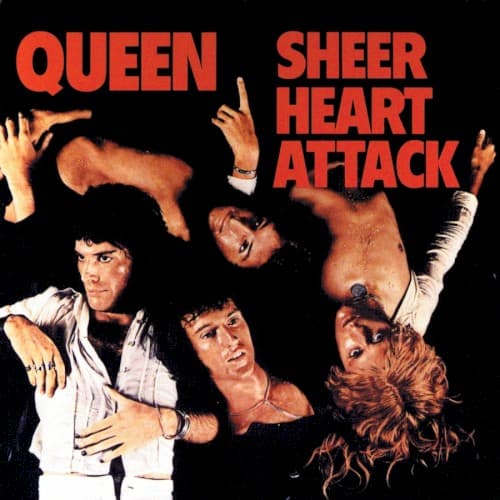
Queen Sheer Heart Attack — The Album That Proved Glam Could Carry Weight
Sheer Heart Attack is the album where Queen stopped trying to be progressive rock's eccentric cousins and started inventing their own genre. The first two records had buried strong songs under fantasy concepts and multi-part suites; this one opens with a three-minute guitar solo in the middle of a Brighton bank holiday story, follows it with a jangle-piano single about a high-class escort, and closes side one with a track Brian May wrote in a hospital bed. The thesis is simple: theatrical rock does not require dungeons or fairies when everyday subjects—lust, youth, touring, gangsters—can be staged with the same operatic excess.
The album reached number twelve in America and gave the band their first top-twenty hit there with Killer Queen, which is the vindication but not the whole story. Sheer Heart Attack works because it commits fully to the variety-show format, even when that format works against album cohesion. Thirteen tracks in forty minutes means constant gear shifts, from the proto-thrash of Stone Cold Crazy to the ukulele-banjo on Bring Back That Leroy Brown, and the sequencing never quite decides whether it is building momentum or just showing off the catalogue.
The best songs here rank among Queen's finest—Brighton Rock, Killer Queen, Now I'm Here, Stone Cold Crazy—but the novelty cuts and minute-long interludes keep it from matching A Night at the Opera's focus. This is the album where Queen found their voice; the next one is where they learned to use it with discipline.
Roy Thomas Baker's 24-Track Laboratory and the Sound of Controlled Excess
Roy Thomas Baker's production, recorded across four studios with Trident's new 24-track board, is the album's most consistent achievement. The backing tracks were cut at Rockfield Studios in Wales over three weeks in July, then overdubbed at Wessex and AIR while Brian May recovered from surgery, and finally mixed at Trident in September and October. The result is a dense, layered sound that was advanced for 1974 but never feels clinical—the harmonies on In the Lap of the Gods stack like a cathedral choir, the Brighton Rock solo splits into multi-tracked counterpoint, and Bring Back That Leroy Brown reportedly used seventy vocal tracks bounced down to fit the mixer. The production creates the illusion of scale without much actual room sound; every element is close-miked and placed deliberately, which makes the quieter moments like Lily of the Valley feel airless.
May's guitar orchestrations, refined since the first album, are the sonic signature: the Brighton Rock solo uses modified delay and separate amplifiers for each echo, and the heavy riffs on Now I'm Here and Stone Cold Crazy layer rhythm and lead parts into a single harmonic mass. Freddie Mercury plays jangle piano and grand piano on multiple tracks, and his vocal arrangements are as composed as the guitar parts—Killer Queen's stacked harmonies and the call-and-response on Flick of the Wrist both sound like studio constructions that the band would need to rework for the stage. Roger Taylor's drumming, especially on Bring Back That Leroy Brown and Stone Cold Crazy, shows range that the first two albums had not required: big-band swing on the former, rapid-fire endurance on the latter.
The songwriting is sharper and more direct than Queen II's fantasy sprawl, but the focus is uneven. Killer Queen and Now I'm Here are complete statements with memorable hooks and no wasted bars; Brighton Rock has a strong narrative verse and a long solo that justifies itself on record even if it became self-indulgent in concert. Stone Cold Crazy, written in Mercury's pre-Queen band Wreckage and refined over years of live performances, is two minutes of distorted speed that prefigures thrash metal—Music magazine Q called it thrash before the term existed, though Deep Purple's Hard Lovin' Man had tried something similar four years earlier.
The weaker material falls into two camps: brief piano interludes like Dear Friends and Lily of the Valley that feel like Palace Music Hall sketches rather than songs, and novelty tracks like Bring Back That Leroy Brown and Misfire that are competent pastiches but lack the urgency of the album's best moments. John Deacon's Misfire, his first individual composition for the band, is a lightweight funk-rock number that he plays almost entirely himself; it is professionally executed and instantly forgettable. The vaudeville turn on Bring Back That Leroy Brown, complete with ukulele-banjo and double bass, works as a palate cleanser but wears thin on repeated listens.
The structural problem is that the album never decides whether it is a singles collection or a coherent statement. The first six tracks include four of the strongest—Brighton Rock, Killer Queen, Flick of the Wrist, Now I'm Here—but also Tenement Funster and Lily of the Valley, which are connective tissue. Side two starts with the most ambitious track, In the Lap of the Gods, then pivots through Stone Cold Crazy, two short ballads, two novelty cuts, and a reprise of the opener. The effect is variety-show pacing: constant surprises, no sustained mood, and a finale that works live but feels tacked on in the context of the album.
The result is an album that is easier to admire than to love as a whole, but packed with individual moments that justify Queen's reputation.
An Album Built for Shuffle Play
Sheer Heart Attack does not build; it pivots. The sequencing front-loads the singles and the heaviest tracks, then scatters the rest across the back half without much concern for flow. The opening stretch establishes the variety-show format immediately—a hard-rock opener with an extended guitar solo, followed by a jangle-piano single with Mercury's most controlled vocal performance. The first side ends with a three-song suite that shares a tonal arc, moving from youth-rebellion lyric through sarcastic put-down to mournful piano, before closing with the momentum that the second side never recovers.
The back half starts strong with its most ambitious stretch, then loses energy. Two early highlights would anchor a more focused album, but the one-minute interludes, two-minute funk-rock number, and vaudeville turn sap the momentum. An acoustic track has no reason to exist between the novelty number and the reprise. The closing run features a live set-closer that sounds effective in an arena but redundant on an album that already included the same melody thirteen tracks earlier.
The pacing suggests a band that had not yet learned to self-edit. The thirteen-track, forty-minute runtime is not bloated by 1970s standards, but the album would be stronger at ten tracks: drop the piano interlude, the funk number, the vaudeville turn, the acoustic track, and the reprise, and you have a thirty-minute record with no filler and a tighter argument. As it stands, this is an album to program rather than to play straight through, which is a weakness but also the source of its durability—something for every mood, nothing that overstays its welcome except the concept itself.
The Overture to the Main Event
Sheer Heart Attack ranks third in Queen's 1970s output, behind A Night at the Opera and News of the World but ahead of everything else. It is the album where the band's core strengths—Mercury's vocal theatre, May's guitar orchestrations, Baker's production density—came into focus, but the songwriting discipline and the sequencing instincts had not caught up. Opera refined this template by cutting the novelty fat and committing to the operatic conceit; Sheer Heart Attack is the rehearsal, which makes it essential for understanding how the band got there but not the best place to start.
The album has aged well where it leaned into hard rock and poorly where it leaned into music hall. The opening stretch and the heaviest moments are canonical Queen tracks, and the sneering put-down and the ambitious centerpiece are not far behind. The vaudeville cuts, which seemed cheeky in 1974, now sound like the work of a band that had not yet figured out that being theatrical did not require being literally theatrical. The production, which was years ahead of most rock in 1974, sounds merely expensive now; the 24-track layering has none of the warmth of the band's live sound, which is the trade-off for the precision.
This is an album for fans who already know A Night at the Opera and want to hear the previous chapter, or for listeners who prefer the harder edge of the early catalogue. Start with the piano single and the proto-metal track to understand the range, then decide whether the variety-show format is charm or clutter. If the former, play the whole thing; if the latter, skip to Opera. The closest comparison in the band's catalogue is Queen II, which had stronger ambition and weaker execution; Sheer Heart Attack inverts that equation.
For similar variety-show hard rock with theatrical production, try Mott the Hoople's The Hoople or Sparks' Kimono My House, both from 1974 and both wrestling with the same glam-meets-art-rock tension. For the proto-metal side, Deep Purple's Made in Japan and Budgie's Never Turn Your Back on a Friend cover the same ground with less polish. Sheer Heart Attack is the album where Queen became Queen, which is reason enough to hear it once, but not reason enough to return unless the sprawl is part of the appeal.
Track by track
Track Listing
Brighton Rock
StandoutThe album's most ambitious track, opening with a fairground carousel sample and a hard-rock riff that tells a Mods-in-Brighton story before breaking for a three-minute unaccompanied guitar solo. Brian May's solo, recorded with modified delay and split across separate amplifiers, builds multi-tracked harmonies and contrapuntal lines that later became a live showcase—Guitar World ranked it number 41 on their list of greatest solos. The solo is technically impressive and musically coherent, each phrase answering the previous one, but it dominates the track to the point where the song itself feels like a frame for the performance. The lyric, about two young lovers named Jenny and Jimmy meeting on a bank holiday, nods to the Who's Quadrophenia without the narrative depth, and the vocal melody in the verses is stronger than the chorus. The track works because it commits to the conceit: this is a guitar solo with a song attached, and both parts earn their space.
Killer Queen
StandoutThe album's commercial breakthrough and its tightest piece of songwriting, written by Freddie Mercury in a single night. The jangle piano and the stacked vocal harmonies create a sound that was polished and arch in a year when most rock was aiming for raw or cosmic, and the lyric's portrait of a high-class escort is specific enough to avoid cliché. Mercury's vocal performance is controlled and character-driven, playing the role rather than emoting, and the production—Roy Thomas Baker's cleanest work on the album—serves the song instead of overwhelming it. The track reached number two in the UK and number twelve in the US, and it remains one of the band's most durable singles because it has a clear idea and no wasted motion. The guitar solo is brief and melodic, the bridge modulates without showboating, and the final chorus ends before the arrangement runs out of ideas. The definitive early Queen single.
Tenement Funster
SolidRoger Taylor's youth-rebellion lyric, sung by Taylor with John Deacon playing prominent acoustic guitar parts while Brian May recovered from surgery. The track is energetic and slight, a two-minute burst of defiance that works as a transition into Flick of the Wrist but does not stand alone. The riff is serviceable, the vocal melody is adequate, and the production is dense in the house style, but the song has no hook strong enough to justify its place in the running order except as connective tissue. It segues smoothly into the next track, which is its primary function.
Flick of the Wrist
StandoutWritten by Mercury during May's illness-induced absence, this is one of the album's most venomous tracks, a sarcastic put-down delivered with layered harmonies and a descending riff that sounds like a sneer. The vocal arrangement, with Mercury and Taylor trading lines in call-and-response, is as composed as anything on the album, and the production keeps the dense instrumentation from burying the lyric's bite. The track was released as a double A-side with Killer Queen in some markets, which suggests the band saw it as single-worthy, but it lacks the melodic immediacy of the stronger cuts. Still, the attitude and the arrangement make it one of the more memorable deep cuts, and the segue from Tenement Funster gives it momentum it would not have on its own.
Lily of the Valley
SolidA one-minute-and-forty-second piano ballad that feels like a sketch rather than a finished song. The melody is pretty, Mercury's vocal is restrained, and the production is sparse by the album's standards, but the track has no development and no resolution—it just ends. The lyric gestures toward the fantasy themes of the first two albums without committing, and the whole thing plays like an interlude that was given a title and placed on the tracklist because the album needed a breather. It works in context as a palate cleanser before Now I'm Here, but it is inessential on its own.
Now I’m Here
StandoutWritten by May while hospitalised and recorded during the final week of sessions, this is the album's most direct rocker and one of its best songs. The riff is heavy and memorable, the chorus is built for arenas, and the lyric recalls the band's early tour supporting Mott the Hoople with enough specificity to feel lived-in rather than generic. May plays piano on the track, and the production layers rhythm and lead guitars into a thick harmonic wall that drives the song forward without burying the melody. The track reached number eleven on the UK singles chart and became a live staple, and it has aged better than most of the album's attempts at variety because it does one thing well instead of three things adequately. The best example of the album's hard-rock side and the closest thing here to a perfect Queen single besides Killer Queen.
In the Lap of the Gods
StandoutThe most ambitious track on side two, built on multiple vocal overdubs from Mercury and Roger Taylor and featuring one of Taylor's highest notes on the album. The song has a hymnal quality, with stacked harmonies that sound like a cathedral choir, and the arrangement builds from a quiet verse to a full-band chorus without rushing. The production is dense and deliberate, and the track works as a statement piece, but it lacks the melodic clarity of the album's best songs—the verses meander, and the chorus, while powerful, does not have a hook strong enough to justify the five-minute runtime. The track also suffers from being reprised at the end of the album, which makes it feel like half of a suite rather than a standalone piece. Still, it is one of the more successful experiments on side two, and the vocal performance alone makes it worth hearing.
Stone Cold Crazy
StandoutA proto-thrash track that predates the genre by several years, originally performed by Freddie Mercury's pre-Queen band Wreckage and refined over years of live performances before being recorded here. The tempo is fast, the distortion is heavy, and the lyric, which deals with gangsters and includes a reference to Al Capone, is delivered at a breathless pace. The track is two minutes and twelve seconds of controlled chaos, and it remains one of the most influential songs in Queen's catalogue—Metallica covered it in 1990 and won a Grammy for the version. The song is more impressive as a historical artifact than as a piece of music; the riff is simple, the structure is repetitive, and the production, while powerful, does not have the dynamics of the album's best moments. But as a demonstration of the band's range and as a blueprint for speed metal, it is essential. Music magazine Q called it thrash metal before the term was invented, though Deep Purple's Hard Lovin' Man had tried something similar in 1970.
Dear Friends
WeakA one-minute-and-seven-second piano ballad written by Brian May and sung by Freddie Mercury. The track is too short to develop any ideas and feels like a fragment that should have been left off the album or expanded into a full song. The melody is slight, the production is minimal, and the lyric is vague. Filler.
Misfire
SolidJohn Deacon's first individual composition for the band, a lightweight funk-rock number that he plays almost entirely himself except for some guitar parts at the end where May's Red Special becomes more prominent. The track is competent and professional, with a decent groove and a serviceable vocal melody, but it has no memorable hook and no reason to exist beyond giving Deacon a writing credit. The album would not miss it.
Bring Back That Leroy Brown
SolidA vaudeville pastiche written by Freddie Mercury, featuring grand piano, jangle piano, ukulele-banjo played by Brian May, double bass played by John Deacon, and seventy vocal tracks mixed down to fit the 24-track board. The title alludes to Jim Croce's Bad Bad Leroy Brown, and the arrangement is pure music hall, with Roger Taylor's drumming showing big-band swing and precision. DRUM! Magazine commended Taylor's versatility on the track, noting that he could have fit into any theatrical pit band if Queen had not worked out. The track is a palate cleanser and a showcase for the band's technical range, but it is also a novelty that wears thin after one or two listens. It works in the context of the album's variety-show format, but it is not a song anyone would return to on its own.
She Makes Me (Stormtrooper in Stilettos)
WeakWritten and sung by Brian May, with May and John Deacon playing acoustic guitars. The track is a mid-tempo rocker with a decent riff and a forgettable vocal melody, and it has no clear reason to be placed between Bring Back That Leroy Brown and the album-closing reprise. The lyric is generic, the production is flat, and the whole thing feels like a B-side that made the album because the band needed to fill out the runtime. May's vocal performance is adequate but lacks the charisma of Mercury's work, and the track has no hook strong enough to justify its four-minute length. Skippable.
In the Lap of the Gods… Revisited
SolidA reprise of track seven, rewritten as a live set-closer with a bigger chorus and a more straightforward arrangement. The track was performed as a set-closer from 1974 to 1977 and again in 1986 during the Magic tour, where it segued into Seven Seas of Rhye. The studio version is effective in an arena context—big, dumb, built for crowd participation—but redundant on an album that already included the same melody thirteen tracks earlier. The vocal performance is powerful, the production is full, and the arrangement is tighter than the original, but the song does not justify existing twice on the same record. It would have worked better as a standalone single or a live-only track.