The Power Trio That Redefined Electric Guitar in Three Albums
The Jimi Hendrix Experience existed for less than three years, yet that brief window fundamentally altered what electric guitar could accomplish in popular music. Formed in London during September 1966, the trio united Seattle-born guitarist Jimi Hendrix with British bassist Noel Redding and drummer Mitch Mitchell, creating a lineup that would deliver three studio albums before imploding under the weight of its own intensity.
Chas Chandler, former bassist for The Animals, discovered Hendrix playing Greenwich Village clubs and brought him to England specifically to build a group around his explosive talent. The chemistry proved immediate. Mitchell's jazz-informed drumming and Redding's melodic bass lines provided the rhythmic foundation for Hendrix's sonic experiments, which transformed blues structures into something wholly unprecedented.
What makes their story remarkable isn't just the brevity but the concentrated innovation. Between May 1967 and October 1968, they released Are You Experienced, Axis: Bold as Love, and Electric Ladyland—three albums that progressively expanded the vocabulary of rock music. By mid-1969, internal tensions and Hendrix's desire for different musical directions had fractured the group irreparably.
Psychedelic Blues Architecture and Feedback as Melody
The Jimi Hendrix Experience built their sound on blues foundations, then systematically dismantled traditional approaches to guitar tone and song construction. Hendrix employed feedback, distortion, and wah-wah effects not as embellishments but as primary compositional tools. What sounded like chaos to initial listeners revealed itself as carefully controlled sonic manipulation—feedback sustained at specific pitches, distortion shaped into harmonic layers.
Mitchell's drumming drew heavily from jazz, particularly Elvin Jones's work with John Coltrane. His fluid approach to timekeeping gave Hendrix freedom to stretch and compress phrases without losing rhythmic momentum. On tracks like "Manic Depression" and "Fire," Mitchell's fills functioned almost as lead instruments, creating polyrhythmic textures that pushed beyond standard rock patterns.
Redding's bass work often moved in counterpoint to Hendrix's guitar lines rather than simply anchoring the bottom end. His melodic sensibility, influenced by British pop as much as American R&B, created space in arrangements that could have collapsed under Hendrix's density. The interplay between all three musicians—particularly evident in their live performances—established the power trio as a viable format for ambitious rock music, directly influencing everyone from Cream to Nirvana decades later.
From London Clubs to Monterey: The Meteoric Ascent and Studio Evolution
Chandler's strategy focused on building British buzz before tackling the American market. The Experience spent late 1966 and early 1967 playing small London venues, where their shows quickly became events within the city's psychedelic underground. Their first single, "Hey Joe," reached number six on UK charts in January 1967, followed by "Purple Haze" in March—both songs establishing Hendrix's presence before the debut album arrived.
Are You Experienced dropped in May 1967 to immediate critical recognition in Britain, though American release came months later with a different track listing. The album's production, handled by Chandler, captured the raw energy of their live performances while incorporating studio techniques like backwards guitar and phasing effects. Songs like "The Wind Cries Mary" demonstrated Hendrix's capacity for delicate balancing alongside the aggression of "Foxy Lady."
The Monterey Pop Festival in June 1967 served as their American coming-out party. Hendrix's guitar-burning finale became instant legend, but the performance itself showcased the trio's musical sophistication—their version of "Wild Thing" deconstructed the song into avant-garde noise exploration. Suddenly, American audiences understood what British fans had been witnessing for months.
Axis: Bold as Love followed in December 1967, revealing deeper psychedelic ambitions. The album's production grew more complex, with stereo panning effects and layered guitar harmonies that required multiple overdubs. Hendrix was increasingly interested in the studio as an instrument itself, working with engineer Eddie Kramer to develop techniques that standard recording practices hadn't yet codified. "Little Wing" and "Castles Made of Sand" showed his expanding songwriting range, moving beyond blues structures into more intricate harmonic territory.
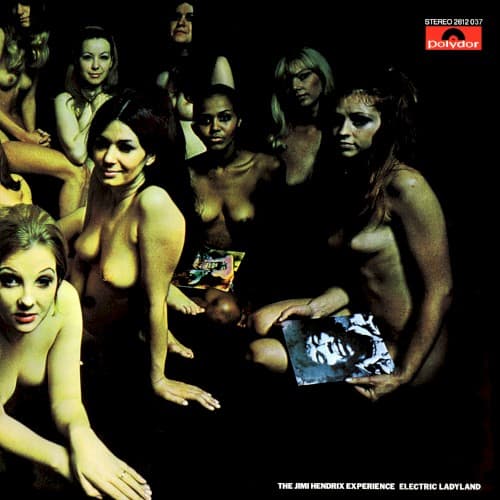
Electric Ladyland represented the culmination of their studio experimentation. Released in October 1968 as a double album, it showcased Hendrix's vision fully realized—lengthy instrumental passages, guest musicians including Steve Winwood and Jack Casady, and production that treated every sonic element as malleable. The album took months to complete, with Hendrix obsessing over details that frustrated his bandmates. His cover of "All Along the Watchtower" inverted Bob Dylan's acoustic original into something harder and more desperate, ultimately becoming their highest-charting single.
By early 1969, the group was fracturing. Redding grew frustrated with his diminishing role as Hendrix brought in additional bass players for recording sessions. Mitchell remained committed, but the relentless touring schedule and Hendrix's increasingly erratic behavior created unsustainable tension. Their final performance came in June 1969 at the Denver Pop Festival. Hendrix would continue performing with different lineups, but the specific chemistry of the Experience—that particular balance of personalities and approaches—never reconvened.
The Template for Guitar-Driven Rock Innovation
The Jimi Hendrix Experience established parameters that guitar-based rock still operates within. Their power trio format—one guitar handling all harmonic and melodic responsibilities, supported by rhythm section—became the default configuration for hard rock and heavy metal. Every guitarist who treats distortion as texture rather than novelty, who uses feedback melodically, who approaches the instrument as an orchestra rather than a single voice, walks paths Hendrix cleared.
Their studio work proved equally influential. The production techniques developed for Electric Ladyland became standard practice, but in 1968 they represented genuine innovation. The idea that rock albums could be constructed rather than simply captured, that the recording studio enabled sounds impossible in live performance—these concepts weren't invented by the Experience, but their execution made the ideas undeniable to subsequent generations.
What remains most striking is the concentration of achievement. Three studio albums in eighteen months, each one advancing beyond its predecessor, before the whole thing collapsed. No slow decline, no creative exhaustion, no desperate comeback attempts. The Jimi Hendrix Experience burned through their possibilities completely, leaving behind a body of work that sounds neither dated nor nostalgic but permanently contemporary, the way genuine innovation always does.