The scorecard
8.0/10 · Great
- Songwriting25%
- 8.5
- Production25%
- 8.0
- Performance15%
- 8.0
- Cohesion15%
- 6.5
- Originality10%
- 8.0
- Replay value10%
- 8.5
The three epics—"Roundabout", "South Side of the Sky", and "Heart of the Sunrise"—construct asymmetric forms that develop ideas rather than repeat them, with Squire's ascending bass riff in "Heart of the Sunrise" serving as a structural anchor instead of mere decoration.
Eddy Offord's 16-track recording captures distinct spatial separation—Howe's acoustic guitar tracked in the corridor for "Roundabout" sounds warmer than the main room would allow—though the synthesizer timbres on "Cans and Brahms" date the album audibly.
Anderson's vocal phrasing floats above the rhythmic turbulence without strain, while Bruford and Squire lock into the shifting meters of "Roundabout" and "Heart of the Sunrise" with the precision required to make the asymmetry feel inevitable rather than forced.
The solo showcases fracture the album's momentum: "Five Per Cent for Nothing" and "Mood for a Day" function as palette cleansers between the epics, but the structure reads as cost-saving strategy more than deliberate sequencing.
Rick Wakeman's Mellotron and Moog expanded what a rock keyboard section could be in 1971, and the recapitulation structure in "Heart of the Sunrise" imported classical form into electric rock without sounding like a classroom exercise.
"Roundabout" and "Heart of the Sunrise" reward repeated listens by revealing how their discrete sections interlock, while the solo tracks remain efficient diversions that do not demand return visits.
Yes Fragile — The Album Where Prog Found Its Structure
The argument for Fragile rests on three tracks. "Roundabout", "South Side of the Sky", and "Heart of the Sunrise" are not sprawling jams that forget where they started; they are asymmetric compositions that develop motifs across shifting time signatures and return to restate themes with the logic of a sonata. The rest of the album—five solo reveal totaling under twelve minutes—exists because studio time was expensive and Rick Wakeman needed gear. That division could have sunk the record, but it instead clarified what Yes did better than their progressive peers in 1971: they wrote rock songs with classical architecture, not rock songs dressed in classical clothing.
Fragile was the first Yes album with Wakeman, whose Mellotron, Moog and classical training gave the band the harmonic and textural range to realize the ambitions sketched on The Yes Album. His arrival also coincided with the band's commercial breakthrough, as "Roundabout" hit number thirteen on the Billboard Hot 100 after Atlantic trimmed it to three and a half minutes without asking. The edit horrified Jon Anderson and Steve Howe, but it worked: Fragile peaked at number four in the US, sold two million copies, and established the template every mid-tier prog band would copy for the next five years. The question is whether the album's structure serves the music or just manages the budget. The answer is both, and the three epics are strong enough that it does not matter.
How Wakeman's Keyboards Rebuilt the Band's Framework
Tony Kaye played Hammond organ and piano. Rick Wakeman played Hammond, grand piano, electric piano, harpsichord, Mellotron and Moog, and he had conservatory training in orchestration. That range let Yes write songs that modulated through multiple keys and dynamic zones without losing coherence. "Roundabout" opens with a reversed piano chord, shifts from Howe's fingerpicked acoustic verse to a chugging electric chorus, and climaxes with Wakeman's single-take Hammond solo—recorded after Bill Bruford told him to hold back in rehearsal and unleash it on tape. The solo does not show off; it glues the song's three or four discrete ideas into a structure that feels circular without repeating.
"Heart of the Sunrise" demonstrates what Wakeman's classical training added beyond texture. The track originated as a love song from Anderson and an ascending bass riff from Chris Squire that Howe compared to King Crimson's "21st Century Schizoid Man". Wakeman introduced the band to recapitulation—the technique of restating a theme in a new context later in the piece—and the song's final minutes revisit the opening bass line and vocal melody with the weight of everything that came between them. That is compositional thinking, not jamming. Bruford called it the band's breakthrough in originality, and he was correct: the track combines the pastoral English imagery Anderson favored with the structural ambition that separated Yes from the blues-rock bands stretching songs to eight minutes by soloing longer.
Producer and engineer Eddy Offord recorded the album on 16-track tape at Advision Studios over two months in 1971, with a budget around thirty thousand dollars. The spatial separation is deliberate: Howe tracked his acoustic guitar parts for "Roundabout" in the studio corridor because the main room made the instrument sound dead. The result is warmer and more intimate than the electric sections, which gives the song its dynamic range. The percussion and bass sit forward in the mix on "South Side of the Sky", where Squire and Bruford drive a heavy riff adapted from Howe's previous band, Bodast. The interlude features Wakeman's piano and Anderson's voice isolated in near-silence before the band crashes back in with synthesized wind effects. The production supports the song's narrative about climbers freezing on a mountain, and it does so without burying the lyric in reverb.
The solo pieces were a cost-saving measure. Wakeman needed expensive new equipment, and the band had financial pressures, so each member contributed a short piece they could arrange and record quickly. The concept worked on paper, but the execution is uneven. Wakeman's "Cans and Brahms" adapts an excerpt from Brahms' Symphony No. 4 using electric piano for strings, organ for brass, and synthesizer for contrabassoon.
He spent fifteen hours recording it and later called it dreadful; legal constraints from his solo contract with A&M Records prevented him from writing an original piece. The track sounds like a technical exercise because it is one. Anderson's "We Have Heaven" layers his voice into a multi-tracked chant over acoustic guitar, and Squire's "The Fish" overdubs multiple bass lines into a melodic highlight. Both are efficient and pleasant.
Howe's "Mood for a Day" is a flamenco-influenced acoustic piece he later disavowed, saying the studio version was technically inferior to his live performances. Bruford's "Five Per Cent for Nothing" is a thirty-five-second instrumental named as a joke about the band paying five percent of future royalties to settle a contract dispute with their former manager. It is the shortest track in the Yes catalog and required extensive rehearsal because the syncopated ending needed all five members to stop on the same beat. Howe used his guitar headstock as a visual cue.
The solo tracks do not derail the album because they are short and sequenced as breathers between the epics. "Five Per Cent for Nothing" and "Long Distance Runaround" separate "South Side of the Sky" from "Heart of the Sunrise", preventing epic fatigue. The structure is pragmatic, not visionary, but it works because the group-arranged tracks are strong enough to carry the record. The weakness is that the solo pieces reveal how much the band depended on ensemble interplay: Wakeman, Howe and Squire are all technically skilled, but their individual pieces are less compelling than what they build together.
A Record That Peaks Early and Sustains Through Sequencing
The opening stretch delivers the album's best material. "Roundabout" became the band's signature track because it compresses Yes's ambitions into eight and a half minutes without wasting a measure: acoustic verses, electric choruses, a Hammond solo, a return to the opening motif. The structure is circular, the execution is tight, and the melody is strong enough that Atlantic's three-and-a-half-minute radio edit—trimmed without the band's knowledge—drove the album to number four on the Billboard chart. The edit worked because the song's core ideas were clear, and the longer version justifies its length by developing those ideas rather than repeating them.
The sequencing decision to alternate solo pieces with group epics prevents the album from sagging under its own weight. The first side closes with a seven-minute track built on a heavy riff and a piano interlude that drops into near-silence before the band returns with wind effects. The narrative about climbers freezing to death could have been portentous, but the music sells it. The back half concludes with eleven minutes of recapitulation and dynamic contrast that Bruford regarded as the band's definitive breakthrough. The closing track justifies its length because it restates its themes with structural purpose, not because it needs to fill time.
The solo tracks function as interludes, and that is the correct role for them. The middle section includes a three-and-a-half-minute track that was released as a B-side and became a surprise hit on album-oriented rock radio, driven by an interlocking riff between Howe's guitar and Wakeman's electric piano. It makes its point and ends with an Echoplex delay run that segues directly into the next piece. That pacing—short, focused tracks between the epics—keeps the album moving. The structure is not visionary, but it is functional, and the peaks are high enough that the valleys do not matter.
The Album That Made Prog a Commercial Genre
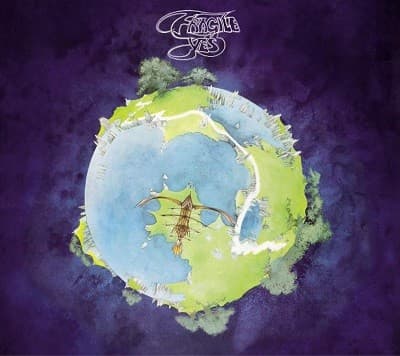
Fragile is the fourth-best Yes album by default—it is the only one reviewed on this site—but it would rank in the top three of their catalog regardless. "Roundabout", "South Side of the Sky", and "Heart of the Sunrise" are among the best tracks the band recorded, and the solo demonstrate are efficient enough that they do not drag the record down. The album sold two million copies in the US, earned a double-platinum certification, and established Yes as a headlining arena act. It also inaugurated the band's collaboration with artist Roger Dean, whose fractured-planet gatefold art became as recognizable as the music. Retrospectively, Fragile is cited as a foundational pillar of progressive rock, and the claim is justified: it demonstrated that rock bands could write asymmetric compositions with classical structure and sell them to a mainstream audience.
The album is for listeners who want rock music with compositional ambition and for fans of early-seventies prog who can tolerate a few solo diversions between the main attractions. It has aged well because the three epics do not rely on the synthesizer timbres that date "Cans and Brahms"; the Mellotron and Moog serve the arrangements rather than define them. Skip the album if you need every track to justify its presence or if you prefer prog that prioritizes atmosphere over structure. Fragile is designed music, and the design is visible.
Start with "Roundabout" and "Heart of the Sunrise". If those two tracks work, the rest of the album will follow. For context, listen to The Yes Album (1971) to hear what the band sounded like before Wakeman joined, then move forward to Close to the Edge (1972) to hear where they took the recapitulation concept next. Fragile is the album where Yes figured out how to write rock songs that developed like classical movements. That is a specific achievement, and it holds up.
Track by track
Track Listing
Roundabout
StandoutThe signature track and the strongest song on the album. The reversed piano chord that opens the song came from Eddy Offord's production trick, and it sets the tone for a composition that cycles through acoustic verses, electric choruses, and a Hammond organ solo without losing its melodic center. Steve Howe tracked his acoustic guitar parts in the studio corridor to avoid the dead sound of the main room, and the warmth of that tone contrasts with the electric sections in a way that gives the song its dynamic range. Rick Wakeman recorded his organ solo in a single take after Bill Bruford advised him to hold back in rehearsal and unleash it on tape; the solo does not grandstand, it resolves the song's harmonic tension. The structure is circular—the title and the imagery came from the roundabouts Jon Anderson saw while traveling through Scotland in March 1971—but the song develops its ideas rather than repeating them. Atlantic trimmed it to three and a half minutes for radio without asking the band, and the edit horrified Anderson and Howe. They were wrong to resist: the single hit number thirteen on the Billboard Hot 100 and drove the album to commercial success. The full version justifies its eight and a half minutes by earning every section.
Cans and Brahms (extracts from Brahms’ 4th Symphony in E minor, Third Movement)
WeakWakeman's solo showcase, an electronic adaptation of Brahms using electric piano for strings, organ for brass, and synthesizer for contrabassoon. He spent fifteen hours recording it and later called it dreadful. Legal constraints from his A&M solo contract prevented him from contributing an original composition, so he adapted a public-domain excerpt instead. The arrangement is technically competent but emotionally inert, and the synthesizer timbres date the track more than anything else on the album. Bill Bruford coined the title as a pun on the slang term for studio headphones. The track functions as a brief interlude, and at ninety-four seconds it does not overstay its welcome, but it is the weakest solo piece on the record.
We Have Heaven
SolidJon Anderson's solo contribution, built on multi-tracked vocal overdubs that layer his voice into a choral effect over acoustic guitar. The lyrics—two short chants about telling the moon dog and the March hare—are cryptic even by Anderson's standards, but the arrangement works as a textural experiment. The track ends with sound effects of a slamming door and running footsteps, designed to segue into the wind effects that open "South Side of the Sky". At ninety-eight seconds it serves its purpose as a transition without demanding much from the listener. A brief reprise appears as a hidden track after "Heart of the Sunrise", introduced by the sound of a door opening.
South Side of the Sky
StandoutA seven-minute epic built on a heavy riff adapted from Steve Howe's previous band, Bodast, contrasted by a piano and vocal interlude that drops into near-silence before the band crashes back in with synthesized wind effects. The narrative recounts a team of climbers freezing to death on a mountain, and the production supports the lyric without overplaying it: the wind at the beginning and end frames the track as a tragedy, and the mid-section silence functions as the moment of collapse. Chris Squire and Bill Bruford drive the main riff with precision, and Rick Wakeman's piano solo demonstrates his classical training without showboating. Wakeman did not receive a songwriting credit due to contractual conflicts between his A&M solo deal and the band's Atlantic contract; Atlantic promised compensation but never paid him. He chose not to pursue legal action because he valued the creative environment. Yes did not perform the song live in its entirety until 2002, which suggests the band recognized its difficulty. The track is one of the album's three essential pieces.
Five Per Cent for Nothing
SolidBill Bruford's first composition, a thirty-five-second instrumental named as a joke about the five percent royalty settlement the band paid to their former manager. The syncopated arrangement required extensive rehearsal because all five members had to end on the same beat; Howe used his guitar headstock as a visual cue during practice. The piece is functional as a palette cleanser between "South Side of the Sky" and "Long Distance Runaround", but it is more notable as a footnote than as music.
Long Distance Runaround
StandoutReleased as the B-side to "Roundabout" and a surprise hit on album-oriented rock radio. Jon Anderson wrote the lyrics as a critique of religious exclusivity—the second verse references the 1970 Kent State shootings and the government's crackdown on anti-war protests. The track is built on an interlocking riff between Steve Howe's guitar and Rick Wakeman's electric piano, and the interplay between the two instruments drives the song more than the vocal melody. At three and a half minutes it makes its point and exits cleanly, ending with an Echoplex delay guitar run that segues into "The Fish". The song is efficient and well-constructed, a reminder that Yes could write concise tracks when the budget and the structure demanded it.
The Fish (Schindleria Praematurus)
StandoutChris Squire's solo showcase, featuring multiple overdubbed bass lines that provide both rhythm and melody. The title incorporates Squire's nickname, coined by Bill Bruford because Squire took long baths; the subtitle came from lighting director Michael Tait, who found the name of a marine species with exactly eight syllables to fit Anderson's closing vocal chant. The arrangement is melodic and playful, and it demonstrates Squire's technical skill without turning into a technical exercise. At two and a half minutes it is the ideal length for a bass showcase: long enough to develop an idea, short enough to avoid self-indulgence.
Mood for a Day
SolidSteve Howe's solo acoustic piece, recorded on a flamenco guitar and influenced by Sabicas and Carlos Montoya. Howe later expressed dissatisfaction with the studio version, saying he considered it technically inferior to his subsequent live performances. The track is competent but forgettable, a showcase for classical and flamenco technique that does not add much to the album's argument. It functions as a breather before "Heart of the Sunrise", and at under three minutes it does not overstay its welcome.
Heart of the Sunrise
StandoutThe album's longest and most ambitious track, an eleven-minute epic that originated as a love song Jon Anderson wrote for his wife, contrasting the beauty of the natural world with the friction of London's streets. Chris Squire's ascending bass riff—compared by Steve Howe to King Crimson's "21st Century Schizoid Man"—serves as the central theme, and Rick Wakeman introduced the band to the classical concept of recapitulation, where previously established themes are restated in a new context. The track's final minutes revisit the opening bass line and vocal melody with the accumulated weight of the intervening sections, and the effect is structural rather than decorative. Bill Bruford called it the band's definitive breakthrough in originality, and he was correct: the song demonstrates that Yes could write asymmetric compositions with the logic of a sonata, not just extended jams. Wakeman's classical training is audible in the arrangement, which modulates through multiple keys and dynamic zones without losing coherence. Howe initially recorded his parts on a Gibson ES-5 Switchmaster but switched to his standard Gibson ES-175 after finding the former's tone unsatisfactory. The track ends with a brief silence before a hidden reprise of "We Have Heaven" closes the album. This is the strongest track on the record and one of the best songs Yes recorded.