The scorecard
8.6/10 · Essential
- Songwriting25%
- 8.5
- Production25%
- 9.0
- Performance15%
- 9.5
- Cohesion15%
- 7.0
- Originality10%
- 9.0
- Replay value10%
- 8.5
Rotten and Cook's riffs are hooks first, slogans second, and 'Anarchy in the U.K.' remains the rare protest song built on a chorus rather than a slogan.
Thomas and Price make the cleanest punk record of 1977, with Jones's guitar stacked thick and Rotten's sneer mixed dry and forward where it can do the most damage.
Rotten's half-sung, half-spat vocal on 'Bodies' and 'God Save the Queen' is the sound of contempt performed with technical control, and Cook's drums hit harder than most metal records of the era.
Four previously released singles break the album's momentum, and the back half sags under sequencing choices made by Branson rather than the band.
The Pistols did not invent punk, but they were the first to make it sound expensive and deliberate, with hooks engineered for maximum damage rather than maximum speed.
The riffs on 'Holidays in the Sun' and 'Pretty Vacant' remain immediately recognizable, and Rotten's delivery has not softened over repeated listens or decades.
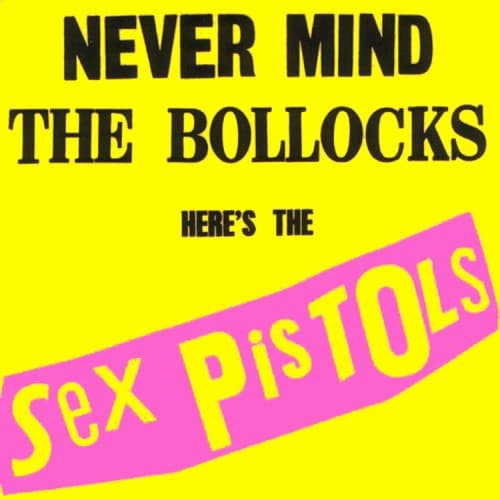
Sex Pistols Never Mind the Bollocks — Punk as Expensive Vandalism
The Sex Pistols made the cleanest punk record of 1977, which was either the point or the problem. Never Mind the Bollocks sounds like it cost money, because it did: Chris Thomas and Bill Price spent months getting Steve Jones's guitar tone thick enough to choke on and Johnny Rotten's sneer dry enough to cut. The result is a record that refuses the amateur hour. Where the Ramones played fast and the Clash played angry, the Pistols played hooks, with Rotten's half-sung contempt riding riffs designed for maximum damage. The album argues that punk's threat was never in sounding cheap but in using expensive studio time to say things polite society would rather not hear sung clearly.
That clarity is why the record still lands. Bollocks does not hide behind distortion or speed; it makes sure every word and every chord arrives intact. When Rotten spits the verses of 'Bodies' or holds the notes on 'God Save the Queen,' the performance is controlled enough to sound deliberate, which makes the contempt harder to dismiss as noise. The album's weakness is its length and its sequencing: Virgin head Richard Branson overruled the band and loaded the tracklist with all four previously released singles, which means the second half repeats peaks the first half already hit. The record would have been tighter at ten tracks, but what remains is the sound of a band that meant to be heard and knew how to make that happen.
Studio Craft Against the Grain
Thomas and Price recorded Bollocks across multiple sessions at Wessex Sound Studios, with lineup chaos forcing Steve Jones onto bass for all but one track. Glen Matlock, the original bassist and co-writer on ten of the twelve songs, quit before most of the album was tracked, and replacement Sid Vicious lacked the skill to record his parts cleanly. Jones stepped in, and his bass playing is satisfactory enough that the bottom end never sounds like a compromise. What the record loses in low-end grit it gains in coherence: Jones's guitar and bass lock with Paul Cook's drums to create a wall that Rotten's voice cuts through rather than sits atop.
The production is where Bollocks separates itself from the rest of 1977 punk. Thomas and Price used the studio as a tool rather than an obstacle, layering Jones's guitars until they sound like a single serrated blade and mixing Rotten's voice forward and dry, with no reverb to soften the edges. The result is a record that sounds designed rather than captured. 'Holidays in the Sun' opens with what Noel Gallagher identified as the sound of jackboots before the verse riff kicks in, and that deliberate choice of opening noise signals a band that thought about impact. 'God Save the Queen' builds its verse on a descending riff that sounds like it is falling apart, which makes the chorus hit harder when it arrives. The cleanness is the point: Rotten's sneer and the riffs underneath it are engineered to be heard clearly, which makes the anger harder to ignore.
The weakness is in the sameness of tempo and tone. Most of these songs sit in the same mid-tempo churn, and the lack of dynamic range means the album's second half feels like a rerun of the first. 'Seventeen' is a two-minute throwaway, and 'New York' is a riff in search of a song. The sequencing does not help: Branson placed all four singles on the album despite the band's objections, which means 'Anarchy in the U.K.' and 'Pretty Vacant' arrive after the record has already made its case. The decision to include them makes commercial sense, but it makes the album longer and less focused than it needed to be.
Sequenced for Singles, Not for Flow
Bollocks was sequenced by Richard Branson in a single night, and it shows. The first half moves without a wasted moment, building momentum through its opening stretch. The back half sags under the weight of four previously released singles scattered across the tracklist. The band's first and best-known song is placed seventh, meaning it arrives after the album has already peaked.
The peaks are front-loaded. The opening track is the album's best introduction, with a martial stomp and a riff that sounds like it is marching somewhere unwelcome. The most vicious moment arrives second, with Rotten spitting contempt over a verse riff that Cook drives with snare hits hard enough to crack ribs. The album would have been tighter as a ten-track statement, cutting three songs from the back half. As it stands, the second half feels like a victory lap that runs too long.
The Blueprint, Not the Breakthrough
Never Mind the Bollocks is the most influential punk album because it proved punk could sound expensive without losing its edge. The Clash made records that sounded like barricades; the Pistols made a record that sounded like it belonged in a shop window, which is why the police kept trying to take it down. Bollocks is not the rawest or the fastest punk record of 1977, but it is the most clearly engineered, and that clarity is why it still works. Rotten's sneer has not softened, and the riffs on 'Holidays in the Sun' and 'God Save the Queen' remain immediately recognizable.
The record ranks as the template rather than the peak. It is the sound of a band that knew what it wanted to say and used the studio to make sure it landed, but the sequencing and the decision to include every single weaken the album as a statement. Start with 'Holidays in the Sun,' 'Bodies' and 'God Save the Queen' to hear what the band could do when it was focused. Skip 'Seventeen' and 'New York' unless you need every track. For the next step, the Spunk bootleg offers rougher, faster versions of these songs that some, including manager Malcolm McLaren, considered more accurate to the band's live sound. Bollocks is the sound of punk made deliberate, which means it is also the sound of punk made repeatable, and whether that was progress or compromise depends on what you think punk was supposed to be.
Track by track
Track Listing
Holidays in the Sun
StandoutThe album's best opener and its most deliberate construction. The jackboot stomp that precedes the verse riff signals a band that thought about impact, and the riff itself is a descending churn that sounds like it is marching somewhere hostile. Rotten's vocal is half-sung, with the verses delivered in a clipped monotone and the chorus stretched into something close to melody. Cook's drumming drives the track without speeding it up, and the result is a song that feels tense rather than fast. The production is spotless: every guitar layer is audible, and Rotten's voice is mixed dry and forward. This is the sound of punk as deliberate vandalism.
Bodies
StandoutThe most vicious track on the record, with Rotten spitting verses over a riff that Cook hammers with snare hits hard enough to crack ribs. The song is effectively anti-abortion, anti-woman and anti-sex, and Rotten does not exclude himself from the contempt. The performance is what makes it work: Rotten's delivery is controlled enough to sound deliberate, which makes the anger harder to dismiss as posturing. Sid Vicious is credited with bass here, though Steve Jones added a second bass track mixed low. The layers make the bottom end thicker without losing the clarity, and the result is a track that sounds expensive and ugly at the same time.
No Feelings
SolidA mid-tempo churn built on a riff that repeats without developing. Rotten's vocal is clipped and declarative, and the chorus is a hook rather than a slogan, but the song does not build anywhere. The production is clean, with Jones's guitar stacked thick and Cook's drums mixed forward, but the track feels like a solid album cut rather than a peak. It works as part of the first half's momentum, but it would not be missed if the album were trimmed to ten tracks.
Liar
SolidAnother mid-tempo track that sits in the same churn as most of the album. The riff is serviceable, and Rotten's delivery is sharp, but the song does not distinguish itself from the tracks around it. The production is consistent with the rest of the record: clean, layered guitars and a dry vocal mix. It is filler in the context of an album that already has too many songs.
God Save the Queen
StandoutThe most famous song here and one of the most deliberate. The verse riff descends like it is falling apart, which makes the chorus hit harder when it arrives. Rotten's vocal is half-sung and half-spat, with the verses clipped and the chorus stretched into something close to melody. The production is spotless: every layer is audible, and the mix places Rotten's voice where it can do the most damage. Sid Vicious played bass on this track, though Thomas and Price gave up trying to use his performance and had Jones overdub a cleaner part. The result is a song that sounds designed for maximum impact, and it delivers.
Problems
SolidThe longest track on the album at just over four minutes, and the length is not earned. The riff is solid, and Rotten's vocal is committed, but the song repeats its ideas without developing them. Cook's drumming is the highlight, with fills that keep the track from sagging completely, but the production cannot save a song that needed editing. It works better live, where the energy can carry it, but on the record it feels like the band ran out of ideas halfway through and kept playing anyway.
Seventeen
WeakA two-minute throwaway that sounds like it was written in ten minutes. The riff is thin, and Rotten's vocal is perfunctory. The production is clean, but there is nothing here to produce. This is the weakest track on the album, and it would have been the first cut if Branson had let the band trim the tracklist.
Anarchy in the U.K.
StandoutThe band's first single and the only track with Glen Matlock on bass. The riff is the most recognizable here, and Rotten's delivery is the most controlled: he holds notes and stretches syllables in a way that makes the sneer sound deliberate. The song is a protest built on a chorus rather than a slogan, which is why it works better than most punk anthems. The production is slightly rougher than the rest of the album, recorded earlier with a different energy, and the difference is audible. Placing it seventh in the sequence weakens its impact; it would have worked better as the opener or the closer.
Submission
SolidA mid-tempo track with a verse riff that repeats without much variation. Rotten's vocal is sharp, and the chorus has a hook, but the song does not build anywhere. The production is clean and consistent with the rest of the record. It is a solid album cut that does not distinguish itself, and it suffers from arriving late in the tracklist when the sameness of tempo has already set in.
Pretty Vacant
StandoutOne of the band's best-known tracks, built on a riff that Noel Gallagher called one of the first things you learn on electric guitar. The simplicity is the point: the riff is immediate, and Rotten's vocal is clipped and declarative. The production is spotless, with every layer audible and the vocal mixed dry and forward. The song works, but placing it tenth in the sequence means it arrives after the album has already made its case. It would have been more effective earlier in the tracklist.
New York
WeakA riff in search of a song. The verse is serviceable, and Rotten's vocal is committed, but the track does not develop its ideas. The production is clean, but there is not much here to produce. This is filler, and it would have been cut if the band had controlled the tracklist.
EMI
SolidA mid-tempo track about being dropped from a record label, which makes it one of the few songs here with a specific subject. The riff is solid, and Rotten's delivery is sharp, but the song does not distinguish itself musically. The production is consistent with the rest of the album: clean guitars and a dry vocal mix. It works as a closer in the sense that it ends the record, but it does not provide a climax or a resolution. The album simply stops.