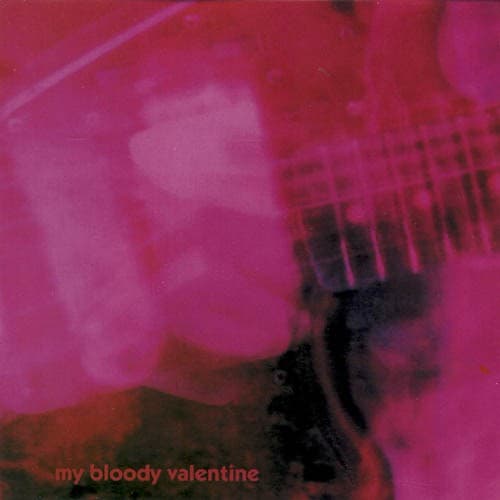
The scorecard
8.8/10 · Essential
- Songwriting25%
- 8.0
- Production25%
- 10.0
- Performance15%
- 7.5
- Cohesion15%
- 8.5
- Originality10%
- 9.5
- Replay value10%
- 9.0
The songs are skeletal but purposeful: verse-chorus-verse hooks built to dissolve into texture, with melodies that surface and vanish under layers of treatment.
Shields spent two years reinventing guitar recording with glide technique, sampled drums from Ó Cíosóig's patterns, stacked vocals until they became instruments, and mixed in mono to center the chaos.
Shields and Butcher sing in pitched whispers kept low in the mix by design, while the guitar work is virtuosic in its manipulation of the tremolo bar to bend strings in and out of tune.
Eleven tracks in 48 minutes with no filler: the sequencing moves from the opening assault of Only Shallow through the hypnotic center to the six-minute dance coda of Soon.
Glide guitar with no chorus or flanger pedals, drum loops sampled from the band's own drummer, vocals as texture rather than narrative: a technique no peer had attempted in 1991.
The album rewards repeat listens as the ear learns to separate the layers: what sounds like a wall on first play reveals melody, rhythm and space underneath.
My Bloody Valentine Loveless — The Guitar Dismantled and Rebuilt as Pure Texture
Kevin Shields recorded Loveless at nineteen studios over two years, drove a label executive to a nervous breakdown, and nearly bankrupted Creation Records in pursuit of a sound no one had made before. The result is not an expensive indulgence but the most inventive use of guitar recording in rock since the Beatles ran tape backward. Shields did not layer hundreds of guitars as rumored; he used fewer tracks than most demos. What he did was invent glide guitar, a technique of bending the tremolo bar while strumming to pull strings slightly in and out of tune, then mixed the result in mono to plant it dead center.
The effect is a wall that moves: solid but unstable, loud but weightless, distorted but pretty. No chorus pedals, no flangers, just the tremolo arm and an obsessive's patience.
The thesis: Loveless is the only essential shoegaze album because it is the only one that could not be made with off-the-shelf effects. Ride and Slowdive wrote beautiful songs and drenched them in modulation; My Bloody Valentine rewired the studio itself. Shields sampled drummer Colm Ó Cíosóig's patterns because Ó Cíosóig was injured, then used the samples as building blocks the way The Bomb Squad did, keying them up and down until the drums sounded unmoored from tempo. He recorded vocals low and stacked twelve takes into a single blurred voice.
He bounced guitar through a parametric equalizer in real time to fake a wah-wah. Every song is simple underneath: verse, chorus, verse. The density is in the treatment, and the treatment required Shields to forget which tunings he had used and spend months relearning his own album. The cost was real, though not the quarter million pounds the press claimed.
Texture as Structure: How Shields Reinvented Guitar Without Adding Tracks
The songwriting is minimal by design. Most tracks on Loveless are two-chord loops with a vocal melody and a hook that may be a riff or may be a sampled fragment of feedback. The structures are skeletal because Shields wanted space to mess with the contents, and what he put in that space was a production method no engineer had seen. He recorded almost everything in mono, rejecting the stereo spread that defined shoegaze peers, because he wanted the guitar smack in the middle with no modulation.
That decision makes the album sound denser than records with twice the tracks: there is nowhere for the sound to drift, so it piles up.
The glide guitar technique is the album's central innovation. Shields strums while bending the tremolo bar, which pulls the strings slightly sharp and flat in a continuous waver. The result is a pitch instability that sounds like chorus but is entirely mechanical, generated by the player's hands rather than a pedal. He told Guitar World that people assumed hundreds of guitars when the album had fewer tracks than most demos, and the proof is audible: the guitar does not shimmer in stereo but churns in the center, a single source made unstable by motion.
Shields recorded the guitar, then bounced it to another track while manually adjusting a parametric equalizer to mimic a wah-wah sweep. The effect is a rising and falling filter that sounds aquatic, and it took longer than plugging in a pedal would have, which was the point. Shields was not interested in convenience.
The drums are nearly all samples of Ó Cíosóig's playing, keyed and looped with the tuning shifted. Ó Cíosóig recorded live drums on a few tracks and overdubbed toms on others, but the rest of the album uses his sampled patterns, sometimes sped up or slowed down to pull them out of natural time. Shields learned the technique from hip-hop production, specifically Public Enemy and The Bomb Squad. The drums sound live but are constructed from samples, and Shields claimed listeners could not tell the difference except where he wanted the sampled quality to show.
The claim holds: the drums feel human even when they are not.
Shields and Bilinda Butcher sang most of the album in the final two months at Britannia Row and Protocol, often without lyrics written in advance. Shields would sing a scratch vocal, Butcher would transcribe what she thought he sang, and they would both sing the result until they had twelve or thirteen takes. Shields gave up trying to pick the right take and played all of them at once, then added his own voice sped up and slowed down. The result sounds like two people singing in unison, but it is one voice split and stacked.
Butcher and Shields both sing high, though Shields sometimes took the higher register and Butcher the lower, and the vocals are mixed low enough that the words are often inaudible. Shields said he could not tolerate clear vocals after spending so long on them, so he turned them into texture. Ó Cíosóig sampled Butcher's voice on some tracks and used it as an instrument, which means the line between singing and arrangement is deliberately erased.
The production cost Creation Records more than the label could afford, and the reported figure of £250,000 became a myth. Shields said the total was closer to £160,000, with most of that money spent on studio time over two years and only a few thousand from Creation itself. The band moved between nineteen studios, often spending a day at a location before deciding it was unsuitable, and hired multiple engineers who were told not to attend sessions. Alan Moulder was the only engineer Shields trusted to mic the amps; Anjali Dutt assisted with vocals and guitar.
The final mix took thirteen days instead of the usual one because an aging editing machine threw the album out of phase and Shields had to reconstruct it from memory. Creation's second-in-command Dick Green had a nervous breakdown during the process, and label owner Alan McGee dropped the band immediately after release because he could not work with Shields again.
The weakness is that the songs themselves are not as strong as the production. A few tracks are beautiful, and the opener is perfect, but some are built on ideas that do not develop. The melodies are often single-note figures or two-chord loops, and while that simplicity creates space for the production, it also means the album has fewer hooks than its reputation suggests. The innovation is in the sound, not the composition, and listeners who do not care about production technique will find half the tracklist underwritten.
The Album as a 48-Minute Drift: Sequencing That Earns Every Second
The sequencing is flawless. The opening track establishes the album's range with the most direct hook, a descending riff and a Butcher vocal that cuts through the distortion, and it works as both an introduction and a warning: the next 44 minutes will not repeat this clarity. The first stretch pulls back into abstraction, with tracks built on minimal pulses and slowed textures. The opening three establish the album's range in under eight minutes, and the rest of the sequence moves between the poles without repeating.
The middle stretch is the album's hypnotic center, where the production is most extreme and the songs dissolve into texture. One track is five and a half minutes of a single arpeggiated figure with Butcher's vocal buried so deep it becomes part of the guitar shimmer. Another is the closest the album comes to a conventional pop song, with a major-key melody and a chorus that surfaces briefly before sinking back under the layers. Two use the parametric equalizer wah effect, which gives the section a sonic continuity even as the tempos and moods shift.
The longest track is the prettiest: a slow build on a clean guitar line that eventually gets swallowed by distortion but never loses the melody.
The final three tracks accelerate. Two are slight but short enough that they do not drag, both vocals on minimal backings that feel like sketches. The closer is six minutes of a dance beat and a guitar line that could be a sample or could be live; the track was mixed at a different studio and released as part of an EP before the album. It works as a closer because it is the only track that nods to a genre outside rock, and the rhythm pulls the album out of its internal dream state and drops it on a floor.
The sequencing earns the 48-minute runtime because no track is redundant and the order creates a logic the individual songs do not always have on their own.
A Studio Album in the Truest Sense: Loveless as Blueprint and Dead End
Loveless is the second-greatest shoegaze album and the most influential, which is not a contradiction. The songs are not as strong as the best of Slowdive's Souvlaki or Ride's Nowhere, but the production is in a different class, and influence runs on technique more than melody. Shields proved that you could make a guitar album without chorus pedals, that you could sample your own drummer and key the loops until they sounded unreal, that you could stack a dozen vocal takes into a single blurred line and mix the result low enough to become texture. Bands spent the next decade trying to reverse-engineer the sound, and no one succeeded because the method was too labor-intensive and too specific to Shields' hands.
Glide guitar requires a feel for the tremolo bar that cannot be taught, and the patience to spend two years on eleven songs is not replicable at scale. The album is a blueprint that cannot be followed, which makes it both essential and a dead end.
The weaknesses are real. Half the tracklist is underwritten, and some songs are pretty but inert. The vocal melodies are often single-note figures, and the lyrics are deliberately obscure to the point of meaninglessness. Shields and Butcher spent hours writing words they then mixed too low to hear, which is a defensible artistic choice but also a waste.
The album works as a production highlight and as a listening experience, but it does not work as a songwriting statement, and the lack of strong composition is why My Bloody Valentine could not follow it up. Shields went silent for 22 years because the method he invented on Loveless was unsustainable, and the album's legacy is as much about what it made impossible as what it made possible.
This is an album for listeners who care about how records are made. If you listen for hooks and lyrics, start with a few standout tracks, then move to Slowdive or Ride. If you listen for production and texture, start with the experimental centerpieces, then work backward through the album until the techniques become audible: the glide guitar, the sampled drums, the stacked vocals, the mono mix. The album rewards the effort because the innovations are not obvious on first listen.
What sounds like a wall of sound is a few tracks recorded and manipulated with methods no one else had tried. Next listen to Slowdive's Souvlaki for better songs in a similar style, or to the Jesus and Mary Chain's Psychocandy for the noisier ancestor. Loveless is the album that defined a subgenre and then exhausted it. No one made a better shoegaze record because no one could afford to.
Track by track
Track Listing
Only Shallow
StandoutThe most direct song on the album and the only one that could work as a single. Butcher's vocal cuts through the distortion with a melody that stays audible even under the layers, and the descending guitar riff is the closest Shields comes to a conventional hook. The glide guitar is already present but used as accent rather than foundation: the tremolo bar bends pull the chords slightly out of tune but do not obscure the progression. The drums are Ó Cíosóig playing live, which gives the track a propulsion the sampled patterns on later songs do not have. Shields opens with the album's most accessible moment because he knows the rest of the record will not repeat it. The track works as both an introduction to the techniques and a standalone song, which is rare on Loveless. The production is dense but the structure is clear: verse, chorus, verse, and a coda that lets the distortion take over. It is the blueprint for what shoegaze became, and it is still the best example of the form.
Loomer
SolidA two-note bass pulse and a Butcher vocal that floats on top without ever resolving. The guitar is almost entirely glide technique, with the tremolo bar bending the chords into a waver that sounds like motion sickness. Shields overdubbed toms from Ó Cíosóig, which gives the track a rhythmic anchor, but the drums are otherwise sampled and the tempo feels slowed down, like the track is playing at the wrong speed. The song is beautiful but minimal: the bass line repeats for two and a half minutes without variation, and the vocal melody is a single-note figure with no development. It works as a mood piece and as a demonstration of the production, but it is not a song you return to for the melody. The glide guitar is the point, and Loomer is the clearest example on the album of how Shields used the technique to create texture rather than harmony.
Touched
StandoutThe only track composed and programmed entirely by Ó Cíosóig, and the only true instrumental. It sounds like a music box wound too tight, with a repeating melodic figure that could be a sample or could be a keyboard, and a rhythm that feels Eastern but is too distorted to place. Shields called it startling, like a drunken fight between a Disney soundtrack and a mantra, which is accurate. At 56 seconds it is a palate cleanser, and it works because it does not try to be more.
To Here Knows When
StandoutFive and a half minutes of a single arpeggiated guitar figure with Butcher's vocal so low in the mix it becomes another instrument. The production is the most extreme on the album: the vocal is stacked and sampled, the guitar is treated until it sounds like a keyboard, and the drums are looped and keyed to drift out of natural time. The song has no chorus and no development, just the same progression repeating while the layers build and recede. It is hypnotic and beautiful, but it is also the point where the album commits fully to texture over structure. The melody is barely there, and the words are inaudible even if you know what Butcher is singing. This is the track that divides listeners: either you hear it as a sustained drift or as five minutes of nothing happening. It works if you let it, but it requires patience.
When You Sleep
StandoutThe closest Loveless comes to a conventional pop song, with a major-key strum and a vocal melody that surfaces clearly in the chorus before sinking back under the layers. Shields recorded the vocal twelve or thirteen times, then played all the takes at once and added his own voice sped up and slowed down. The result sounds like two people singing in unison, but it is one voice split and stacked until it blurs. The guitar is all glide technique, with the tremolo bar pulling the chords in and out of tune in a continuous waver, and the drums are sampled and looped but sound live. The song is four minutes long and feels shorter because the melody is strong enough to hold attention. It is one of the three or four tracks on the album that work as standalone songs rather than as production showcases, and it is the track most often cited as the album's peak. The stacked vocals are the innovation, but the melody is what makes it memorable.
I Only Said
SolidShields singing over a guitar line treated with a parametric equalizer to mimic a wah-wah sweep. He recorded the guitar, then bounced it to another track while manually adjusting the EQ in real time, which took longer than using a pedal but gave him more control over the filter. The effect is a rising and falling tone that sounds aquatic, and it is the most obvious example on the album of Shields choosing the hard way over the easy one. The song itself is a two-chord loop with a minimal vocal melody, and the structure is verse-chorus-verse with no bridge or development. The drums are sampled and the tempo is mid-pace, which gives the track a loping feel. It is pretty but slight, and the production is more interesting than the composition. The wah effect is the hook, and without it the song would not hold up.
Come In Alone
SolidShields vocal over live drums from Ó Cíosóig, which gives the track more propulsion than most of the album. The guitar is glide technique with the tremolo bar bending the chords into a churn, and the vocal is mixed low but still audible. The song is built on a descending progression that repeats for four minutes, and the structure is minimal: verse, chorus, verse, coda. The drums are the standout, with Ó Cíosóig playing a steady beat that locks the song in place while the guitar drifts around it. The track is solid but not essential, and it works better in the context of the album than as a standalone song.
Sometimes
StandoutThe prettiest song on the album and the longest at just over five minutes. A clean guitar line opens the track and the melody is simple and clear, almost folk-like, before the distortion builds and swallows it. Shields sings in the higher register and the vocal is mixed higher than usual, which makes the words almost intelligible. The structure is a slow build: the first two minutes are clean, the middle section adds layers of glide guitar, and the final minute is full distortion with the melody still audible underneath. The drums are sampled but the loop is long enough that it feels live, and the tempo is slow enough that the track has space to breathe. This is the track to play for someone who does not understand why Loveless matters: the production is extreme but the song is strong enough to survive it. The melody is gorgeous and the arrangement is patient, and the final minute of noise feels earned rather than imposed.
Blown a Wish
WeakButcher vocal on a two-chord loop that does not develop. The guitar is glide technique and the drums are sampled, and the song is three and a half minutes of the same idea repeating. It is pretty but inert, and it is the weakest track on the album. The vocal melody is minimal and the words are inaudible, and the production does not add enough to justify the length. This is filler.
What You Want
SolidShields vocal on a minimal backing that feels like a sketch. The guitar is treated with the parametric wah effect and the drums are sampled, and the song is five and a half minutes of a single progression with no bridge or chorus. The vocal melody is a two-note figure that does not develop, and the production is pretty but does not compensate for the lack of composition. The track is atmospheric and it works as part of the album's flow, but it is not strong enough to stand alone. Another example of Shields prioritizing texture over structure, and this time the texture is not interesting enough to carry it.
Soon
StandoutSix minutes of a dance beat and a guitar line that could be a sample or could be live. The drums are obviously sampled and the rhythm is 4/4, which makes this the only track on the album that nods to dance music. Shields recorded the track with Alan Moulder at a different studio and released it as part of the Glider EP before the album, and it was tacked on as the closer. The production is dense and the guitar is glide technique pushed to the extreme, with the tremolo bar bending the chords until they sound like sirens. The song has no vocal and no melody, just the beat and the guitar building in layers until the six minutes are up. It works as a closer because it is the most rhythmic track on the album and it pulls the listener out of the internal dream state and onto a floor. The track is a statement of intent: Shields was listening to hip-hop and dance music and trying to apply those production techniques to guitar rock, and Soon is where that ambition is most audible. The Mojo magazine tour review rated My Bloody Valentine's live shows the second loudest in history, and Soon was the track where the volume was most extreme.