Style & Context
Influences
Ramones debut, early Rolling Stones promo shots, pub rock aesthetic
Location
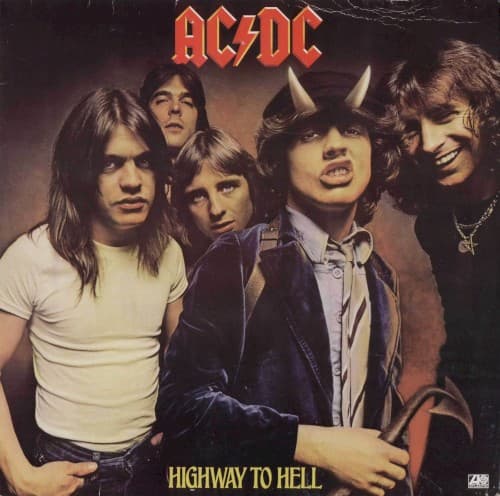
This cover emerged from the Australian pub rock scene transplanted to London's gritty club circuit during punk's aftermath.
Visual Language
The photograph rejects elaborate staging for raw documentation, treating the band as street fighters rather than rock gods.
Symbols
Devil horns on Angus Young
The schoolboy guitarist literally embodies the "highway to hell" concept, playfully wearing Satan's signature accessory.
Direct eye contact from all members
The unblinking stares challenge the viewer to a confrontation, communicating raw aggression over polished performance.
Bon Scott's centered position
The frontman dominates the frame in his final album, unknowingly positioned as the band's doomed captain.
Where Sound Meets Image
The no-frills photography mirrors the album's driving simplicity and refusal to overcomplicate the blues-rock formula. Bon Scott's centered presence and devil horns visualize the title track's gleeful damnation and the lyrical themes of hedonism, rebellion, and mortality that run through songs like "Touch Too Much" and "If You Want Blood." The band's collective stare conveys the relentless, locomotive energy of "Shot Down in Flames" and "Walk All Over You," while the brown-gray atmosphere matches the album's gritty production that favored rawness over studio polish.
This cover established the template for unpretentious hard rock photography that bands like Motorhead and Iron Maiden would refine throughout the eighties. The straightforward band shot became the anti-thesis to progressive rock's fantasy artwork and hair metal's airbrushed glamour, proving that five guys and a camera could sell millions without elaborate concepts. The image's enduring power comes from its documentation of Bon Scott's final creative peak, making it both a commercial breakthrough and an unintentional memorial.